 PluginStats
cimg/node pulls statistics
By cimg (24 listings) · Docker Hub · Languages & frameworks
The CircleCI Node.js Docker Convenience Image.
cimg/node has 883,125,661 recorded pulls on Docker Hub.
It ranks #12 of 1,263 tracked Docker Hub listings by pulls.
PluginStats has 3 daily observations since Oct 16, 2026; the latest is from Oct 18, 2026.
About cimg/node
CircleCI Convenience Images => Node.js
A Continous Integration focused Node.js Docker image built to run on CircleCI
*This image is designed to supercede the legacy CircleCI Node.js image, circleci/node.*
cimg/node is a Docker image created by CircleCI with continuous integration builds in mind. Each tag contains a version of Node.js, npm, yarn v1, and any binaries and tools that are required for builds to complete successfully in a CircleCI environment.
Table of Contents
• Getting Started • How This Image Works • Development • Contributing • Additional Resources • License
Getting Started
This image can be used with the CircleCI docker executor. For example:
In the above example, the CircleCI Node.js Docker image is used for the primary container. More specifically, the tag 15.0.1 is used meaning the version of Node.js will be Node.js v15.0.1. You can now use Node.js within the steps for this job.
How This Image Works
This image contains the Node.js programming language and its package managers. This includes npm and yarn.
There was a recent change reimplmenting vanilla node after briefly using nvm. While it is implied and recommended to not use sudo when possible, you will now need it when installing packages globally.
Variants
Variant images typically contain the same base software, but with a few additional modifications.
Browsers
The browsers variant is the same Node.js image but with Java, Selenium, and browser dependencies pre-installed via apt. The browsers variant can be used by appending -browser to the end of an existing cimg/node tag. The browsers variant is designed to work in conjunction with the CircleCI Browser Tools orb. You can use the orb to install a version of Google Chrome and/or Firefox into your build. The image contains all of the supporting tools needed to use both the browser and its driver.
Tagging Scheme
This image has the following tagging scheme:
- The version of Node.js to use. This can be a full SemVer point release (such as 10.16.3), or just the minor release (such as 12.6), or a version alias. This Node.js image has two version aliases, "current" and "lts". This aliases will always point to the latest "current" and latest "lts" releases that Node.js has as according to their website. Keep in mind that using an alias tag will be less stable that specifying a full SemVer version. If you use the minor release tag, it will automatically point to future patch updates as they are released by Node.js. For example, the tag 12.6 points to Node.js v12.6.0 now, but when the next release comes out, it will point to Node.js v12.6.1.
Development
Images can be built and run locally with this repository. This has the following requirements:
• local machine of Linux (Ubuntu tested) or macOS • modern version of Bash (v4+) • modern version of Docker Engine (v19.03+)
Cloning For Community Users (no write access to this repository)
Fork this repository on GitHub. When you get your clone URL, you'll want to add --recurse-submodules to the clone command in order to populate the Git submodule contained in this repo. It would look something like this:
If you missed this step and already cloned, you can just run git submodule update --recursive to populate the submodule. Then you can optionally add this repo as an upstream to your own:
Cloning For Maintainers ( you have write access to this repository)
Clone the project with the following command so that you populate the submodule:
Generating Dockerfiles
Dockerfiles can be generated for a specific Node.js version using the gen-dockerfiles.sh script. For example, to generate the Dockerfile for Node.js v12.16, you would run the following from the root of the repo:
The generated Dockerfile will be located at ./12.16/Dockefile. To build this image locally and try it out, you can run the following:
Building the Dockerfiles
To build the Docker images locally as this repository does, you'll want to run the build-images.sh script:
This would need to be run after generating the Dockerfiles first. When releasing proper images for CircleCI, this script is run from a CircleCI pipeline and not locally.
Publishing Official Images (for Maintainers only)
The individual scripts (above) can be used to create the correct files for an image, and then added to a new git branch, committed, etc. A release script is included to make this process easier. To make a proper release for this image, lets's use the fake Node version of Node v9.99, you would run the following from the repo root:
This will automatically create a new Git branch, generate the Dockerfile(s), stage the changes, commit them, and push them to GitHub. The commit message will end with the string [release]. This string is used by CircleCI to know when to push images to Docker Hub. "alias" would be "current" or "lts" depending on the version. All that would need to be done after that is:
• wait for build to pass on CircleCI • review the PR • merge the PR
The main branch build will then publish a release.
Incorporating Changes
How changes are incorporated into this image depends on where they come from.
build scripts - Changes within the ./shared submodule happen in its own repository. For those changes to affect this image, the submodule needs to be updated. Typically like this:
parent image - By design, when changes happen to a parent image, they don't appear in existing Node.js images. This is to aid in "determinism" and prevent breaking customer builds. New Node.js images will automatically pick up the changes.
If you *really* want to publish changes from a parent image into the Node.js image, you have to build a specific image version as if it was a new image. This will create a new Dockerfile and once published, a new image.…
Description from the Docker Hub listing.
Where cimg/node sits in the listing
Each band is one page of 20. Pulls on a log scale. Placement is projected from pulls, so it can differ from the marketplace's own sort order. Hover a dot to see the listing.


Charts
Images: 30d · 1y · all time · 1600×900 dark
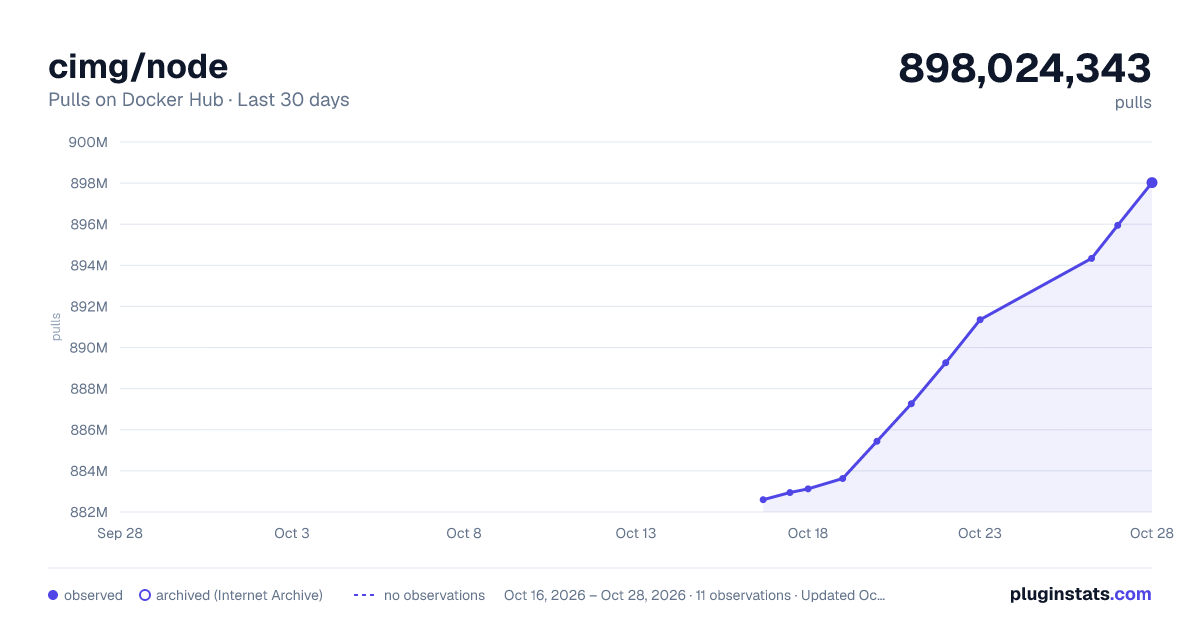
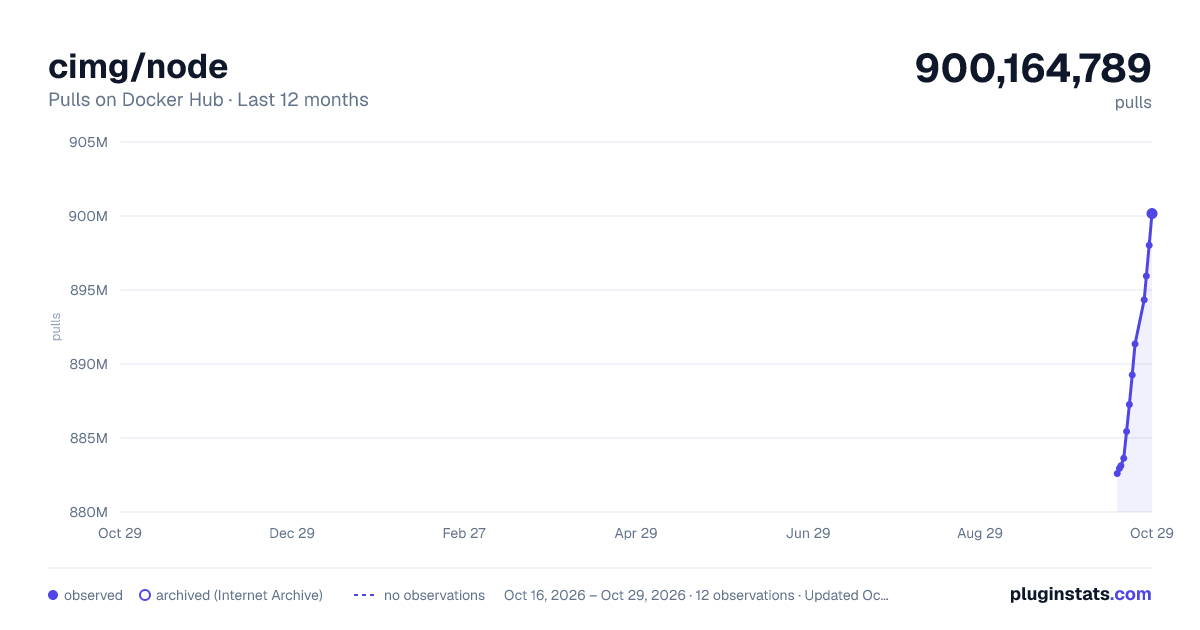
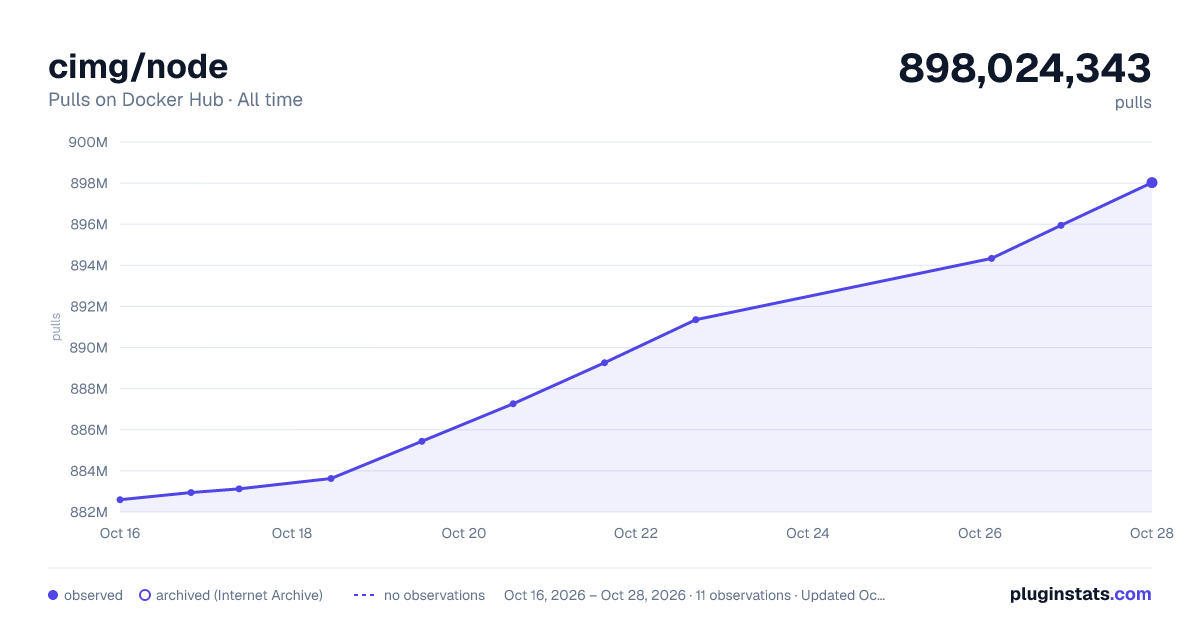

Adoption over time


7/30/90-day growth


Filled points are observed values; hollow points come from Internet Archive snapshots of the listing page. Dashed segments span periods with no observations — values between points are not interpolated.
Recent observations
Full history (3)Similar Docker Hub Languages & frameworks plugins
Data source
Cumulative pull counts and stars come from the public Docker Hub API. Pulls count image downloads (including automated CI pulls), not installs or users.
Listing: https://hub.docker.com/r/cimg/node. First seen Oct 16, 2026; last successful collection Oct 18, 2026. See the methodology.