 PluginStats
linuxserver/pidgin pulls statistics
By linuxserver (100 listings) · Docker Hub · Languages & frameworks
linuxserver/pidgin has 85,668 recorded pulls on Docker Hub.
It ranks #420 of 1,263 tracked Docker Hub listings by pulls.
PluginStats has 3 daily observations since Oct 16, 2026; the latest is from Oct 18, 2026.
About linuxserver/pidgin
The LinuxServer.io team brings you another container release featuring:
• regular and timely application updates • easy user mappings (PGID, PUID) • custom base image with s6 overlay • weekly base OS updates with common layers across the entire LinuxServer.io ecosystem to minimise space usage, down time and bandwidth • regular security updates
Find us at:
• Blog - all the things you can do with our containers including How-To guides, opinions and much more! • Discord - realtime support / chat with the community and the team. • Discussions - post on our community forum. • GitHub - view the source for all of our repositories. • Open Collective - please consider helping us by either donating or contributing to our budget
linuxserver/pidgin
Pidgin is a chat program which lets you log into accounts on multiple chat networks simultaneously. This means that you can be chatting with friends on XMPP and sitting in an IRC channel at the same time.
Supported Architectures
We utilise the docker manifest for multi-platform awareness. More information is available from docker here and our announcement here.
Simply pulling lscr.io/linuxserver/pidgin:latest should retrieve the correct image for your arch, but you can also pull specific arch images via tags.
The architectures supported by this image are:
| Architecture | Available | Tag |
| x86-64 | ✅ | amd64-\ | | arm64 | ✅ | arm64v8-\ |
Application Setup
The application can be accessed at:
• https://yourhost:3001/
This Pidgin installation comes with default chat plugins plus a series of third party ones. Please note that the third party plugins for the most part are not simply plug and play, you will need to reference their documentation and possibly generate oauth tokens along with other workarounds. Third party plugins are always in a state of constant development do not expect every single native feature to work flawlessly. To ease integration with some third party plugins we include Firefox in this image to allow you to fill out captchas or pre-auth before loading your credentials into the program, simply right click the desktop to launch it.
• Bonjour- Default XMPP style plugin • Discord- Provided by purple-discord • Facebook- Provided by purple-facebook • Gadu-Gadu- Default libgadu plugin • Google Talk- Provided by purple-hangouts • GroupWise- Default GroupWise plugin • Hangouts- Provided by purple-hangouts • ICQ (WIM)- Provided by icyque • IRC- Default IRC plugin • Instagram- Provided by purple-instagram • Office Comminicator (SIPE)- Provided by SIPE Project • Rocket.chat- Provided by purple-rocketchat • SIMPLE- Default plugin • Skype (HTTP)- Provided by skype4pidgin • Slack- Provided by slack-libpurple • Telegram- Provided by telegram-purple • XMPP- Default XMPP plugin • Zephyr- Default project Athena plugin
Strict reverse proxies
This image uses a self-signed certificate by default. This naturally means the scheme is https. If you are using a reverse proxy which validates certificates, you need to disable this check for the container.
This container is based on Docker Baseimage Selkies, which streams a desktop or single application to your web browser. Only the essentials are covered below, the full platform documentation lives at docs.linuxserver.io/selkies.
Start Minimal
Most support issues we see stem from large run configurations assembled from years of forum posts. These containers are designed to work with almost nothing. Start with the minimal command below, confirm it works, then add your options (volumes, env vars, GPU flags) one at a time:
Open https://localhost:3001 (note the https) and accept the self signed certificate warning. The trailing bash gives you a shell inside the container, ctrl+d exits and cleans everything up. If a bigger setup misbehaves, return to this command to isolate the problem, see the Quickstart and Troubleshooting guides.
GPU Acceleration
A GPU is optional, the CPU pipeline is fast enough for smooth sessions on modest hardware. When a GPU is mounted into the container it is automatically detected and configured for zero copy rendering and encoding, set AUTO_GPU=false to disable this behavior.
Intel / AMD (open source drivers), one flag is all it takes:
Compose examples, multi GPU selection (DRINODE/DRI_NODE), Unraid notes, and a step by step debugging loop are in the GPU Acceleration guide.
Security
[!WARNING] This container provides privileged access to the host system. Do not expose it to the Internet unless you have secured it properly.
HTTPS is required. Modern browser features used for video and audio (WebCodecs) only work in a secure context. Port 3001 serves HTTPS directly, the HTTP port exists only to sit behind a reverse proxy.
By default there is no authentication. Setting the CUSTOM_USER and PASSWORD environment variables enables HTTP basic auth, which is suitable only for a trusted local network. For internet exposure, place the container behind a reverse proxy with robust authentication, such as SWAG. Keep in mind the web interface includes a terminal with passwordless sudo, anyone who can reach the GUI can gain root inside the container.
Authentication options, sharing link behavior, container isolation, and the lockdown variables for kiosk style deployments are covered in Security and Hardening.
Language Support - Internationalization
To launch the session in a different language, set the LC_ALL environment variable, e.g. -e LC_ALL=zh_CN.UTF-8 (Chinese), ja_JP.UTF-8 (Japanese), ko_KR.UTF-8 (Korean), ar_AE.UTF-8 (Arabic), ru_RU.UTF-8 (Russian), es_MX.UTF-8 (Spanish Latin America), de_DE.UTF-8 (German), fr_FR.UTF-8 (French), nl_NL.UTF-8 (Dutch), it_IT.UTF-8 (Italian).
Beyond Running the App
This image inherits every capability of the Selkies platform, all documented in depth on the docs site:…
Description from the Docker Hub listing.
Where linuxserver/pidgin sits in the listing
Each band is one page of 20. Pulls on a log scale. Placement is projected from pulls, so it can differ from the marketplace's own sort order. Hover a dot to see the listing.


Charts
Images: 30d · 1y · all time · 1600×900 dark
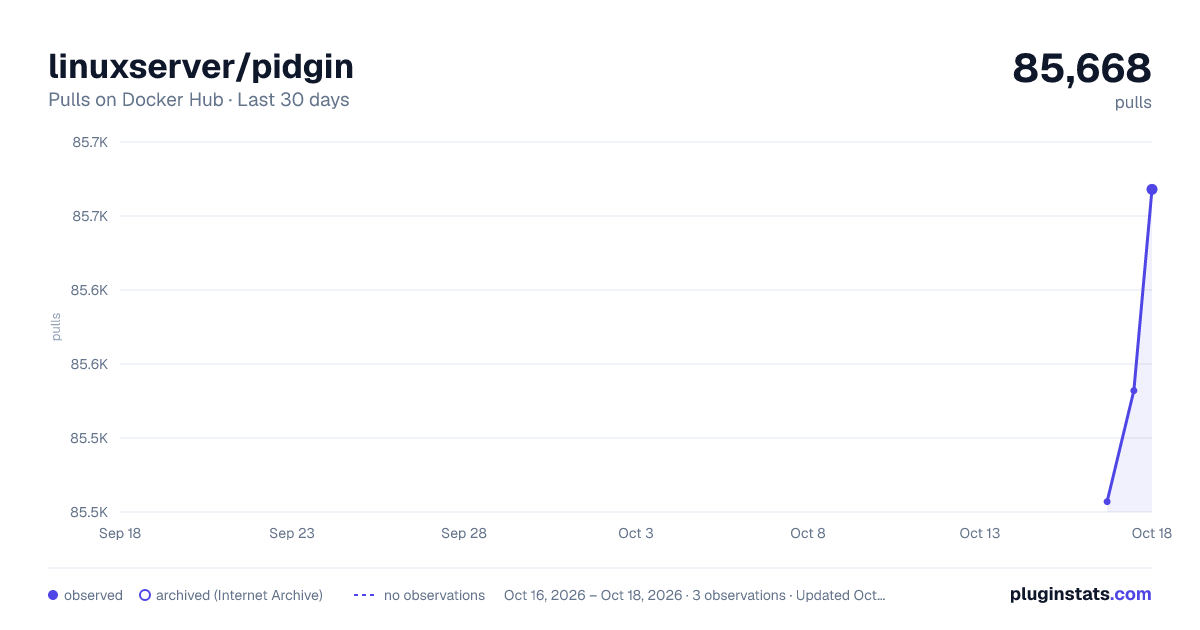
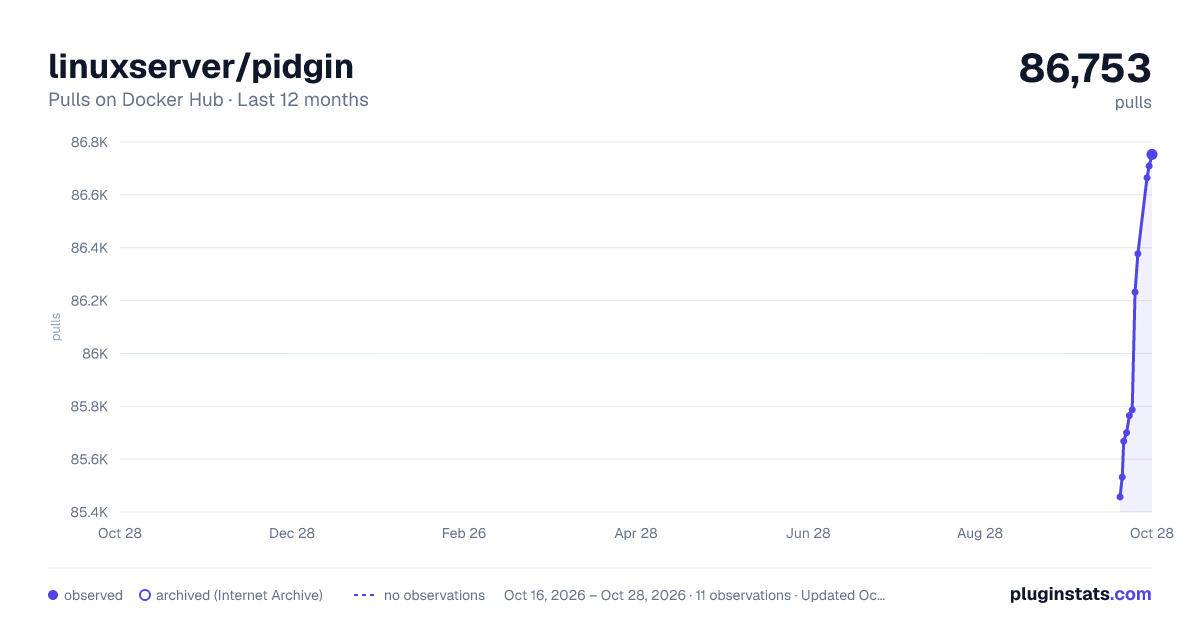
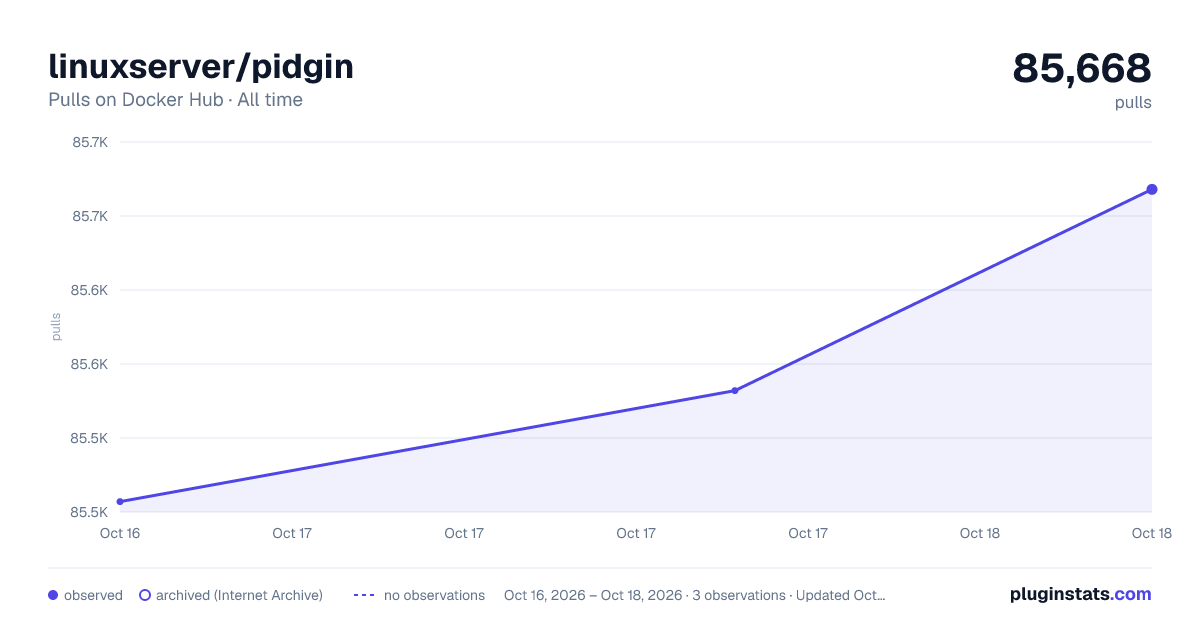

Adoption over time


7/30/90-day growth


Filled points are observed values; hollow points come from Internet Archive snapshots of the listing page. Dashed segments span periods with no observations — values between points are not interpolated.
Recent observations
Full history (3)Similar Docker Hub Languages & frameworks plugins
Data source
Cumulative pull counts and stars come from the public Docker Hub API. Pulls count image downloads (including automated CI pulls), not installs or users.
Listing: https://hub.docker.com/r/linuxserver/pidgin. First seen Oct 16, 2026; last successful collection Oct 18, 2026. See the methodology.