 PluginStats
ros pulls statistics
Docker Hub · Languages & frameworks
The Robot Operating System (ROS) is an open source project for building robot applications.
ros has 35,386,368 recorded pulls on Docker Hub, ranking #77 of 1,263 tracked listings.
About ros
Quick reference
• Maintained by: the Open Source Robotics Foundation • Where to get help: the Docker Community Slack, Server Fault, Unix & Linux, or Stack Overflow
Supported tags and respective Dockerfile links
• humble-ros-core, humble-ros-core-jammy • humble-ros-base, humble-ros-base-jammy, humble • humble-perception, humble-perception-jammy • jazzy-ros-core, jazzy-ros-core-noble • jazzy-ros-base, jazzy-ros-base-noble, jazzy • jazzy-perception, jazzy-perception-noble • kilted-ros-core, kilted-ros-core-noble • kilted-ros-base, kilted-ros-base-noble, kilted • kilted-perception, kilted-perception-noble • lyrical-ros-core, lyrical-ros-core-resolute • lyrical-ros-base, lyrical-ros-base-resolute, lyrical, latest • lyrical-perception, lyrical-perception-resolute • rolling-ros-core, rolling-ros-core-resolute • rolling-ros-base, rolling-ros-base-resolute, rolling • rolling-perception, rolling-perception-resolute
Quick reference (cont.)
• Where to file issues: https://github.com/osrf/docker_images/issues • Supported architectures: (more info) amd64, arm64v8 • Published image artifact details: repo-info repo's repos/ros/ directory (history) (image metadata, transfer size, etc) • Image updates: official-images repo's library/ros label official-images repo's library/ros file (history) • Source of this description: docs repo's ros/ directory (history)
What is ROS?
The Robot Operating System (ROS) is a set of software libraries and tools that help you build robot applications. From drivers to state-of-the-art algorithms, and with powerful developer tools, ROS has what you need for your next robotics project. And it's all open source.
wikipedia.org/wiki/Robot_Operating_System
How to use this image
Creating a Dockerfile to install ROS packages
To create your own ROS docker images and install custom packages, here's a simple example of installing the C++, Python client library demos using the official released Debian packages via apt-get.
Note: all ROS images include a default entrypoint that sources the ROS environment setup before executing the configured command, in this case the demo packages launch file. You can then build and run the Docker image like so:
Creating a Dockerfile to build ROS packages
To create your own ROS docker images and build custom packages, here's a simple example of installing a package's build dependencies, compiling it from source, and installing the resulting build artifacts into a final multi-stage image layer.
The example above consists of three sequential stages. The cacher stage first updates the apt lists and ROS index, uses vcstool to clone a demo repo into the workspace source directory, and derives build and runtime dependency sets using rosdep. The builder stage installs the derived build dependencies, sources the ROS install underlay, and compiles the source in release mode using colcon. Finally, the runner stage installs only runtime dependencies, copies the compiled workspace artifacts, and sets up the environment to launch the demo. Note the example consists of several subtle optimizations:
• Multi-Stage Build • Dependency derivation, compilation, and runtime setup are partitioned • Maximizes cache retention despite package source or build/runtime changes • Greater concurrency, e.g., colcon build while runtime apt installs • Persistent Cache Propagation • Use of --mount to cache temp data without bloating layers • Maintain temporally consistent apt lists between parallel stages • Avoid needless network I/O between stages or across Docker rebuilds • Minimal Image Size • Final stage builds from ros-core for smallest runtime image • Builds and installs only a select few packages in the workspace • Only workspace install artifacts are copied into final layers
For comparison, the resulting runner image is similar in size to the earlier aptgetter example. This allows you to develop and distribute custom ROS packages without significantly increasing image size compared to pre-built Debian installations:
For more advance examples such as daisy chaining multiple overlay workspaces to improve caching of docker image build layers, using tools such as ccache to accelerate compilation with colcon, or using buildkit to save build time and bandwidth even when dependencies change, the project Dockerfiles in the Navigation2 repo are excellent resources.
Deployment use cases
This dockerized image of ROS is intended to provide a simplified and consistent platform to build and deploy distributed robotic applications. Built from the official Ubuntu image and ROS's official Debian packages, it includes recent supported releases for quick access and download. This provides roboticists in research and industry with an easy way to develop, reuse and ship software for autonomous actions and task planning, control dynamics, localization and mapping, swarm behavior, as well as general system integration.
Developing such complex systems with cutting edge implementations of newly published algorithms remains challenging, as repeatability and reproducibility of robotic software can fall to the wayside in the race to innovate. With the added difficulty in coding, tuning and deploying multiple software components that span across many engineering disciplines, a more collaborative approach becomes attractive. However, the technical difficulties in sharing and maintaining a collection of software over multiple robots and platforms has for a while exceeded time and effort than many smaller labs and businesses could afford.
With the advancements and standardization of software containers, roboticists are primed to acquire a host of improved developer tooling for building and shipping software. To help alleviate the growing pains and technical challenges of adopting new practices, we have focused on providing an official resource for using ROS with these new technologies.…
Description from the Docker Hub listing.
README badge
Show your rank in a README or on your website. The badge updates automatically.
Charts
Images: 30d · 1y · all time · 1600×900 dark
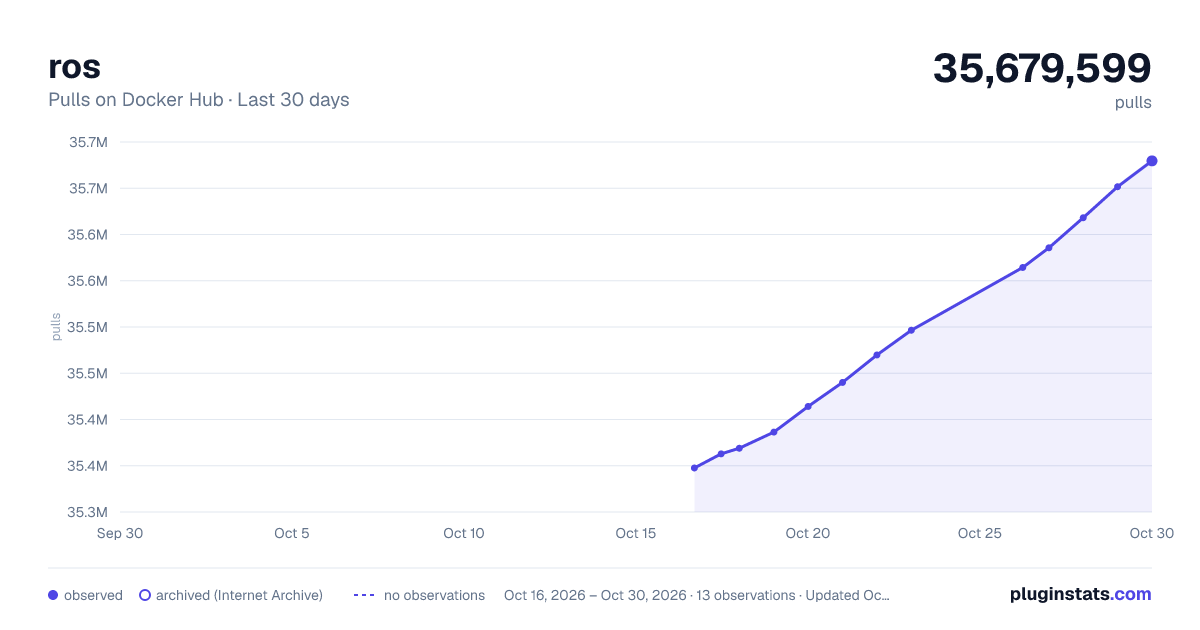
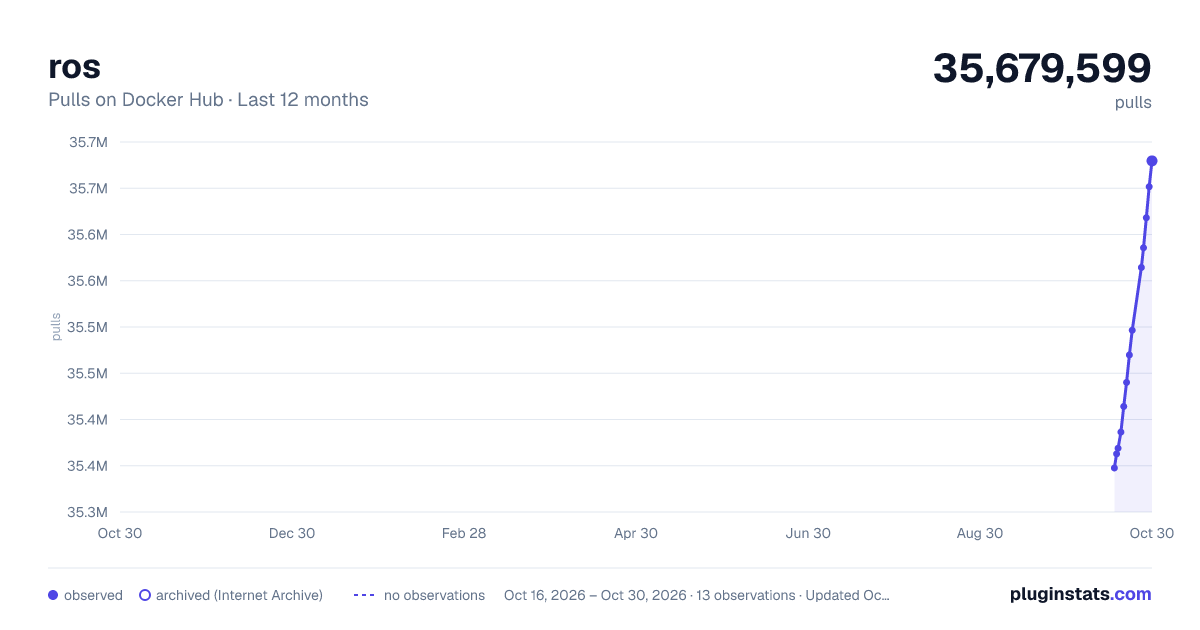
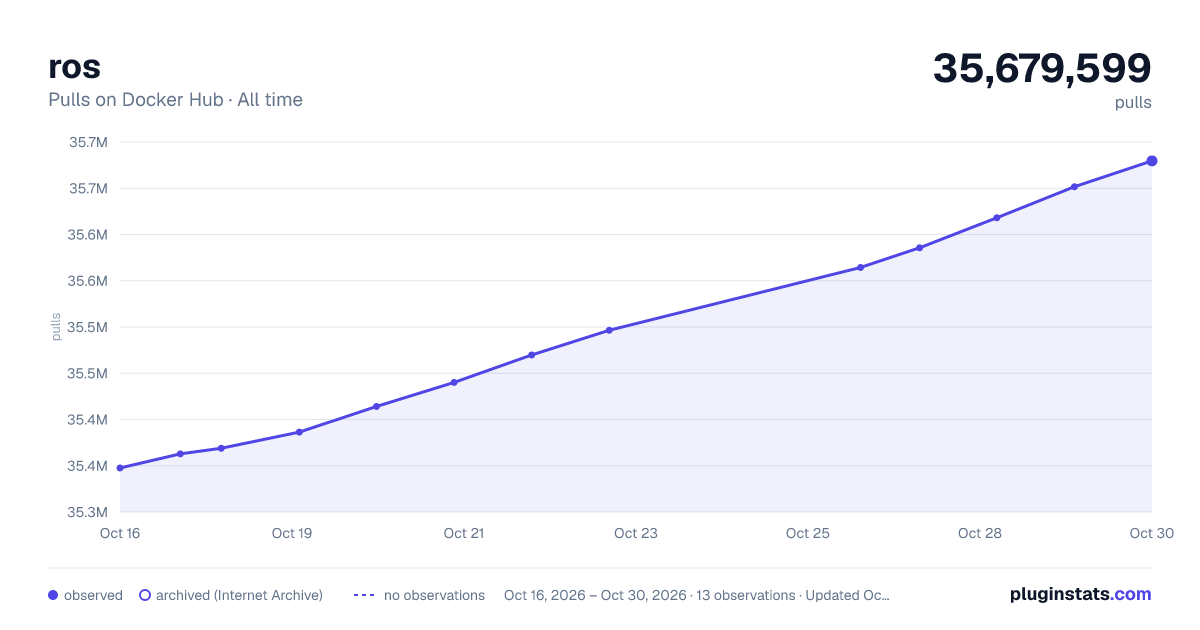

Adoption over time
7/30/90-day growth
Ranking history
Listing placement
Listing placement
Listing placement
Listing placement
Filled points are observed values; hollow points come from Internet Archive snapshots of the listing page. Dashed segments span periods with no observations — values between points are not interpolated.
Each band is one page of 20. Pulls on a linear scale. Placement is projected from pulls, so it can differ from the marketplace's own sort order. Hover a dot to see the listing.
Recent observations
Full history (4)Similar Docker Hub Languages & frameworks plugins
All 20 ros alternativesros on other marketplaces
Data source
Cumulative pull counts and stars come from the public Docker Hub API. Pulls count image downloads (including automated CI pulls), not installs or users.
Listing: https://hub.docker.com/_/ros. First seen Oct 16, 2026; last successful collection Oct 19, 2026. See the methodology.