 PluginStats
clojure pulls statistics
Docker Hub · Languages & frameworks
Clojure is a dialect of Lisp that runs on the JVM.
clojure has 42,102,572 recorded pulls on Docker Hub.
It ranks #70 of 1,263 tracked Docker Hub listings by pulls.
PluginStats has 3 daily observations since Oct 16, 2026; the latest is from Oct 18, 2026.
About clojure
Quick reference
• Maintained by: the Docker Community • Where to get help: the Docker Community Slack, Server Fault, Unix & Linux, or Stack Overflow
Supported tags and respective Dockerfile links
Note: the description for this image is longer than the Hub length limit of 25000, so the "Supported tags" list has been trimmed to compensate. See also docker/hub-feedback#238 and docker/roadmap#475.
• See "Supported tags and respective Dockerfile links" at https://github.com/docker-library/docs/tree/master/clojure/README.md
Quick reference (cont.)
• Where to file issues: https://github.com/Quantisan/docker-clojure/issues • Supported architectures: (more info) amd64, arm64v8, ppc64le • Published image artifact details: repo-info repo's repos/clojure/ directory (history) (image metadata, transfer size, etc) • Image updates: official-images repo's library/clojure label official-images repo's library/clojure file (history) • Source of this description: docs repo's clojure/ directory (history)
What is Clojure?
Clojure is a dialect of the Lisp programming language. It is a general-purpose programming language with an emphasis on functional programming. It runs on the Java Virtual Machine, Common Language Runtime, and JavaScript engines. Like other Lisps, Clojure treats code as data and has a macro system.
wikipedia.org/wiki/Clojure
How to use this image
Build tools
Clojure has three major approaches to building and running projects:
1. leiningen 1. The oldest and probably most common tool 2. boot 1. An alternative approach that solves similar problems as leiningen 3. tools-deps 1. A more recent official tool for some of the lein/boot use cases
There are variants of this image for all three of these tools and their respective releases. The most basic form of these tags is:
1. clojure:lein 2. clojure:boot 3. clojure:tools-deps
But you can also append a hyphen and the version of that tool you'd like to use. For example, for lein 2.8.1 you can use this image: clojure:lein-2.8.1.
Run your app with leiningen
Add a Dockerfile to an existing Leiningen/Clojure project with the following contents:
Then, run these commands to build and run the image:
While the above is the most straightforward example of a Dockerfile, it does have some drawbacks. The lein run command will download your dependencies, compile the project, and then run it. That's a lot of work, all of which you may not want done every time you run the image. To get around this, you can download the dependencies and compile the project ahead of time. This will significantly reduce startup time when you run your image.
Writing the Dockerfile this way will download the dependencies (and cache them, so they are only re-downloaded when the dependencies change) and then compile them into a standalone jar ahead of time rather than each time the image is run.
You can then build and run the image as above.
Compile your Lein/Clojure project into a jar from within the container
If you have an existing Lein/Clojure project, it's fairly straightforward to compile your project into a jar from a container:
This will build your project into a jar file located in your project's target/uberjar directory.
More details
See the official image README for more details about using this image with boot and tools-deps.
Image Variants
The clojure images come in many flavors, each designed for a specific use case.
clojure:
This is the defacto image. If you are unsure about what your needs are, you probably want to use this one. It is designed to be used both as a throw away container (mount your source code and start the container to start your app), as well as the base to build other images off of.
Some of these tags may have names like bookworm or trixie in them. These are the suite code names for releases of Debian and indicate which release the image is based on. If your image needs to install any additional packages beyond what comes with the image, you'll likely want to specify one of these explicitly to minimize breakage when there are new releases of Debian.
Some of these tags may have names like jammy, noble, or resolute in them. These are the suite code names for releases of Ubuntu and indicate which release the image is based on. If your image needs to install any additional packages beyond what comes with the image, you'll likely want to specify one of these explicitly to minimize breakage when there are new releases of Ubuntu.
clojure:-slim
This image does not contain the common packages contained in the default tag and only contains the minimal packages needed to run clojure. Unless you are working in an environment where *only* the clojure image will be deployed and you have space constraints, we highly recommend using the default image of this repository.
clojure:-alpine
This image is based on the popular Alpine Linux project, available in the alpine official image. Alpine Linux is much smaller than most distribution base images (~5MB), and thus leads to much slimmer images in general.
This variant is useful when final image size being as small as possible is your primary concern. The main caveat to note is that it does use musl libc instead of glibc and friends, so software will often run into issues depending on the depth of their libc requirements/assumptions. See this Hacker News comment thread for more discussion of the issues that might arise and some pro/con comparisons of using Alpine-based images.
To minimize image size, it's uncommon for additional related tools (such as git or bash) to be included in Alpine-based images. Using this image as a base, add the things you need in your own Dockerfile (see the alpine image description for examples of how to install packages if you are unfamiliar).
License
View license information for the software contained in this image.…
Description from the Docker Hub listing.
Where clojure sits in the listing
Each band is one page of 20. Pulls on a log scale. Placement is projected from pulls, so it can differ from the marketplace's own sort order. Hover a dot to see the listing.


Charts
Images: 30d · 1y · all time · 1600×900 dark
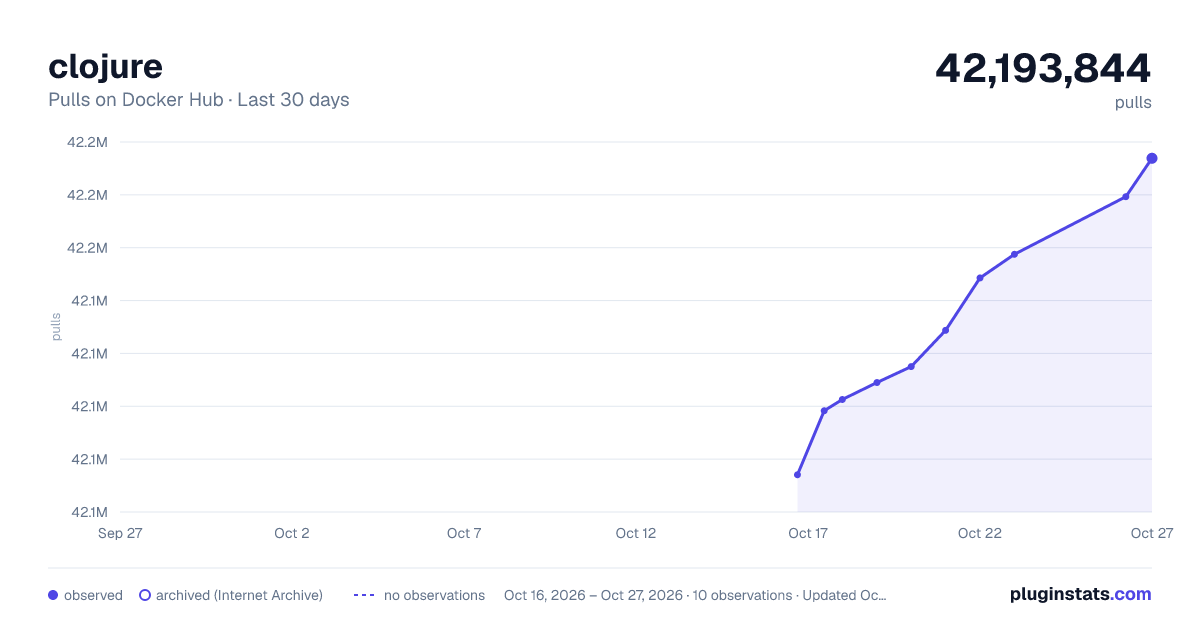
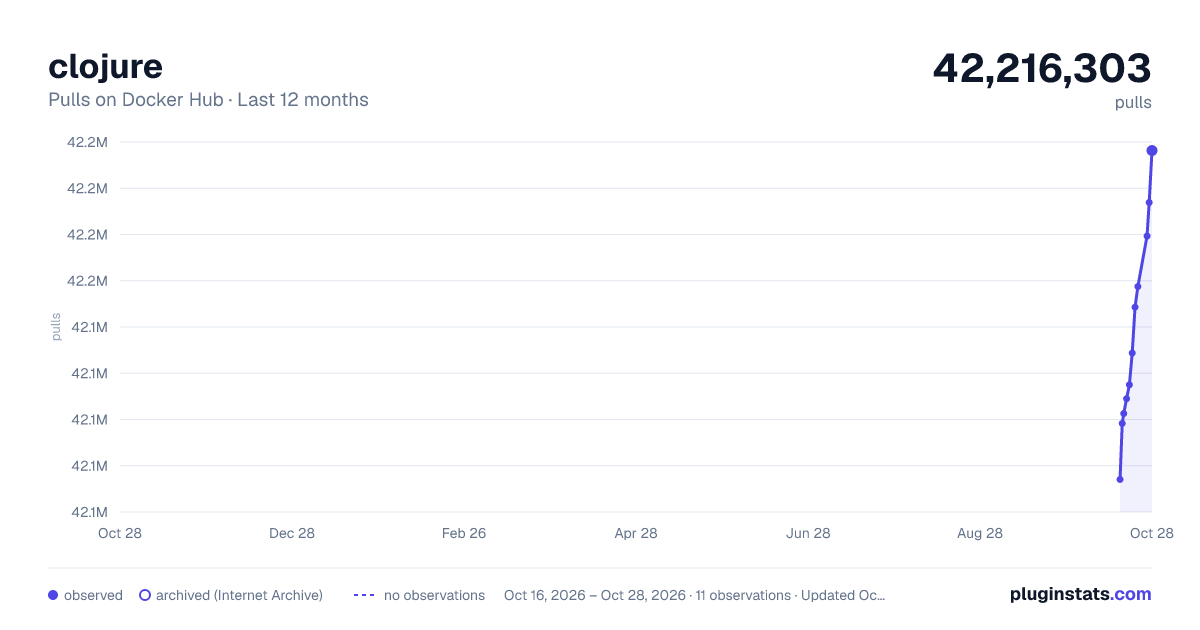
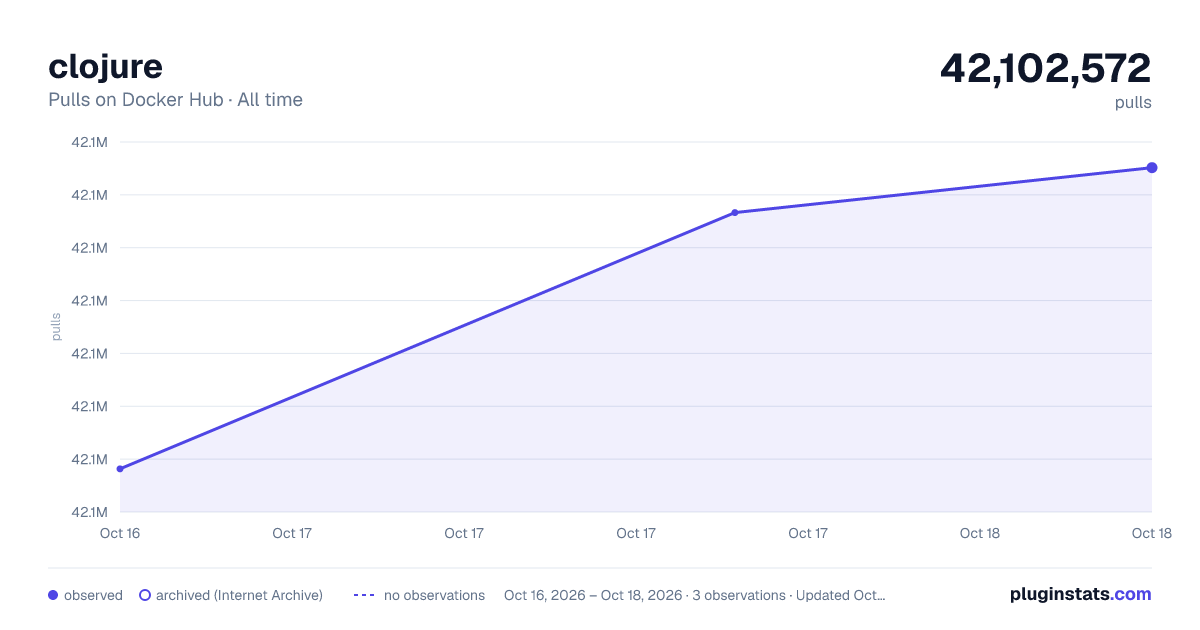

Adoption over time


7/30/90-day growth


Filled points are observed values; hollow points come from Internet Archive snapshots of the listing page. Dashed segments span periods with no observations — values between points are not interpolated.
Recent observations
Full history (3)Similar Docker Hub Languages & frameworks plugins
Data source
Cumulative pull counts and stars come from the public Docker Hub API. Pulls count image downloads (including automated CI pulls), not installs or users.
Listing: https://hub.docker.com/_/clojure. First seen Oct 16, 2026; last successful collection Oct 18, 2026. See the methodology.