 PluginStats
mcp/schemacrawler-ai pulls statistics
By mcp (100 listings) · Docker Hub · Machine learning & AI
The SchemaCrawler AI MCP Server enables natural language interaction with your database schema us...
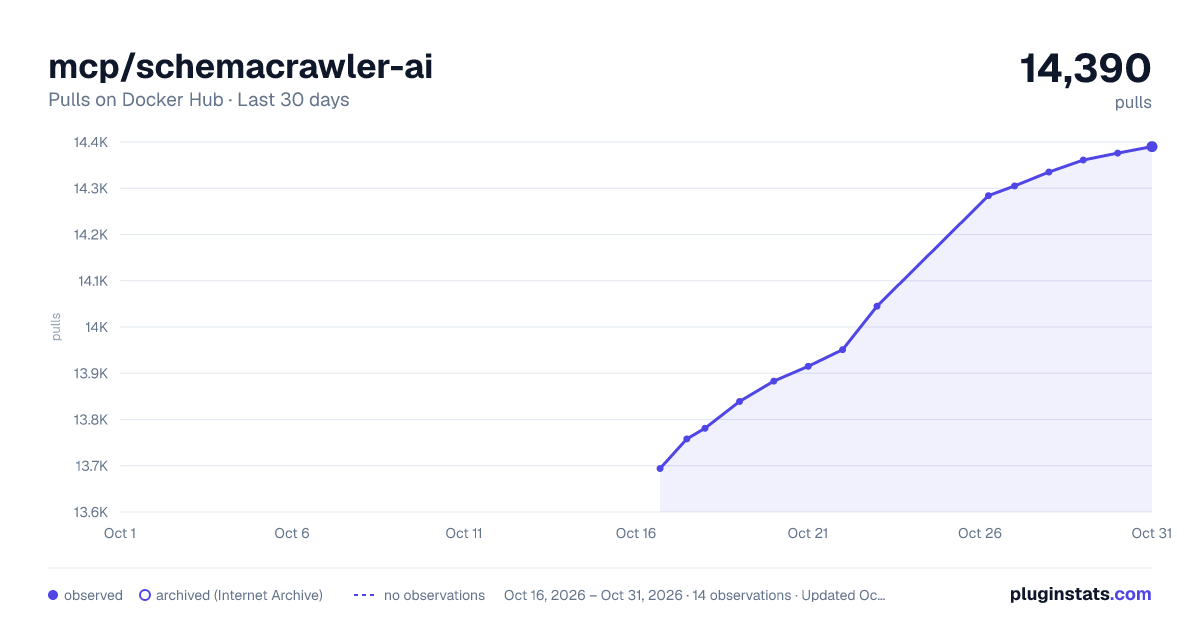
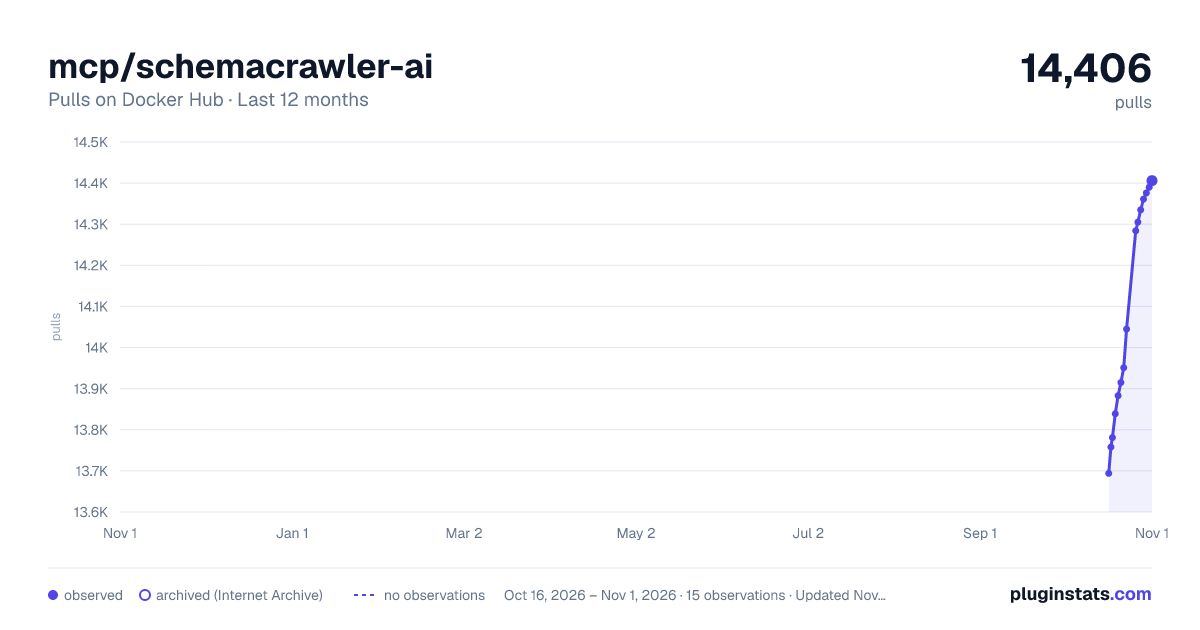
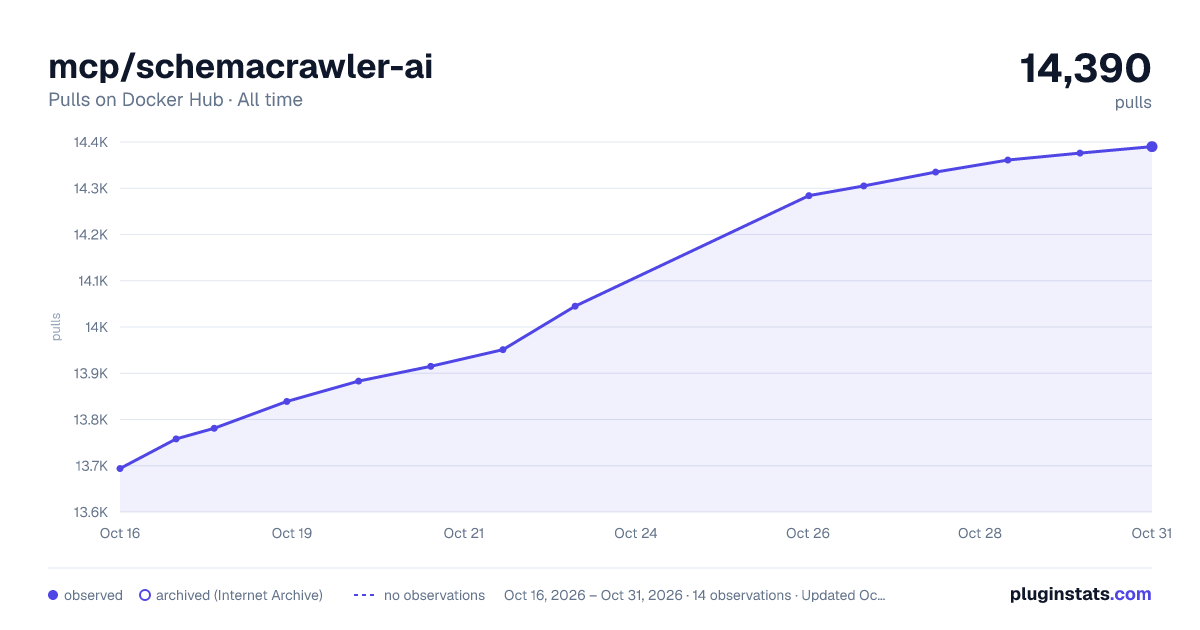
mcp/schemacrawler-ai has 13,839 recorded pulls on Docker Hub.
It ranks #816 of 1,263 tracked Docker Hub listings by pulls.
PluginStats has 4 daily observations since Oct 16, 2026; the latest is from Oct 19, 2026.
About mcp/schemacrawler-ai
SchemaCrawler AI MCP Server
The SchemaCrawler AI MCP Server enables natural language interaction with your database schema using an MCP client in "Agent" mode. It allows users to explore tables, columns, foreign keys, triggers, stored procedures and more simply by asking questions like "Explain the code for the interest calculation stored procedure". You can also ask it to help with SQL, since it knows your schema. This is ideal for developers, DBAs, and data analysts who want to streamline schema comprehension and query development without diving into dense documentation.
What is an MCP Server?
MCP Info
Attribute|Details| |-|-| Docker Image|mcp/schemacrawler-ai Author|schemacrawler Repository|https://github.com/schemacrawler/SchemaCrawler-AI
Image Building Info
Attribute|Details| |-|-| Dockerfile|https://github.com/schemacrawler/SchemaCrawler-AI/blob/3dda2c1d154b707299f9ba577bb67ae4f4726daf/Dockerfile Commit|3dda2c1d154b707299f9ba577bb67ae4f4726daf Docker Image built by|Docker Inc. Docker Scout Health Score| Verify Signature|COSIGN_REPOSITORY=mcp/signatures cosign verify mcp/schemacrawler-ai --key https://raw.githubusercontent.com/docker/keyring/refs/heads/main/public/mcp/latest.pub Licence|Other
Available Tools (8)
Tools provided by this Server|Short Description -|- database_server_information|Show database server information| describe_entities|Describe entities in the ER model| describe_relationships|Describe relationships in the ER model| describe_routines|Describe stored procedures and functions| describe_tables|Describe tables and views| list|List database objects| list_across_tables|List dependent database objects across tables| mcp-server-health|SchemaCrawler AI MCP Server Health|
Tools Details
Tool: database_server_information
Provides database environment and server configuration metadata, including engine type and version, collation, encoding, parameters, capabilities, and platform details. Adapts output to the specific database (such as Oracle, SQL Server, PostgreSQL and so on) to support platform-aware SQL generation and schema analysis.
Tool: describe_entities
Generates detailed documentation for entities in the ER model, including entity type such as strong, weak and subtype entities, and attributes. Supports regex-based entity name filtering to optimize tool performance. Returns data as a JSON object. Parameters|Type|Description -|-|- entity_kind|string *optional*|Indicates the types of entities to return - for example, strong, weak or subtype entities. It can also return associations (or bridge or join tables).
entity_name|string *optional*|Name of entity to describe, from the ER model. May be specified as a regular expression, matching the fully qualified entity name (including the schema). Try not to match all entities, but instead use a regular expression to match a subset or match a single entity, since otherwise results may be large.
*This tool is read-only. It does not modify its environment.*
Tool: describe_relationships
Generates detailed documentation for relationships in the ER model, including 1..1, 1..M, M..N and optional relationships. Supports regex-based relationship name filtering to optimize tool performance. Returns data as a JSON object. Parameters|Type|Description -|-|- cardinality|string *optional*|Indicates the types of relationships to return - for example, 1..1, 1..M, M..N and optional relationships.
relationship_name|string *optional*|Name of relationships to describe, from the ER model. May be specified as a regular expression, matching the fully qualified relationship name (including the schema). Try not to match all relationships, but instead use a regular expression to match a subset or match a single relationships, since otherwise results may be large.
*This tool is read-only. It does not modify its environment.*
Tool: describe_routines
Generates detailed documentation for database routines (stored procedures and functions), including parameter metadata (input/ output parameters, data types, default values), return types, dependencies (on tables, views, or other routines), and full DDL definitions. Supports regex-based routine name filtering and configurable detail levels to optimize tool performance. Returns data as a JSON object. Parameters|Type|Description -|-|- description_scope|array *optional*|Indicates what details of the database stored procedure or function to return - parameters (including return types), attributes, and routine definition. Parameters, return types, and remarks or comments are always returned.
routine_name|string *optional*|Name of database routine (stored procedure or function) to describe. May be specified as a regular expression matching the fully qualified stored procedure or function names (including the schema). Try not to match all routines, but instead use a regular expression to match a subset, since otherwise results may be large.
*This tool is read-only. It does not modify its environment.*
Tool: describe_tables
Generates detailed documentation for database tables and views, including column definitions (names, data types, constraints, nullability), primary and foreign key relationships, index and trigger information, table attributes, and complete DDL definitions. Supports regex-based table name filtering and configurable detail levels to optimize tool performance. Returns data as a JSON object. Parameters|Type|Description -|-|- description_scope|array *optional*|Indicates what details of the database table or view to return - columns, primary key, foreign keys, indexes, triggers, attributes, and table definition. Also returns which objects reference a given table as "used by objects". Columns, primary keys, foreign key references to other tables, and remarks or comments are always returned by default. The other details can be requested. The results could be large.…
Description from the Docker Hub listing.
Where mcp/schemacrawler-ai sits in the listing
Each band is one page of 20. Pulls on a log scale. Placement is projected from pulls, so it can differ from the marketplace's own sort order. Hover a dot to see the listing.


Charts
Images: 30d · 1y · all time · 1600×900 dark

Adoption over time


7/30/90-day growth


Filled points are observed values; hollow points come from Internet Archive snapshots of the listing page. Dashed segments span periods with no observations — values between points are not interpolated.
Recent observations
Full history (4)Similar Docker Hub Machine learning & AI plugins
Data source
Cumulative pull counts and stars come from the public Docker Hub API. Pulls count image downloads (including automated CI pulls), not installs or users.
Listing: https://hub.docker.com/r/mcp/schemacrawler-ai. First seen Oct 16, 2026; last successful collection Oct 19, 2026. See the methodology.