 PluginStats
linuxserver/hishtory-server pulls statistics
By linuxserver (100 listings) · Docker Hub · Integration & delivery
linuxserver/hishtory-server has 115,665 recorded pulls on Docker Hub.
It ranks #383 of 1,263 tracked Docker Hub listings by pulls.
PluginStats has 3 daily observations since Oct 16, 2026; the latest is from Oct 18, 2026.
About linuxserver/hishtory-server
The LinuxServer.io team brings you another container release featuring:
• regular and timely application updates • easy user mappings (PGID, PUID) • custom base image with s6 overlay • weekly base OS updates with common layers across the entire LinuxServer.io ecosystem to minimise space usage, down time and bandwidth • regular security updates
Find us at:
• Blog - all the things you can do with our containers including How-To guides, opinions and much more! • Discord - realtime support / chat with the community and the team. • Discussions - post on our community forum. • GitHub - view the source for all of our repositories. • Open Collective - please consider helping us by either donating or contributing to our budget
linuxserver/hishtory-server
hiSHtory is a better shell history. It stores your shell history in context (what directory you ran the command in, whether it succeeded or failed, how long it took, etc). This is all stored locally and end-to-end encrypted for syncing to to all your other computers.
Supported Architectures
We utilise the docker manifest for multi-platform awareness. More information is available from docker here and our announcement here.
Simply pulling lscr.io/linuxserver/hishtory-server:latest should retrieve the correct image for your arch, but you can also pull specific arch images via tags.
The architectures supported by this image are:
| Architecture | Available | Tag |
| x86-64 | ✅ | amd64-\ | | arm64 | ✅ | arm64v8-\ |
Application Setup
After you have installed hishtory on your machine, add export HISHTORY_SERVER=http://127.0.0.1:8080 (with your server details) to your shellrc. Then run hishtory init (or hishtory init ${SECRET_KEY}) to initialise hishtory against your local server.
See the project readme for more details.
Read-Only Operation
This image can be run with a read-only container filesystem. For details please read the docs.
Non-Root Operation
This image can be run with a non-root user. For details please read the docs.
Usage
To help you get started creating a container from this image you can either use docker-compose or the docker cli.
[!NOTE] Unless a parameter is flagged as 'optional', it is *mandatory* and a value must be provided.
docker-compose (recommended, click here for more info)
docker cli (click here for more info)
Parameters
Containers are configured using parameters passed at runtime (such as those above). These parameters are separated by a colon and indicate : respectively. For example, -p 8080:80 would expose port 80 from inside the container to be accessible from the host's IP on port 8080 outside the container.
| Parameter | Function |
| -p 8080:8080 | API port | | -e PUID=1000 | for UserID - see below for explanation | | -e PGID=1000 | for GroupID - see below for explanation | | -e TZ=Etc/UTC | specify a timezone to use, see this list. | | -e HISHTORY_POSTGRES_DB=postgresql://${HISHTORY_DB_USER}:${HISHTORY_DB_PASS}@hishtory-db:5432/hishtory?sslmode=disable | Postgres DB Connection URI. Special characters must be URL encoded. | | -e HISHTORY_SQLITE_DB=/config/hishtory.db | SQLite database path. Needs to be a mounted volume for persistence. Don't set at the same time as HISHTORY_POSTGRES_DB. | | --read-only=true | Run container with a read-only filesystem. Please read the docs. | | --user=1000:1000 | Run container with a non-root user. Please read the docs. |
Environment variables from files (Docker secrets)
You can set any environment variable from a file by using a special prepend FILE__.
As an example:
Will set the environment variable MYVAR based on the contents of the /run/secrets/mysecretvariable file.
Umask for running applications
For all of our images we provide the ability to override the default umask settings for services started within the containers using the optional -e UMASK=022 setting. Keep in mind umask is not chmod it subtracts from permissions based on it's value it does not add. Please read up here before asking for support.
User / Group Identifiers
When using volumes (-v flags), permissions issues can arise between the host OS and the container, we avoid this issue by allowing you to specify the user PUID and group PGID.
Ensure any volume directories on the host are owned by the same user you specify and any permissions issues will vanish like magic.
In this instance PUID=1000 and PGID=1000, to find yours use id your_user as below:
Example output:
Docker Mods
We publish various Docker Mods to enable additional functionality within the containers. The list of Mods available for this image (if any) as well as universal mods that can be applied to any one of our images can be accessed via the dynamic badges above.
Support Info
• Shell access whilst the container is running: • To monitor the logs of the container in realtime: • Container version number: • Image version number:
Updating Info
Most of our images are static, versioned, and require an image update and container recreation to update the app inside. With some exceptions (noted in the relevant readme.md), we do not recommend or support updating apps inside the container. Please consult the Application Setup section above to see if it is recommended for the image.
Below are the instructions for updating containers:
Via Docker Compose
• Update images: • All images: • Single image: • Update containers: • All containers: • Single container: • You can also remove the old dangling images:
Via Docker Run
• Update the image: • Stop the running container: • Delete the container: • Recreate a new container with the same docker run parameters as instructed above (if mapped correctly to a host folder, your /config folder and settings will be preserved) • You can also remove the old dangling images:
Image Update Notifications - Diun (Docker Image Update Notifier)
[!TIP] We recommend Diun for update notifications. Other tools that automatically update containers unattended are not recommended or supported.…
Description from the Docker Hub listing.
Where linuxserver/hishtory-server sits in the listing
Each band is one page of 20. Pulls on a log scale. Placement is projected from pulls, so it can differ from the marketplace's own sort order. Hover a dot to see the listing.


Charts
Images: 30d · 1y · all time · 1600×900 dark
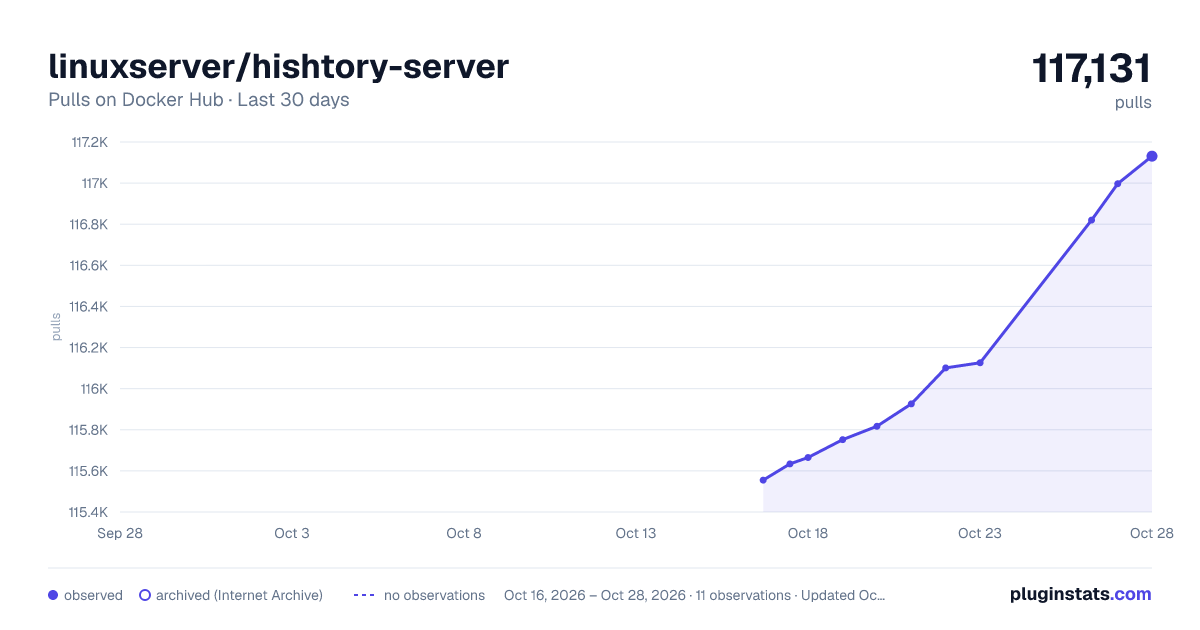
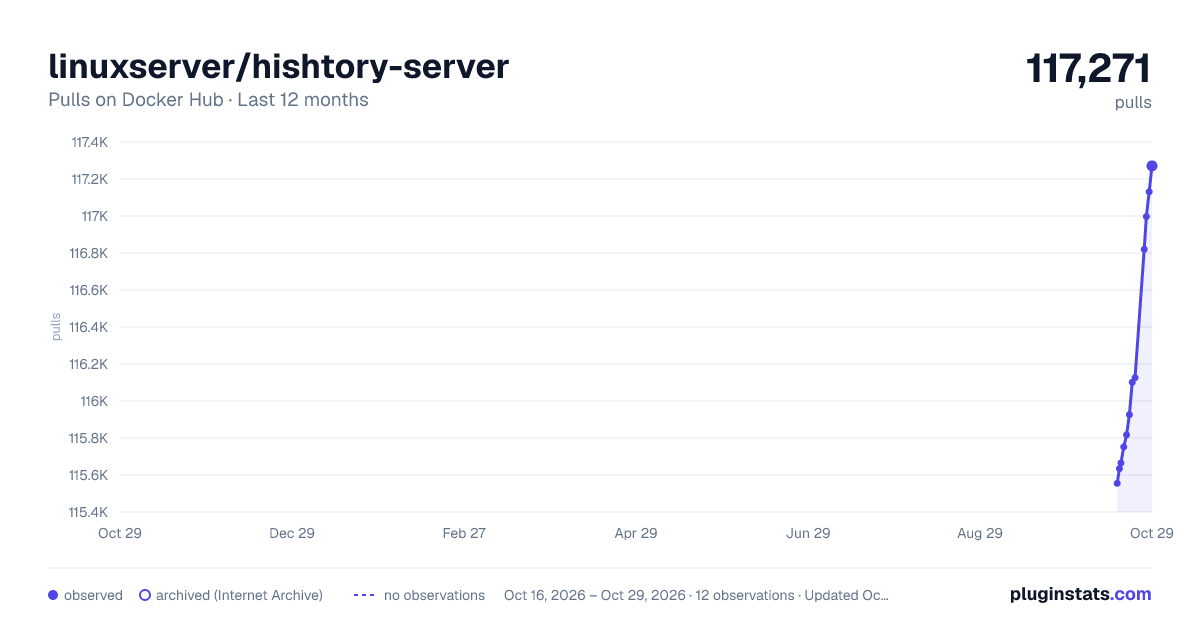
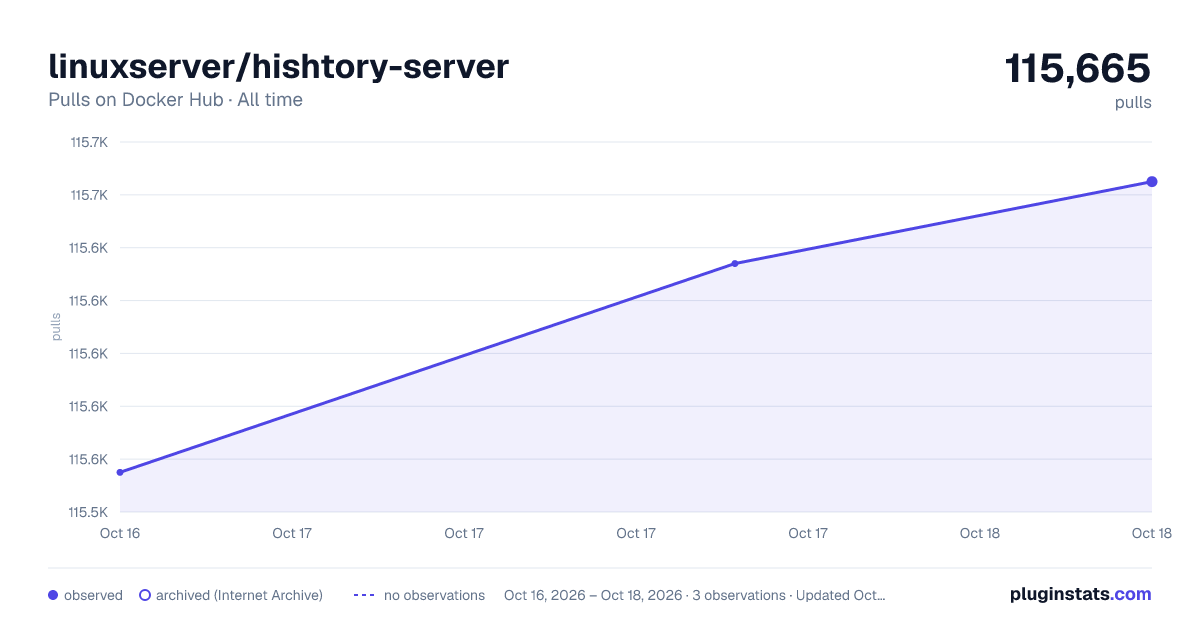

Adoption over time


7/30/90-day growth


Filled points are observed values; hollow points come from Internet Archive snapshots of the listing page. Dashed segments span periods with no observations — values between points are not interpolated.
Recent observations
Full history (3)Similar Docker Hub Integration & delivery plugins
Data source
Cumulative pull counts and stars come from the public Docker Hub API. Pulls count image downloads (including automated CI pulls), not installs or users.
Listing: https://hub.docker.com/r/linuxserver/hishtory-server. First seen Oct 16, 2026; last successful collection Oct 18, 2026. See the methodology.