 PluginStats
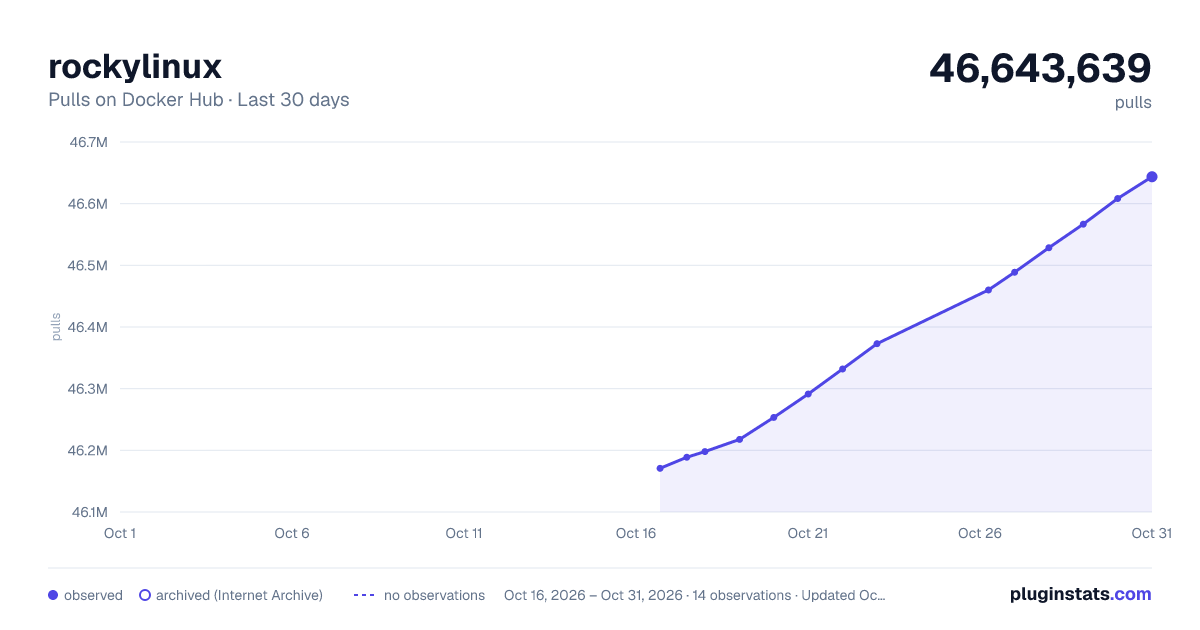
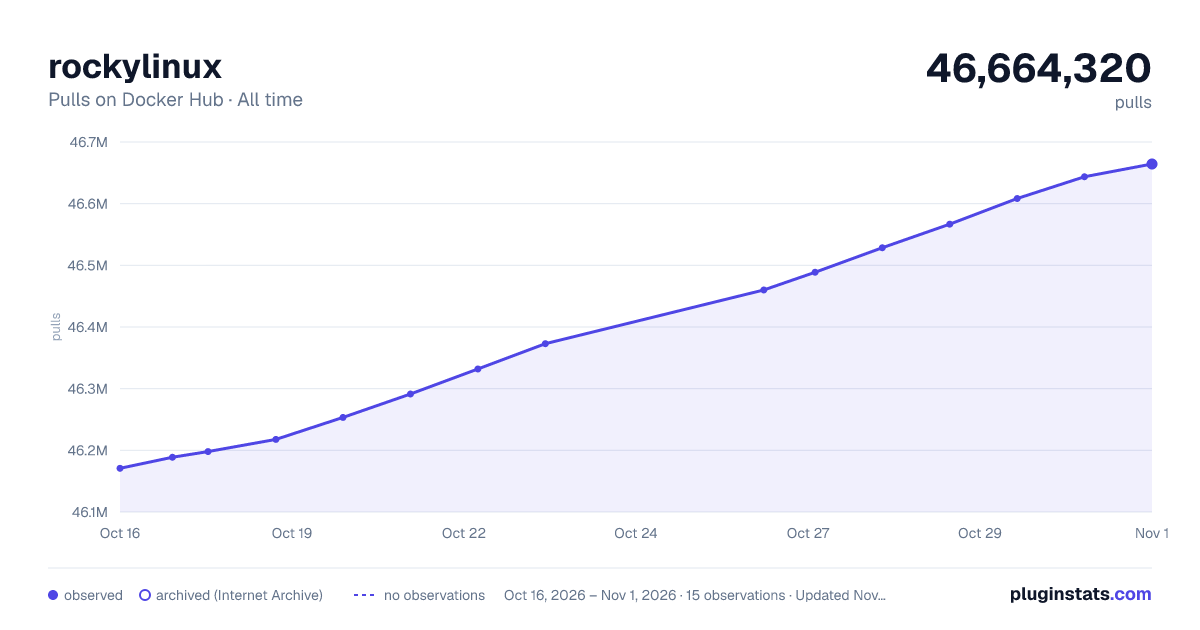
rockylinux has 46,217,710 recorded pulls on Docker Hub.
It ranks #68 of 1,263 tracked Docker Hub listings by pulls.
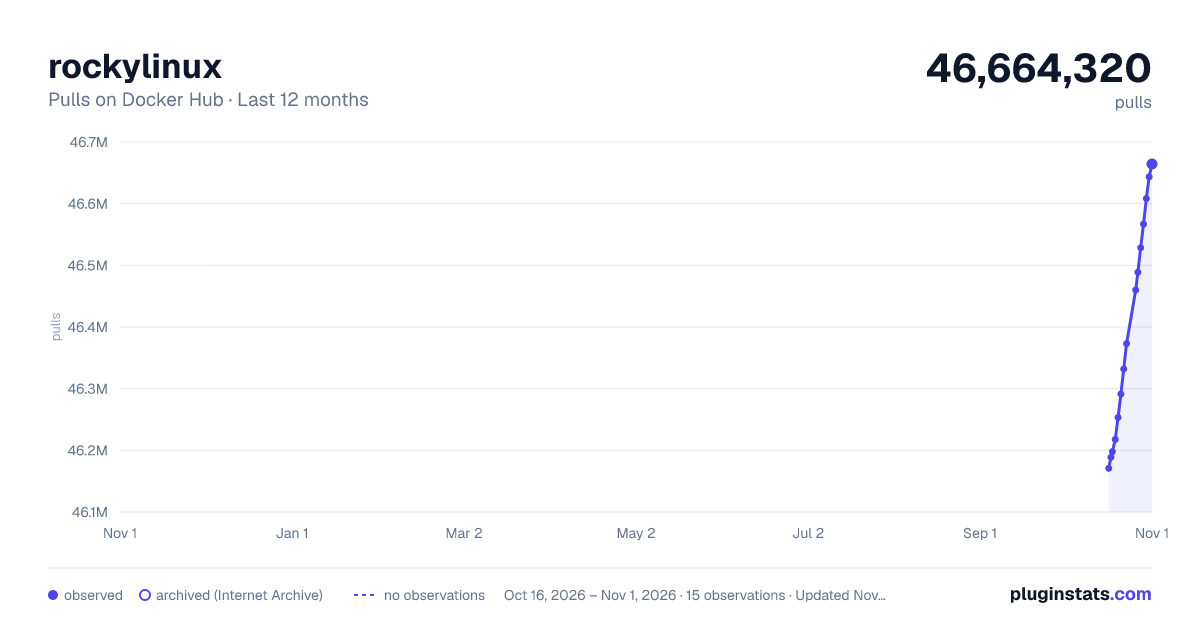
PluginStats has 4 daily observations since Oct 16, 2026; the latest is from Oct 19, 2026.
About rockylinux
IMPORTANT NOTE
The Docker team curates the Official Images program, and there are currently some technical constraints preventing Rocky Linux from publishing updates here. For the most up-to-date container images, please refer to the Rocky Linux Docker Hub repository for now.
Quick reference
• Maintained by: The Rocky Enterprise Software Foundation • Where to get help: the Docker Community Slack, Server Fault, Unix & Linux, or Stack Overflow
Supported tags and respective Dockerfile links
• 9.3.20231119, 9.3, 9 • 9.3.20231119-minimal, 9.3-minimal, 9-minimal • 8.9.20231119, 8.9, 8 • 8.9.20231119-minimal, 8.9-minimal, 8-minimal
Quick reference (cont.)
• Where to file issues: https://bugs.rockylinux.org or GitHub • Supported architectures: (more info) amd64, arm64v8, ppc64le, s390x • Published image artifact details: repo-info repo's repos/rockylinux/ directory (history) (image metadata, transfer size, etc) • Image updates: official-images repo's library/rockylinux label official-images repo's library/rockylinux file (history) • Source of this description: docs repo's rockylinux/ directory (history)
Rocky Linux
Rocky Linux is a community-supported distribution derived from sources freely provided to the public by Red Hat for Red Hat Enterprise Linux (RHEL). As such, Rocky Linux aims to be functionally compatible with RHEL. The Rocky Linux Project mainly changes packages to remove upstream vendor branding and artwork. Rocky Linux is no-cost and free to redistribute. Each Rocky Linux version is maintained for up to 10 years (by means of security updates -- the duration of the support interval by Red Hat has varied over time with respect to Sources released). A new Rocky Linux version is released approximately every 2 years and each Rocky Linux version is periodically updated (roughly every 6 months) to support newer hardware. This results in a secure, low-maintenance, reliable, predictable, and reproducible Linux environment.
Thank you for using Rocky Linux! We appreciate your feedback and welcome you to the community! Please join us on IRC on Libera.chat in #rockylinux or on our Mattermost instance at https://chat.rockylinux.org
• docs.rockylinux.org • wiki.rockylinux.org
Rocky Linux image documentation
The rockylinux:latest tag is intentionally missing. Please choose a major version (currently 8 or 9) tag, or a more specific tag to ensure you are pulling the version of Rocky Linux you want: e.g. rockylinux:8 or rockylinux:9
Minimal variant
In addition to the Base container, a Minimal container with microdnf and a stripped down dependency set is available by using any of the -minimal tags e.g. rockylinux:9-minimal
Rolling builds
Rocky Linux offers regularly updated images for all active releases. These images will be updated monthly or as needed for emergency fixes. These rolling updates are tagged with the major version number only. For example: docker pull rockylinux:8.
Minor tags
Additionally, images with minor version tags that correspond to install media are also offered. These images DO NOT receive updates as they are intended to match installation iso contents. If you choose to use these images it is highly recommended that you include RUN yum -y update && yum clean all in your Dockerfile, or otherwise address any potential security concerns. To use these images, please specify the minor version tag:
For example: docker pull rockylinux:8.4
Package documentation
By default, the Rocky Linux containers are built using yum's nodocs option, which helps reduce the size of the image. If you install a package and discover files missing, please comment out the line tsflags=nodocs in /etc/yum.conf and reinstall your package.
License
View license information for the software contained in this image.
As with all Docker images, these likely also contain other software which may be under other licenses (such as Bash, etc from the base distribution, along with any direct or indirect dependencies of the primary software being contained).
Some additional license information which was able to be auto-detected might be found in the repo-info repository's rockylinux/ directory.
As for any pre-built image usage, it is the image user's responsibility to ensure that any use of this image complies with any relevant licenses for all software contained within.
Description from the Docker Hub listing.
Where rockylinux sits in the listing
Each band is one page of 20. Pulls on a log scale. Placement is projected from pulls, so it can differ from the marketplace's own sort order. Hover a dot to see the listing.


Charts
Images: 30d · 1y · all time · 1600×900 dark

Adoption over time


7/30/90-day growth


Filled points are observed values; hollow points come from Internet Archive snapshots of the listing page. Dashed segments span periods with no observations — values between points are not interpolated.
Recent observations
Full history (4)Similar Docker Hub Operating systems plugins
Data source
Cumulative pull counts and stars come from the public Docker Hub API. Pulls count image downloads (including automated CI pulls), not installs or users.
Listing: https://hub.docker.com/_/rockylinux. First seen Oct 16, 2026; last successful collection Oct 19, 2026. See the methodology.