 PluginStats
oraclelinux has 46,276,767 recorded pulls on Docker Hub.
It ranks #67 of 1,263 tracked Docker Hub listings by pulls.
PluginStats has 3 daily observations since Oct 16, 2026; the latest is from Oct 18, 2026.
About oraclelinux
Quick reference
• Maintained by: the Oracle Linux Container Team • Where to get help: see the "Customer Support" and "Community Support" sections below
Supported tags and respective Dockerfile links
• 10 • 10-slim • 9 • 9-slim • 9-slim-fips • 8.10, 8 • 8-slim • 8-slim-fips • 7.9, 7 • 7-slim • 7-slim-fips
Quick reference (cont.)
• Where to file issues: https://github.com/oracle/container-images/issues • Supported architectures: (more info) amd64, arm64v8 • Published image artifact details: repo-info repo's repos/oraclelinux/ directory (history) (image metadata, transfer size, etc) • Image updates: official-images repo's library/oraclelinux label official-images repo's library/oraclelinux file (history) • Source of this description: docs repo's oraclelinux/ directory (history)
Oracle Linux
Oracle Linux is an open-source operating system available under the GNU General Public License (GPLv2). Suitable for general purpose or Oracle workloads, it benefits from rigorous testing of more than 128,000 hours per day with real- world workloads and includes unique innovations such as Ksplice for zero- downtime kernel patching, DTrace for real-time diagnostics, the powerful Btrfs file system, and more.
NOTE: the oraclelinux image intentionally does *not* provide a latest tag. You must specify an existing tag when referencing this image. See *"Removal of the latest tag"* below for further details.
How to use these images
The Oracle Linux images are intended for use in the FROM field of a downstream Dockerfile. For example, to use the latest optimized Oracle Linux 8 image, specify FROM oraclelinux:8.
Removal of latest tag
The latest tag was removed from the Oracle Linux official images in June 2020 to avoid breaking any downstream images caused by backwards-incompatible changes introduced by the release of a new version. Downstream images must specify the version, i.e. oraclelinux:7 or oraclelinux:8.
Differences between oraclelinux:8 and oraclelinux:8-slim
Oracle recommends using oraclelinux:8 for most images that extend Oracle Linux 8.
The oraclelinux:8-slim variant is intended primarily to provide "just enough user space" for statically compiled binaries or microservices. Use of the 8-slim variant is discouraged for general purposes, due to the inclusion of microdnf in place of dnf and signficantly reduced locale data.
Differences between oraclelinux:7 and oraclelinux:7-slim
For images that want an Oracle Linux 7 user space, Oracle recommends using oraclelinux:7-slim as the base layer as it contains just enough packages for yum to be able to install more packages.
The oraclelinux:7 images is based on the package set of what would be installed on a bare-metal server when performing a minimal install of Oracle Linux.
Changelog
Oracle maintains a CHANGELOG that documents by release date the errata applied and any CVE(s) that are mitigated in each update to the official images.
Official Resources
• Oracle Linux documentation • Oracle Linux Yum Server • Unbreakable Linux Network
Customer Support
Oracle provides support to Oracle Linux subscription customers via the My Oracle Support portal. The Oracle Linux container images are covered by Oracle Linux Basic and Premier support subscriptions. Customers should follow existing support procedures to obtain support for Oracle Linux running in a container.
Community Support
Users without an Oracle Linux support subscription should either open an issue or start a discussion in the Oracle Linux container image repository on GitHub.
License
View the Oracle Linux End-User License Agreement for the software contained in this image.
As with all Docker images, these likely also contain other software which may be under other licenses (such as Bash, etc from the base distribution, along with any direct or indirect dependencies of the primary software being contained).
Some additional license information which was able to be auto-detected might be found in the repo-info repository's oraclelinux/ directory.
As for any pre-built image usage, it is the image user's responsibility to ensure that any use of this image complies with any relevant licenses for all software contained within.
Description from the Docker Hub listing.
Where oraclelinux sits in the listing
Each band is one page of 20. Pulls on a log scale. Placement is projected from pulls, so it can differ from the marketplace's own sort order. Hover a dot to see the listing.


Charts
Images: 30d · 1y · all time · 1600×900 dark
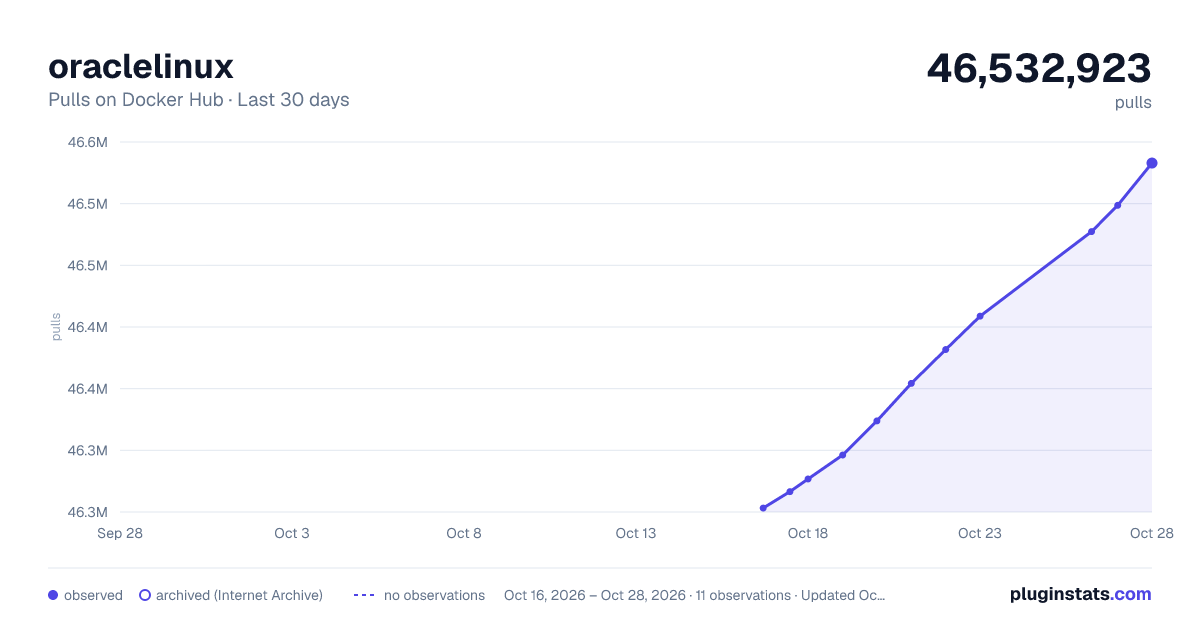
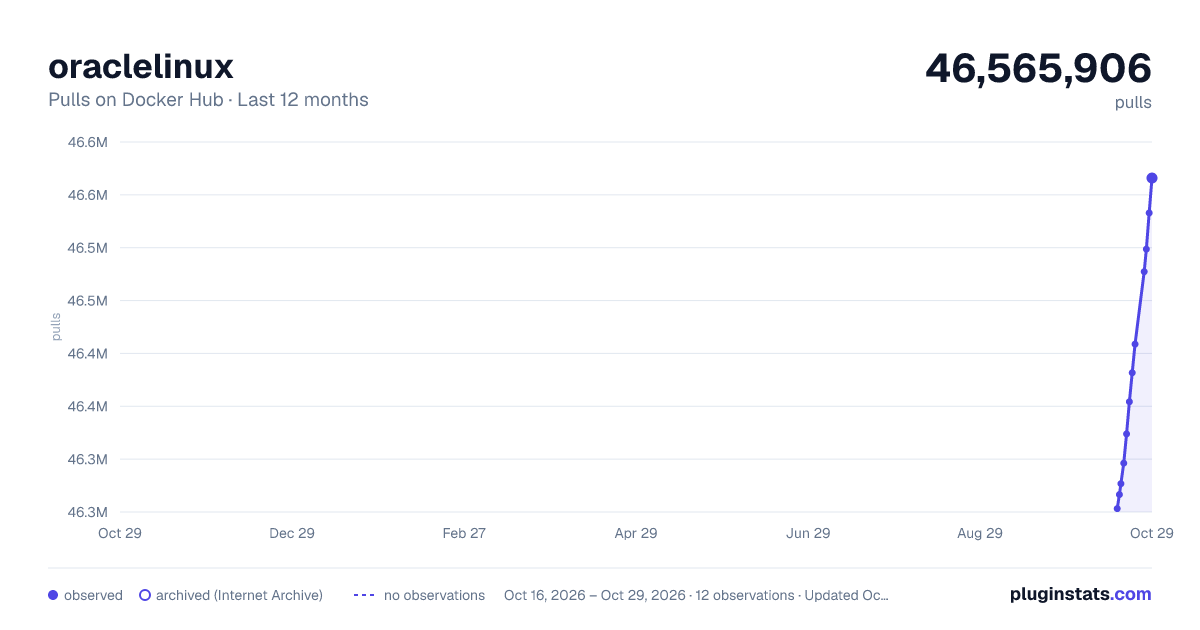
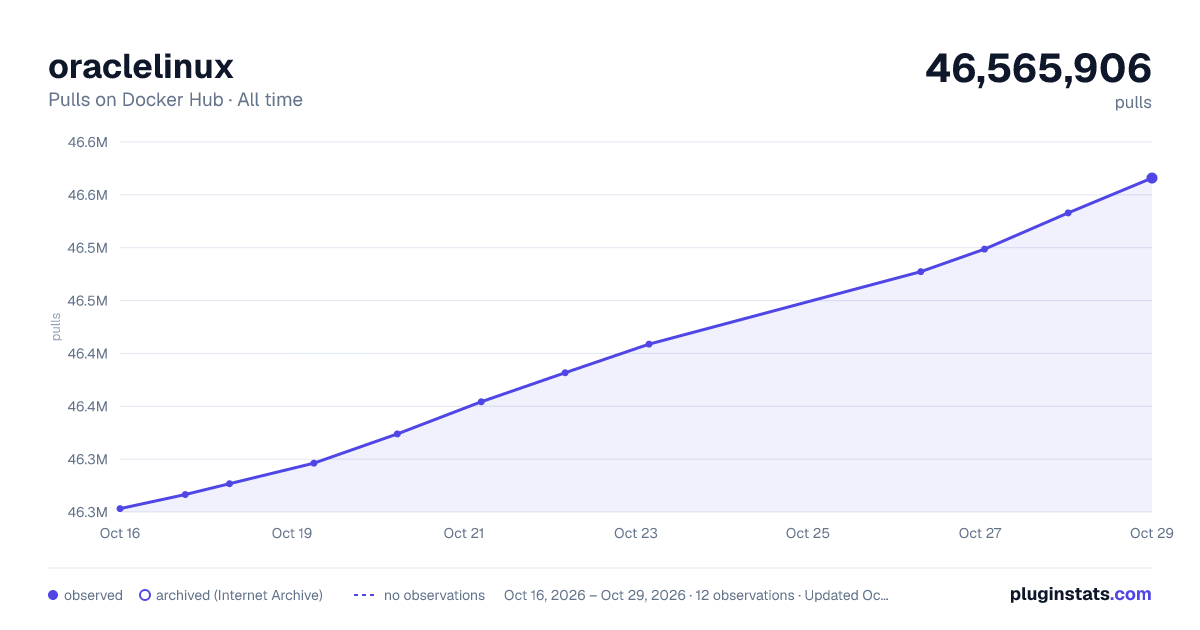

Adoption over time


7/30/90-day growth


Filled points are observed values; hollow points come from Internet Archive snapshots of the listing page. Dashed segments span periods with no observations — values between points are not interpolated.
Recent observations
Full history (3)Similar Docker Hub Operating systems plugins
Data source
Cumulative pull counts and stars come from the public Docker Hub API. Pulls count image downloads (including automated CI pulls), not installs or users.
Listing: https://hub.docker.com/_/oraclelinux. First seen Oct 16, 2026; last successful collection Oct 18, 2026. See the methodology.