 PluginStats
@netlify/vite-plugin-react-router weekly downloads statistics
By netlify (6 listings) · npm · Vite plugins
React Router 7+ Vite plugin for Netlify
@netlify/vite-plugin-react-router has 6,825 recorded weekly downloads on npm, a decrease of 47.4% over the past 30 days, ranking #1058 of 2,322 tracked listings.
About @netlify/vite-plugin-react-router
React Router Adapter for Netlify
The React Router Adapter for Netlify allows you to deploy your React Router app to Netlify.
How to use
To deploy a React Router 7+ site to Netlify, install this package:
npm install @netlify/vite-plugin-react-router
It's also recommended (but not required) to use the Netlify Vite plugin, which provides full Netlify platform emulation directly in your local dev server:
npm install --save-dev @netlify/vite-plugin
and include the Netlify plugin in your vite.config.ts:
import { reactRouter } from '@react-router/dev/vite'
import { defineConfig } from 'vite'
import tsconfigPaths from 'vite-tsconfig-paths'
import netlifyReactRouter from '@netlify/vite-plugin-react-router' // <- add this
import netlify from '@netlify/vite-plugin' // <- add this (optional)

export default defineConfig({
  plugins: [
    reactRouter(),
    tsconfigPaths(),
    netlifyReactRouter(), // <- add this
    netlify(), // <- add this (optional)
  ],
})
Your app is ready to deploy to Netlify.
Deploying to Edge Functions
By default, this plugin deploys your React Router app to Netlify Functions (Node.js runtime). You can optionally deploy to Netlify Edge Functions (Deno runtime) instead.
First, toggle the edge option:
export default defineConfig({
  plugins: [
    reactRouter(),
    tsconfigPaths(),
    netlifyReactRouter({ edge: true }), // <- deploy to Edge Functions
    netlify(),
  ],
})
Second, you must provide an app/entry.server.tsx (or .jsx) file. Create a file with the following content:
export { default } from 'virtual:netlify-server-entry'
[!TIP]
If you prefer to avoid a
@ts-ignorehere, add this tovite-env.d.tsin your project root (or anywhere you prefer):declare module 'virtual:netlify-server-entry' { import type { ServerEntryModule } from 'react-router' const entry: ServerEntryModule export default entry }
Finally, if you have your own Netlify Functions (typically in netlify/functions) for which you've configured a path,
you must exclude those paths to avoid conflicts with the generated React Router SSR handler:
export default defineConfig({
  plugins: [
    reactRouter(),
    tsconfigPaths(),
    netlifyReactRouter({
      edge: true,
      excludedPaths: ['/ping', '/api/*', '/webhooks/*'],
    }),
    netlify(),
  ],
})
Moving back from Edge Functions to Functions
To switch from Edge Functions back to Functions, you must:
- Remove the
edge: trueoption from yourvite.config.ts - Delete the
app/entry.server.tsxfile (React Router will use its default Node.js-compatible entry)
Edge runtime
Before deploying to Edge Functions, review the Netlify Edge Functions documentation for important details:
- Runtime environment - Understand the Deno runtime
- Supported Web APIs - Check which APIs are available
- Limitations - Be aware of resource limits and constraints
Load context
This plugin automatically includes all Netlify context fields on loader and action context.
If you're using TypeScript, AppLoadContext is automatically aware of these fields
(via module augmentation).
For example:
import { useLoaderData } from 'react-router'
import type { Route } from './+types/example'

export async function loader({ context }: Route.LoaderArgs) {
  return {
    country: context.geo?.country?.name ?? 'an unknown country',
  }
}
export default function Example() {
  const { country } = useLoaderData<typeof loader>()
  return <div>You are visiting from {country}</div>
}
If you've opted in to the future.v8_middleware flag, you can still use
the above access pattern for backwards compatibility, but loader and action context will now be an instance of the
type-safe RouterContextProvider. Note that this requires requires v2.0.0+ of @netlify/vite-plugin-react-router.
For example:
import { netlifyRouterContext } from '@netlify/vite-plugin-react-router/serverless'
//                    NOTE: if setting `edge: true`, import from /edge ^ instead here
import { useLoaderData } from 'react-router'
import type { Route } from './+types/example'

export async function loader({ context }: Route.LoaderArgs) {
  return {
    country: context.get(netlifyRouterContext).geo?.country?.name ?? 'an unknown country',
  }
}
export default function Example() {
  const { country } = useLoaderData<typeof loader>()
  return <div>You are visiting from {country}</div>
}
[!IMPORTANT]
Note that in local development,
netlifyRouterContextrequires Netlify platform emulation, which is provided seamlessly by@netlify/vite-plugin(or Netlify CLI - up to you).
Middleware context
React Router introduced a stable middleware feature in 7.9.0.
To use middleware,
opt in to the feature via future.v8_middleware and follow the docs. Note
that this requires requires v2.0.0+ of @netlify/vite-plugin-react-router.
To access the Netlify context
specifically, you must import our RouterContext instance:…
Description from the npm listing.
- react-router
- vite-plugin
- netlify
README badge
Show your rank in a README or on your website. The badge updates automatically.
Charts
Images: 30d · 1y · all time · 1600×900 dark
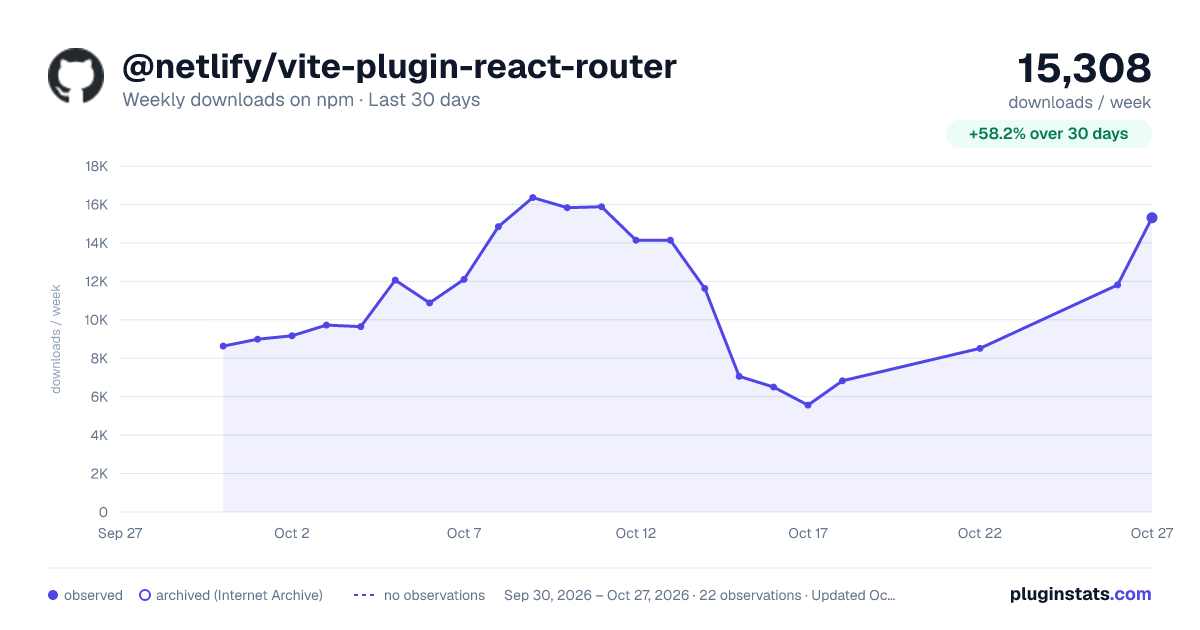

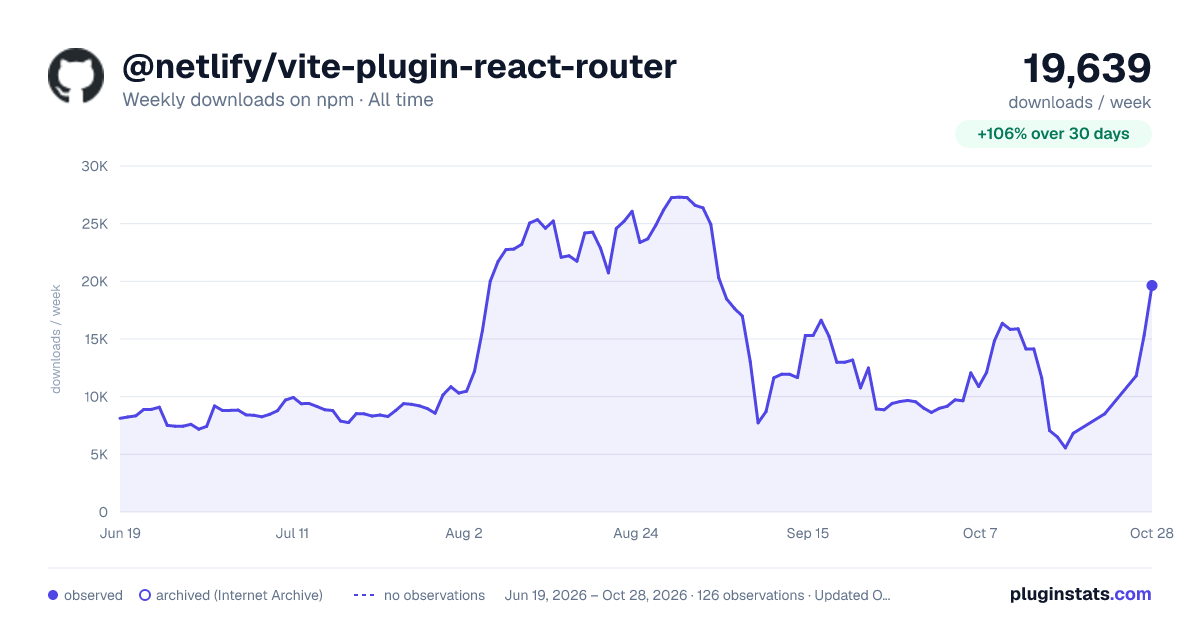

Adoption over time
7/30/90-day growth
Ranking history
Listing placement
Listing placement
Filled points are observed values; hollow points come from Internet Archive snapshots of the listing page. Dashed segments span periods with no observations — values between points are not interpolated.
Each band is one page of 20. Weekly downloads on a linear scale. Placement is projected from weekly downloads, so it can differ from the marketplace's own sort order. Hover a dot to see the listing.
Recent observations
Full history (122)Similar npm Vite plugins plugins
All 20 @netlify/vite-plugin-react-router alternatives- 6.7K weekly downloads-38.8%
- 6.9K weekly downloads-38.1%
- 6.5K weekly downloads-14.5%
Data source
Weekly downloads (trailing 7 complete days) come from the official npm downloads API. Downloads include CI and mirrors and are not equivalent to installs or users. npm publishes no ratings.
Listing: https://www.npmjs.com/package/@netlify/vite-plugin-react-router. First seen Oct 16, 2026; last successful collection Oct 20, 2026. See the methodology.