 PluginStats
@kontextmind/kxm weekly downloads statistics
By kontextmind · npm · MCP servers
KXM local-first multi-agent orchestration and operator dashboard
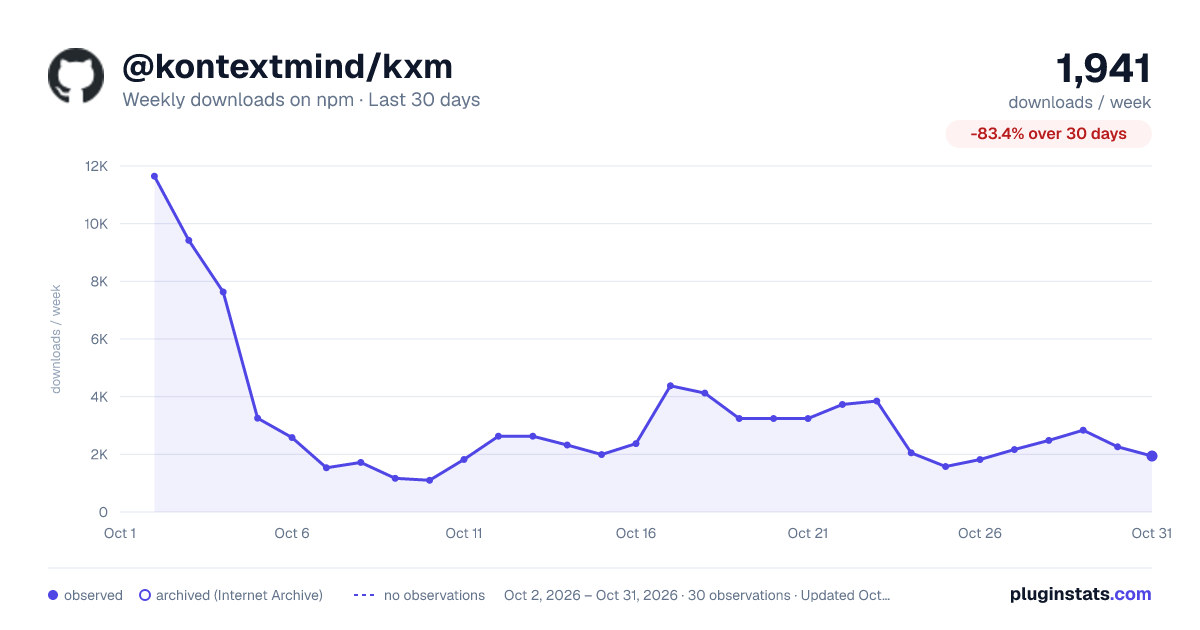
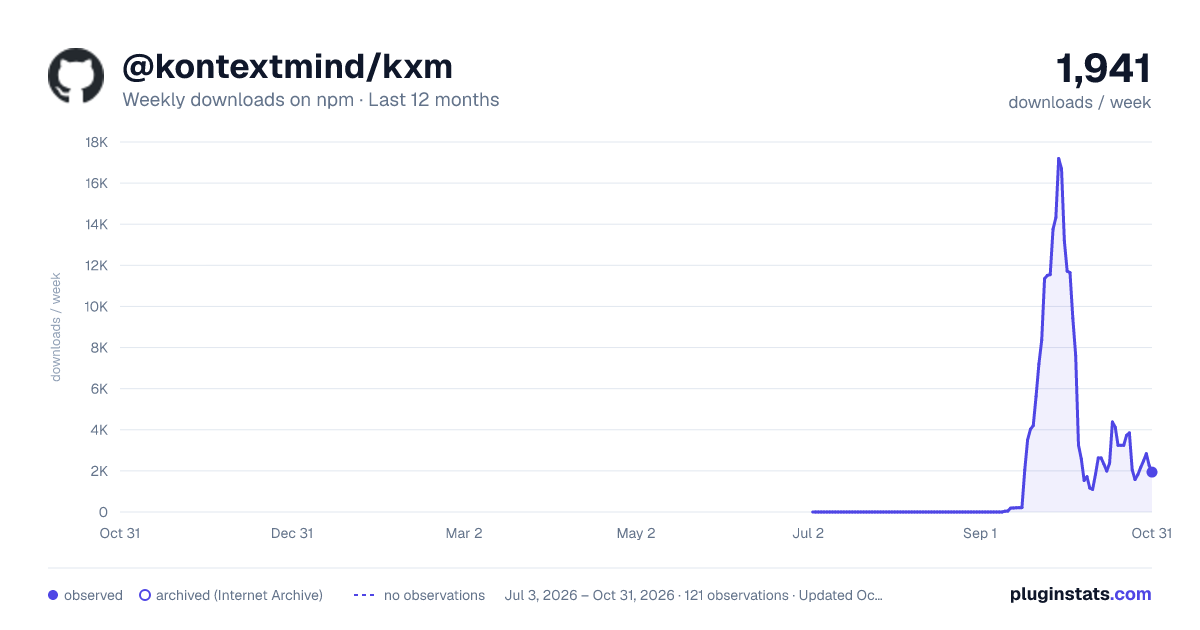
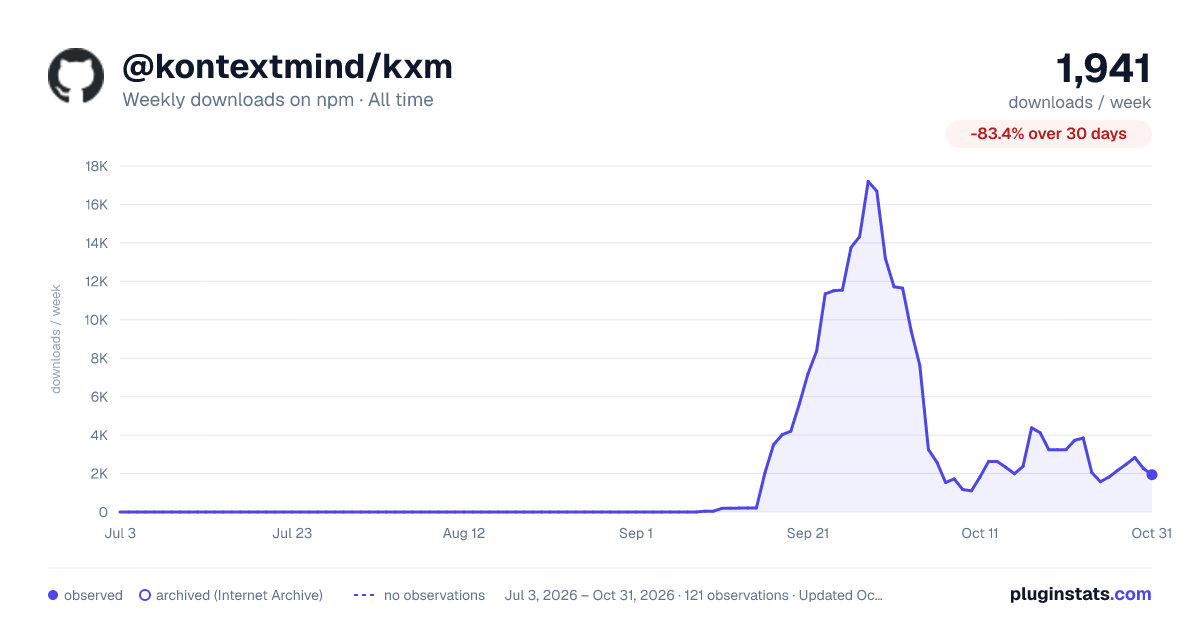
@kontextmind/kxm has 4,124 recorded weekly downloads on npm, ranking #1194 of 2,391 tracked listings.
About @kontextmind/kxm
KXM




KXM gives coding agents (Claude Code, Pi and other harnesses) a durable, authenticated message and workflow plane, so they can delegate bounded work to each other and prove who answered, without sharing one giant context.
KXM runs on your machine: one kxm CLI, a local hub for messages and webhook workflows, and a local Runtime for workflow runs. Your project is reviewable YAML in Git, every agent keeps its own context and its own safety controls, and the docs say plainly what KXM does not guarantee (Status and limits).
What makes KXM different
- Durable messages, not chat. Every request is a SQLite record that moves from
queuedtodeliveredtoreplied, survives hub and agent restarts, and deduplicates retries by idempotency key. Agents authenticate with a project token and see only their own project's peers. Message peer agents - Provenance you can check. A quorum gate counts only replies the hub itself routed, from distinct eligible peers, for the exact run, stage and attempt. Text a coordinator writes never counts. It proves who answered, not that the answer is right. Peer provenance and quorum gates
- Workflows that release the turn. Signed Jira, GitHub or generic webhooks start durable runs. A coordinator can park a stage, give up its turn, and resume only when a signed CI, review or merge callback arrives. Run webhook workflows
- Local-first and reviewable. The project lives in
.kxm/*.yaml.kxm trust difflists every permission expansion, andkxm trust checkfails on any expansion beyond the base revision.kxm runexecutes workflows in an event-sourced Runtime that works with the hub down and ends each drive with a receipt it verifies. Architecture - Native harnesses, fail-closed auth, honest cost. Before a live run dispatches, KXM checks that the harness hosts the model and runs only admitted routes. KXM will not run a model on Pi when its vendor has its own harness, at dispatch or when a worker starts; route admission is a second layer, and a few reseller and policy cases remain operator decisions. A logged-out harness stops the run instead of billing another provider, and cost is recorded as metered, unmetered or unknown. Harness routing
- Context that ranks, learning that only proposes. Context packets are ranked deterministically for the role and task and filled to a token budget, and they carry the selected evidence itself. Hub workflow journals feed
kxm_improvement_report, andkxm improvereads the Runtime's settled attempts and routing telemetry. Both only propose: readiness never authorizes, and nothing changes until a person merges a reviewed Git change. Context and memory · Continuous improvement - One plane for every harness. A Claude Code plugin (MCP tools, pushed channel, a read-only SessionStart brief), a Pi extension with the same tools, portable Agent Skills, and the
kxmCLI all work against the same hub. Claude Code plugin · Agent skills
How it fits together
Claude Code, Pi and the operator CLI talk to one hub on your machine, while the Runtime executes workflow runs locally and syncs their summaries to the hub.
flowchart LR
  subgraph Clients["Agents and operator"]
    CC["Claude Code<br/>plugin: MCP stdio, channel, SessionStart hook"]
    PI["Pi<br/>extension and skills"]
    CLI["kxm CLI<br/>operator"]
  end
  subgraph Machine["Your machine: loopback by default"]
    HUB[("KXM hub<br/>HTTP and SSE, SQLite kxm.db")]
    RT["Runtime supervisor<br/>runs, event store, outbox"]
  end
  GIT[["Git repository<br/>.kxm/*.yaml"]]
  EXT["Webhooks and CI<br/>signed starts and callbacks"]
  CC -->|"MCP tools, SSE"| HUB
  PI -->|"HTTP, SSE"| HUB
  CLI -->|"admin and project APIs"| HUB
  EXT -->|"HMAC-signed"| HUB
  CLI -->|"kxm run, kxm runs"| RT
  RT -->|"sync events, outbound only"| HUB
  GIT -.->|"reviewed config"| CLI
  GIT -.->|"pinned per run"| RT
- The hub authenticates agents, stores messages and webhook workflow runs, and pushes events. It routes work but never runs a model or merges agent contexts, and it refuses to listen beyond loopback without a token.
- The Runtime supervisor owns the runs
kxm runcreates, as an append-only event log per project. It listens only on127.0.0.1and pushes sync-safe events to the hub whenever it can reach one. Architecture explains each component and lifecycle.
Feature tour…
Description from the npm listing.
- pi-package
- pi-extension
- agent-skills
- multi-agent
- webhooks
- workflow-automation
- claude-code-plugin
- mcp
README badge
Show your rank in a README or on your website. The badge updates automatically.
Charts
Images: 30d · 1y · all time · 1600×900 dark

Adoption over time
7/30/90-day growth
Ranking history
Listing placement
Listing placement
Filled points are observed values; hollow points come from Internet Archive snapshots of the listing page. Dashed segments span periods with no observations — values between points are not interpolated.
Each band is one page of 20. Weekly downloads on a linear scale. Placement is projected from weekly downloads, so it can differ from the marketplace's own sort order. Hover a dot to see the listing.
Recent observations
Full history (1)Similar npm MCP servers plugins
All 20 @kontextmind/kxm alternativesData source
Weekly downloads (trailing 7 complete days) come from the official npm downloads API. Downloads include CI and mirrors and are not equivalent to installs or users. npm publishes no ratings.
Listing: https://www.npmjs.com/package/@kontextmind/kxm. First seen Oct 20, 2026; last successful collection Oct 21, 2026. See the methodology.