 PluginStats
trace-mcp weekly downloads statistics
By nikolai-vysotskyi · npm · Claude Code
Framework-aware code intelligence MCP server — 88 framework integrations, 81 languages, 72.7% fewer input tokens to review a pull request, comprehension at parity
trace-mcp has 2,184 recorded weekly downloads on npm, an increase of 13.8% over the past 30 days.
It ranks #1269 of 2,256 tracked npm listings by weekly downloads.
Over 90 days, weekly downloads changed by +1366%.
PluginStats has 121 daily observations since Jun 19, 2026; the latest is from Oct 17, 2026.
About trace-mcp
WORKS WITH · Claude Code · Cursor · Codex · Windsurf · Zed · any MCP client
trace-mcp indexes what your agent keeps re-reading, and serves the answer instead. 72.7% fewer input tokens to review a pull request — median over 60 merged pull requests in open-source repos we don't own.
We change configuration you could change yourself. We do not patch your client's binary, intercept its traffic, or rewrite its files. One declinable exception: the Max tier's tweakcc pairing runs a third-party patcher for you.
72.7% fewer input tokens to review a pull request — median over 60 merged PRs in six repos that are not ours, 13,595 → 3,291 per pull request. Method and reproduction →
Measured at trace-mcp 3.23.2 (cb8ab30c) on 7 September 2026 — a result from that build, not a claim about the current one. What it set out to measure, the bar it had to clear and the verdict: preregistration.
Cheaper is not the same as better, so the same 60 pull requests were reviewed twice and scored blind. The trace-mcp arm understood the change in 67% of them against 65% for naive file loading, at 0.80 false positives per PR against 0.58. Quality half of the benchmark →
The desktop app: a GPU graph explorer over the same index the MCP server serves.
The problem
AI agents pay repeatedly for work they have already done. Every turn, the agent re-reads the same files, re-traverses the same dependencies, and re-inflates the context window with structure it discovered five steps ago. That repeated work is most of what a long session costs in tokens and latency.
trace-mcp builds a framework-aware graph of your codebase once, then serves it through MCP so the agent reasons from a precomputed structure instead of brute-reading the repo. Ask *"what breaks if I change this model?"* — instead of 80 Grep calls and 190 file reads, the agent calls get_change_impact once and gets the blast radius across PHP, Vue, migrations, and DI. 88 framework integrations across 81 languages, 182 tools.
The binding constraint is recomputation, not model capability: token bills, latency, and hallucinations all grow with project size instead of with task complexity. trace-mcp closes the recomputation leak. The graph is built once, kept incrementally fresh, and served to every agent that asks — so the same work isn't paid for over and over.
• Lower cost — fewer tokens per successful answer, on average and at peak • Lower latency — fewer sequential tool calls, fewer round-trips to the model • Higher accuracy — less noise in context means fewer hallucinations and stronger first-response correctness • Production stability — context growth tracks task complexity rather than repository size
We started with code intelligence, where the repetition is most expensive, and the same engine now indexes markdown knowledge vaults (Obsidian, Logseq, plain MD) as a peer domain. Wikilinks, tags, frontmatter, and embeds become graph edges and symbol metadata; search, find_usages, get_change_impact, and apply_rename work identically over both.
What trace-mcp does for you
| You ask | trace-mcp answers | How |
| "What breaks if I change this model?" | Blast radius across languages + risk score + linked architectural decisions | get_change_impact — reverse dependency graph + decision memory | | "Why was auth implemented this way?" | The actual decision record with reasoning and tradeoffs | query_decisions — searches the decision knowledge graph linked to code | | "I'm starting a new task" | Optimal code subgraph + relevant past decisions + dead-end warnings | plan_turn — opening-move router with decision enrichment | | "What did we discuss about GraphQL last month?" | Verbatim conversation fragments with file references | search_sessions — FTS5 search across all past session content | | "Show me the request flow from URL to rendered page" | Route → Middleware → Controller → Service → View with prop mapping | get_request_flow — framework-aware edge traversal | | "Find all untested code in this module" | Symbols classified as "unreached" or "imported but never called in tests" | get_untested_symbols — test-to-source mapping | | "What's the impact of this API change on other services?" | Cross-subproject client calls with confidence scores | get_subproject_impact — topology graph traversal | | "What notes link to this concept?" | Backlinks across the vault, with section + alias context | find_usages on a note: symbol | | "What breaks if I rename this note?" | Every [[wikilink]] and text that references it | get_change_impact — wikilink-aware reverse graph |
Four capabilities that are rare among adjacent tools:
1. Framework-aware edges — trace-mcp understands that Inertia::render('Users/Show') connects PHP to Vue, that @Injectable() creates a DI dependency, that $user->posts() means a posts table from migrations. 88 framework integrations.
2. Code-linked decision memory — when you record "chose PostgreSQL for JSONB support", it's linked to src/db/connection.ts::Pool#class. When someone runs get_change_impact on that symbol, they see the decision. MemPalace stores decisions as text; trace-mcp ties them to the dependency graph.
3. Cross-session intelligence — past sessions are mined for decisions and indexed for search. When you start a new session, get_wake_up gives you orientation in ~300 tokens; plan_turn shows relevant past decisions for your task; get_wake_up { scope: "resume" } carries over structural context from previous sessions.
4. Code and knowledge in one graph — point trace-mcp at a markdown vault (Obsidian, Logseq, plain MD) and the same engine indexes it: each note becomes a note: symbol, headings become nested sections, [[wikilinks]] and ![[embeds]] become graph edges, frontmatter and #tags ride on metadata. PageRank, Signal Fusion ranking, embeddings, and rename refactoring all apply unchanged. The agent does not learn a second tool: it is the same graph, holding both the codebase and the notes.…
Description from the npm listing.
- mcp-server
- claude-code
- cursor
- ai-agents
- code-graph
- dependency-graph
- token-optimization
- mcp
- code-intelligence
- laravel
- vue
- nuxt
- inertia
- framework-aware
- static-analysis
Charts
Images: 30d · 1y · all time · 1600×900 dark
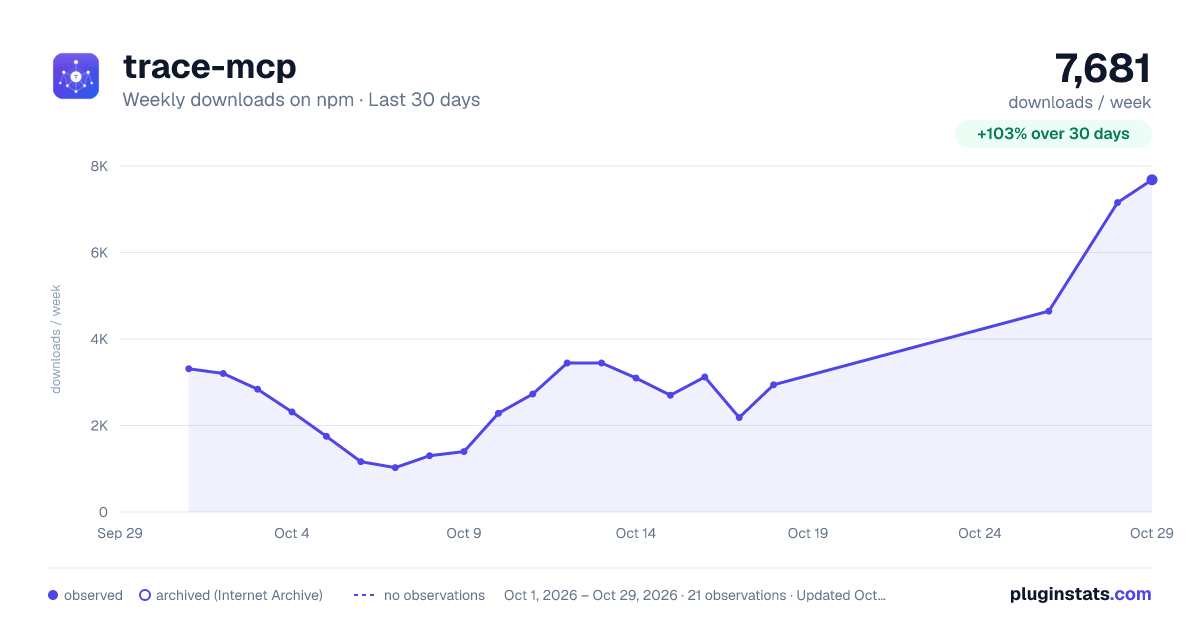
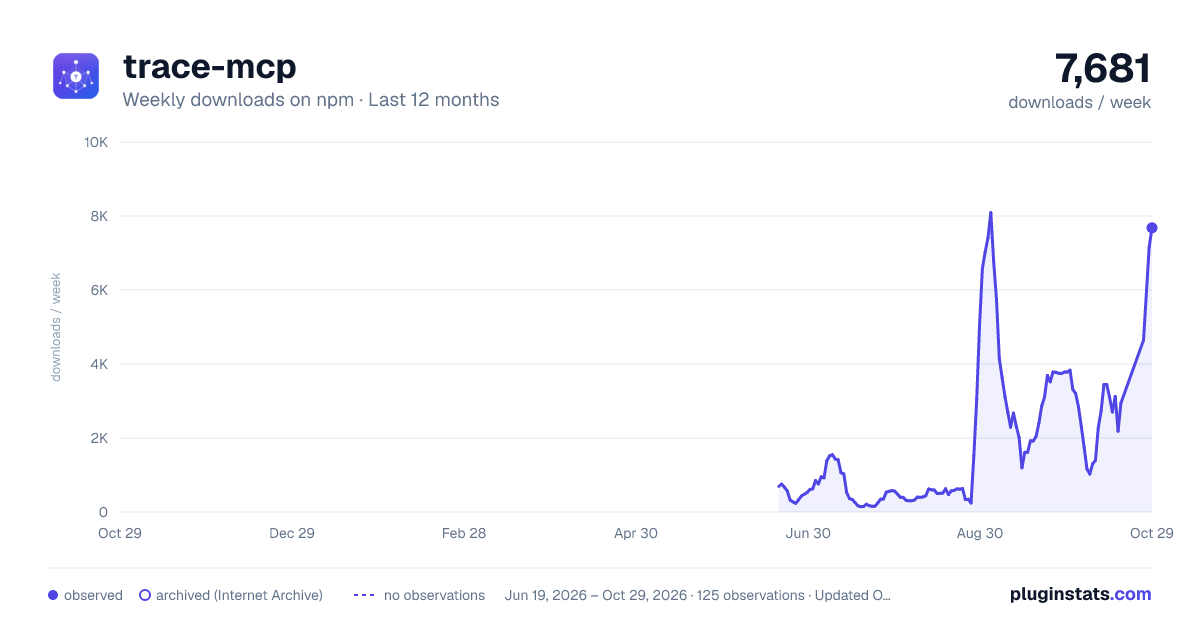
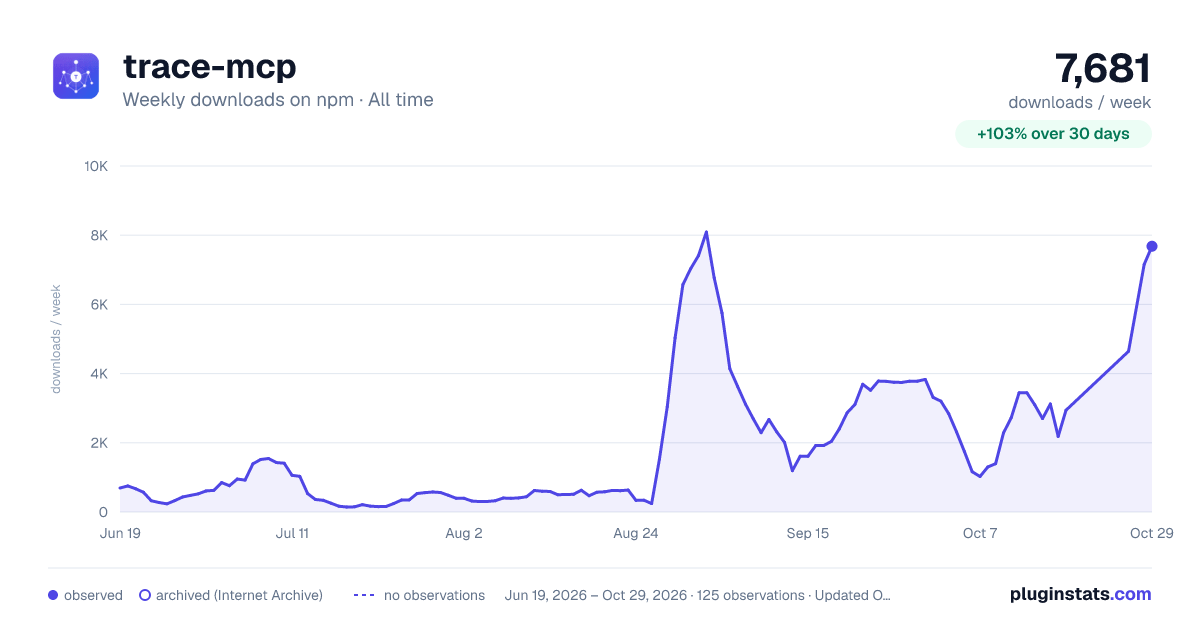

Adoption over time


7/30/90-day growth


Listing placement


Filled points are observed values; hollow points come from Internet Archive snapshots of the listing page. Dashed segments span periods with no observations — values between points are not interpolated.
Each band is one page of 20. Weekly downloads on a log scale. Placement is projected from weekly downloads, so it can differ from the marketplace's own sort order. Hover a dot to see the listing.
Recent observations
Full history (121)Similar npm Claude Code plugins
All 20 trace-mcp alternativesData source
Weekly downloads (trailing 7 complete days) come from the official npm downloads API. Downloads include CI and mirrors and are not equivalent to installs or users. npm publishes no ratings.
Listing: https://www.npmjs.com/package/trace-mcp. First seen Oct 16, 2026; last successful collection Oct 19, 2026. See the methodology.