 PluginStats
agnost weekly downloads statistics
By agnostai · npm · MCP servers
Analytics SDK for Model Context Protocol Servers
agnost has 14,809 recorded weekly downloads on npm, a decrease of 90.2% over the past 30 days.
It ranks #827 of 2,256 tracked npm listings by weekly downloads.
Over 90 days, weekly downloads changed by +3.9%.
PluginStats has 543 daily observations since Apr 23, 2025; the latest is from Oct 17, 2026.
About agnost
Agnost Analytics SDK (TypeScript)
Analytics SDK for tracking and analyzing Model Context Protocol (MCP) server interactions.
Installation
Setup Example
Configuration Example
Disabling All Logs
To completely disable all SDK logs (including error logs), you can use the disableLogs option:
Alternatively, you can use environment variables:
User Identification
The SDK supports user identification to track analytics per user. This is especially useful for understanding usage patterns across different users and roles.
Basic User Identification
Advanced User Identification
User Identity Interface
The identify function should return a UserIdentity object or null:
Identify Function Parameters
• request: The incoming MCP request object containing: • headers: HTTP-style headers (e.g., x-user-id, authorization) • params: Request parameters including tool name and arguments • Other request metadata from the MCP protocol • env: Environment variables from process.env, useful for: • Reading user info from environment variables • Accessing configuration secrets • Getting deployment-specific user context
Common Usage Patterns
1. Header-based Identification
2. Environment Variable Identification
3. Token-based Identification
Important Notes
• The userId field is required in the returned UserIdentity object • If identification fails, return null or { userId: 'anonymous' } • User identification runs per request — safe for concurrent, multi-user servers • Any errors in the identify function are logged and fallback to anonymous tracking • Additional fields beyond userId are included in analytics for segmentation • The raw Authorization header value is never sent to Agnost; only the fields your identify function (or the built-in fallback) returns
Built-in bearer identification (zero config)
If you do NOT provide an identify function, the SDK derives the user id from the request's Authorization: Bearer header automatically. If the MCP auth middleware exposes a validated token as extra.authInfo.token but extra.requestInfo.headers is empty, the SDK uses that token as a fallback.
1. Decode: if the token is a JWT (3 parts) with a decodable payload, the first present identifier claim becomes the userId — in order: sub, user_id, userId, email, preferred_username, username. (No signature verification — your own auth middleware has already validated the token.) 2. Hash: any other token — opaque API keys, 2-part shapes, JWEs, undecodable or claimless JWTs — becomes tok_, a stable pseudonymous per-token id. The raw token is never used as an id and never leaves the process. Note: tokens that rotate (JWE/refresh-style) mint a new pseudo-user per rotation. 3. x-api-key fallback: when there is no Authorization header, an x-api-key header (de facto standard for API-key auth) is hashed the same way. 4. OAuth authInfo fallback: when headers are unavailable, the SDK also reads identity from authInfo.sub, authInfo.claims, authInfo.tokenPayload, authInfo.extra, authInfo.token, authInfo.accessToken, or authInfo.access_token. If your OAuth verifier sets authInfo.extra.userId and authInfo.extra.tokenId, Agnost uses userId for user attribution and tokenId to create a durable OAuth conversation id (oauth:{orgId}:{tokenId}) for stateless HTTP servers.
For OAuth MCP servers, keep the official transport path so headers reach MCP handlers:
If you use a custom transport or manual message dispatch, pass the MCP extra object yourself:
Do not log raw bearer tokens. If your OAuth middleware validates the token, attach stable non-secret identity on authInfo.extra:
Conversations on stateless servers
Session (conversation) grouping precedence, per request:
1. MCP session id (Mcp-Session-Id / extra.sessionId) — stateful servers keep today's grouping. 2. OAuth token id (authInfo.extra.tokenId) — stateless OAuth servers group calls by the durable authorization record: oauth:{orgId}:{tokenId}. 3. User id — stateless servers (new server per request, no session id) group all of a user's tool calls into one conversation: user:{orgId}:{userId}. 4. Anonymous stateless HTTP requests merge into one shared conversation per SDK process (anon:{orgId}) — unattributable traffic is aggregated rather than flooding your dashboard with single-call conversations.
Known limitation
One org per process: the first trackMCP call pins the orgId and endpoint for the process lifetime. A later call with a different orgId logs an error and records under the pinned org.
Configuration Options
| Option | Type | Default | Description |
| endpoint | string | "https://api.agnost.ai" | API endpoint URL | | disableInput | boolean | false | Disable tracking of input arguments | | disableOutput | boolean | false | Disable tracking of output results | | disableError | boolean | false | When disableOutput is true, errors take precedence and the error message is still captured. Set this to true to drop errors as well. | | disableLogs | boolean | false | Completely disable all SDK logs | | identify | IdentifyFunction | undefined | Function to identify users from request context |
Performance Monitoring with Checkpoints
The TypeScript SDK provides a powerful checkpoint() function for detailed latency breakup of tool calls. Checkpoints allow you to track specific points in your tool's execution, providing granular observability into where time is being spent.
Overview
When analyzing tool performance, knowing the total execution time is often not enough. The checkpoint() function lets you mark specific points in your execution flow to understand:
• Which operations are slow • Where bottlenecks occur • How time is distributed across different phases • Performance impact of external API calls, database queries, or processing steps
All checkpoint data is automatically captured and visualized in the Agnost AI dashboard with interactive timeline charts.
Function Signature…
Description from the npm listing.
- analytics
- mcp
- model context protocol
- ai
- tools
Where agnost sits in the listing
Each band is one page of 20. Weekly downloads on a log scale. Placement is projected from weekly downloads, so it can differ from the marketplace's own sort order. Hover a dot to see the listing.


Charts
Images: 30d · 1y · all time · 1600×900 dark
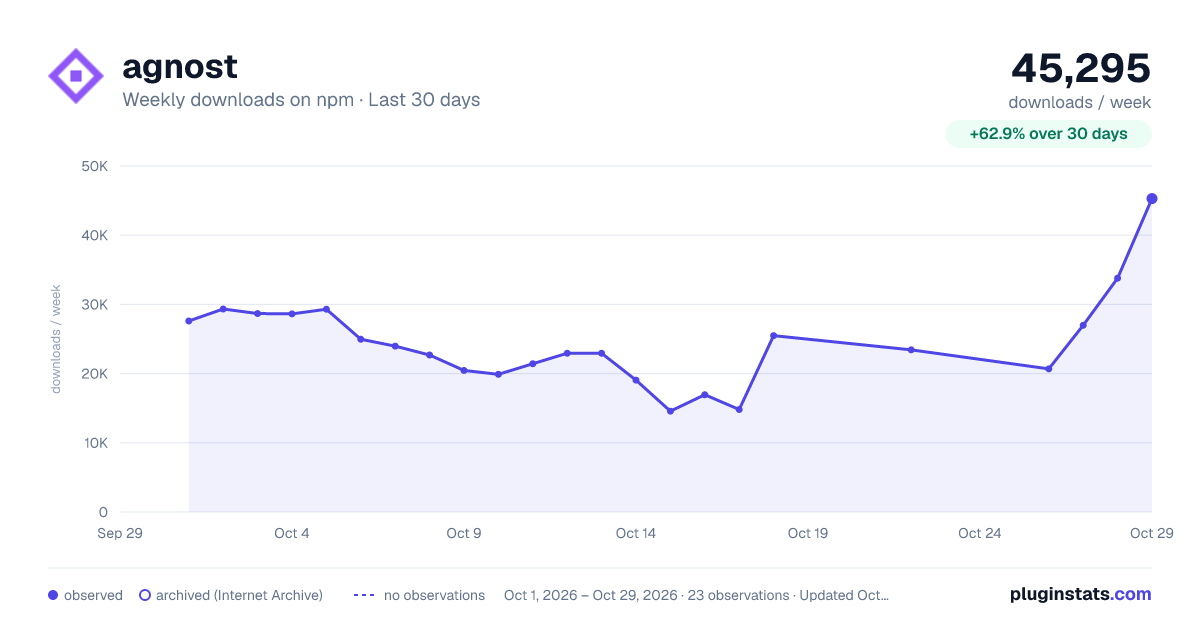
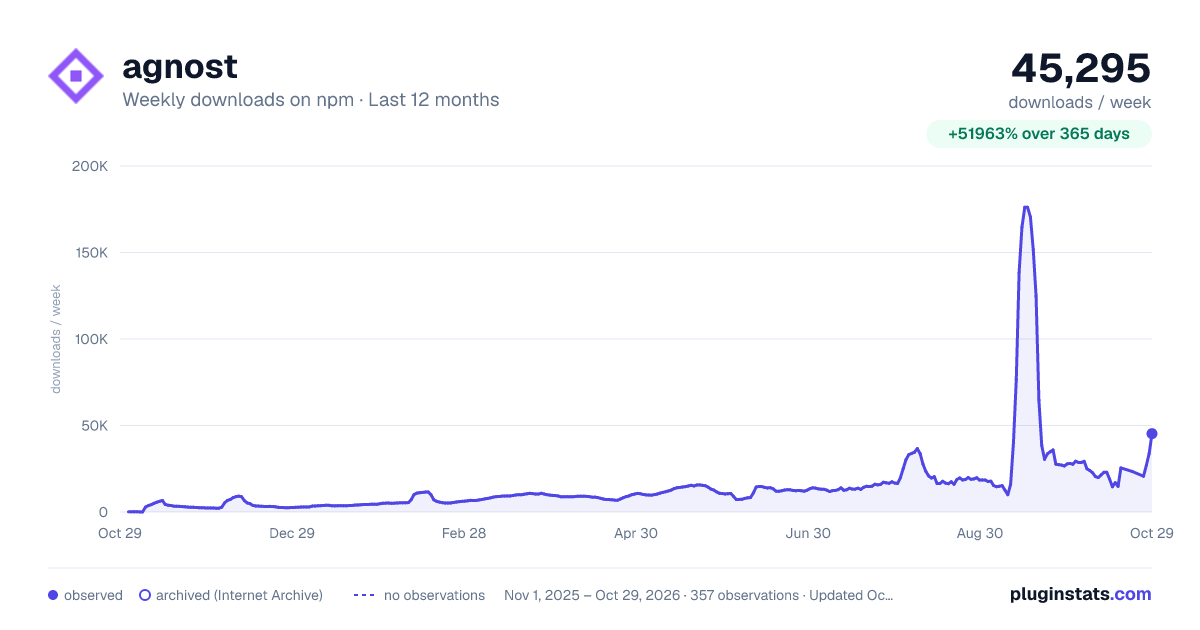
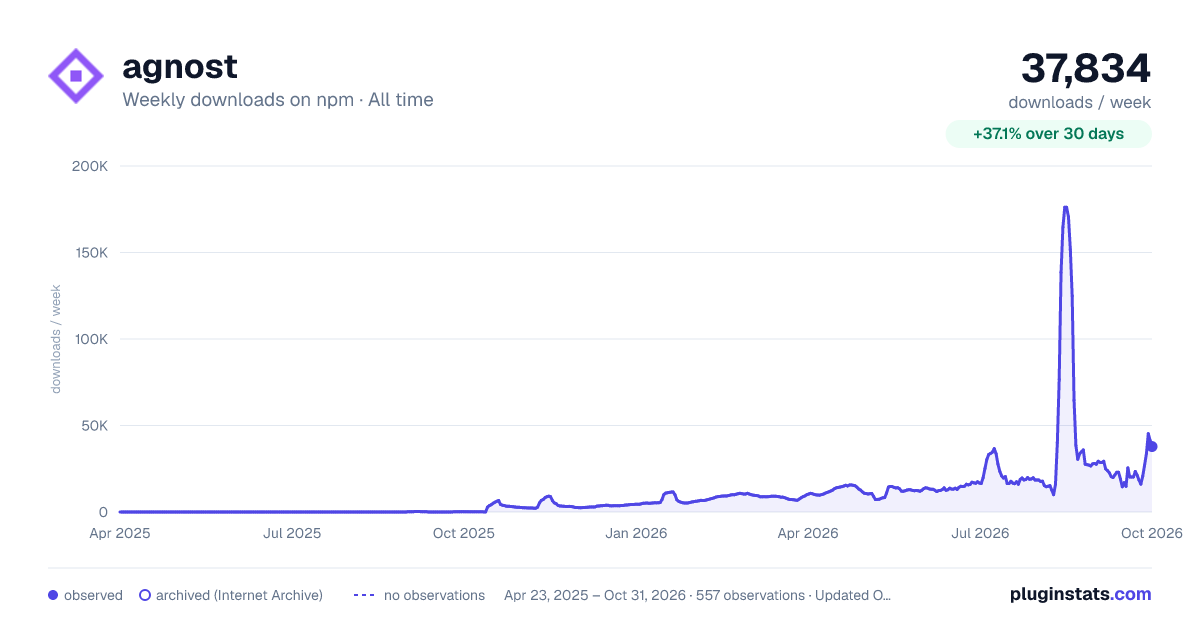

Adoption over time


7/30/90-day growth


Filled points are observed values; hollow points come from Internet Archive snapshots of the listing page. Dashed segments span periods with no observations — values between points are not interpolated.
Recent observations
Full history (543)Similar npm MCP servers plugins
Data source
Weekly downloads (trailing 7 complete days) come from the official npm downloads API. Downloads include CI and mirrors and are not equivalent to installs or users. npm publishes no ratings.
Listing: https://www.npmjs.com/package/agnost. First seen Oct 16, 2026; last successful collection Oct 19, 2026. See the methodology.