 PluginStats
@hypequery/mcp weekly downloads statistics
By hypequery · npm · MCP servers
Governed ClickHouse MCP server for semantic metrics, datasets, Claude, Cursor, and AI agents
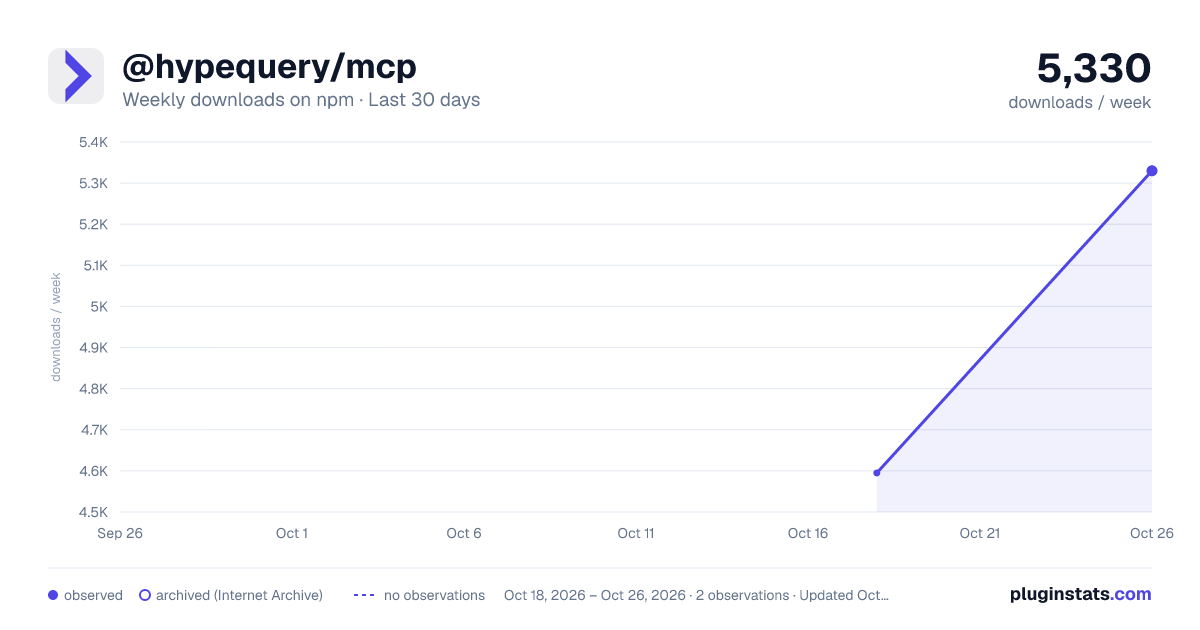
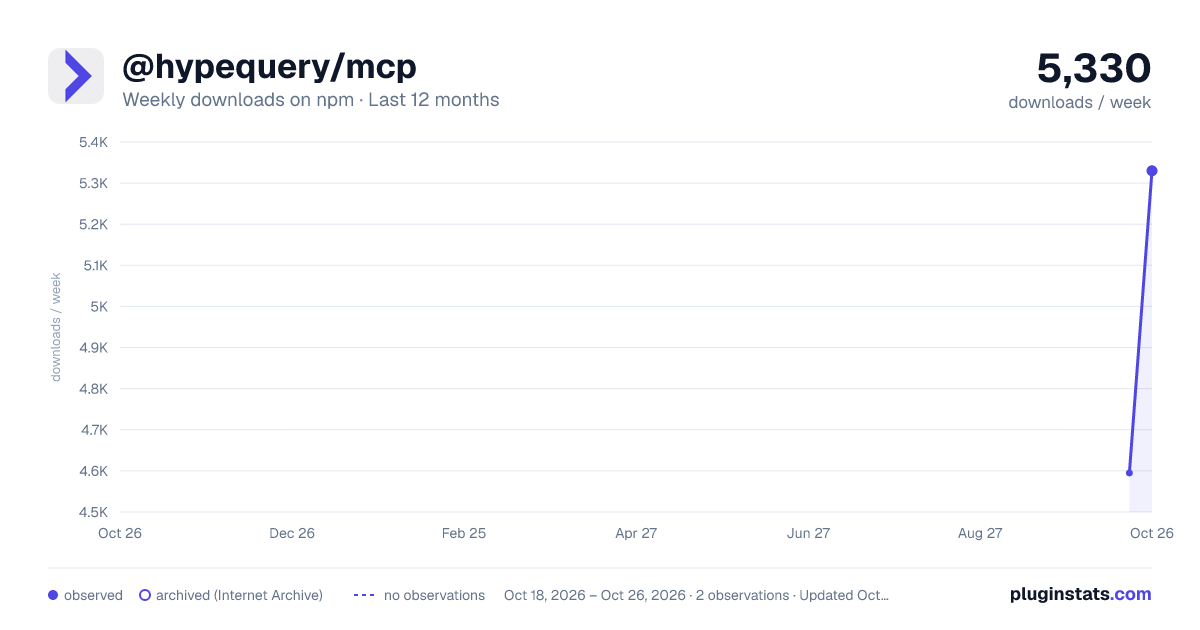
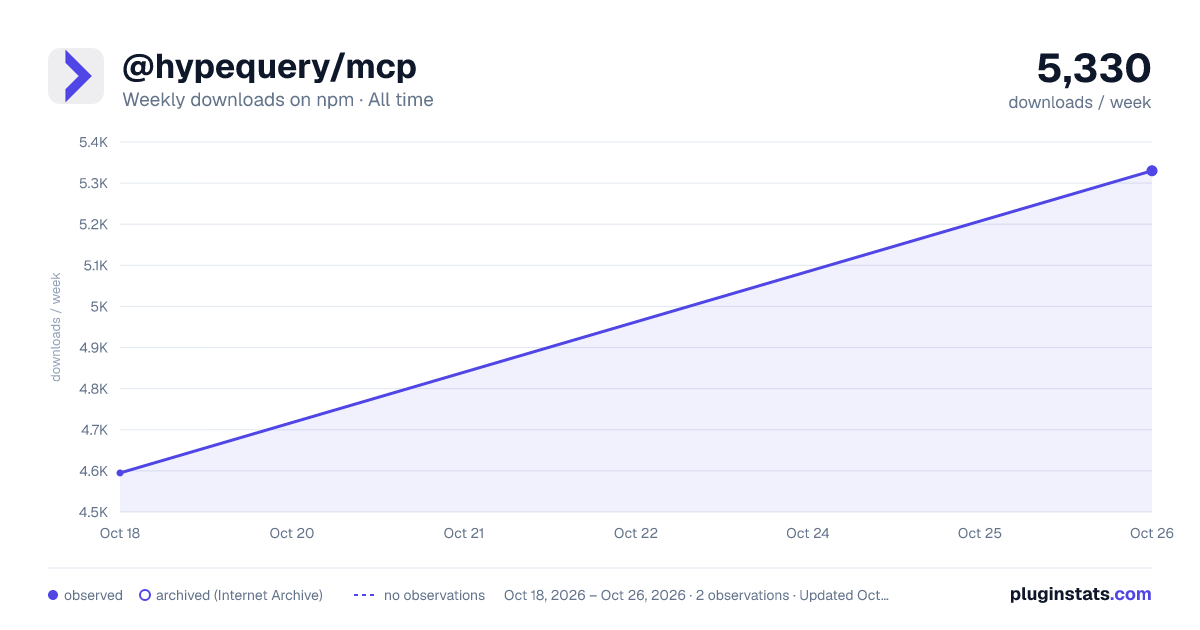
@hypequery/mcp has 4,595 recorded weekly downloads on npm, ranking #1158 of 2,322 tracked listings.
About @hypequery/mcp
@hypequery/mcp
A governed ClickHouse MCP server for AI agents.
@hypequery/mcp turns your hypequery datasets and metrics into Model Context Protocol tools for Claude, Cursor, and other MCP clients. Agents can discover and query approved analytics without receiving unrestricted SQL access or database credentials.
Install
npm install @hypequery/mcp @hypequery/datasets @hypequery/clickhouse
Expose your semantic layer
// mcp-config.ts
import { publishDatasets } from '@hypequery/datasets';

export const datasets = publishDatasets()
  .publish(Orders, { metrics: { revenue } })
  .build();

export const analytics = createDatasetClient({ queryBuilder: db });
Compile the config, then start the stdio server:
npx hypequery-mcp --config /absolute/path/to/mcp-config.js
Add it to an MCP client:
{
  "mcpServers": {
    "hypequery-clickhouse": {
      "command": "npx",
      "args": [
        "hypequery-mcp",
        "--config",
        "/absolute/path/to/mcp-config.js"
      ]
    }
  }
}
Now an agent can ask, “Show revenue by region for the last month,” using the same metric definition as your backend and dashboard.
Tools agents receive
list_datasetsdiscovers available analytics models;get_dataset_schemaexplains dimensions, measures, metrics, and relationships;query_metricexecutes named KPIs;query_datasetexplores the fields you chose to publish.
Every tool declares an output schema and returns the same result twice: MCP
structuredContent for clients that support typed results, and compact JSON in
the text content block for compatibility. Query metadata includes row count,
timing when available, pagination state, and cache outcome. Tools also advertise
human-readable titles and read-only, non-destructive, idempotent annotations.
Tool failures use a stable structured envelope:
{
  "error": {
    "code": "MCP_INVALID_ARGUMENTS",
    "category": "correctable_input",
    "message": "Invalid query_dataset arguments: ...",
    "retryable": false,
    "correctable": true
  }
}
Unclassified backend failures are redacted to MCP_EXECUTION_FAILED; database
error details and physical SQL are not copied into agent-facing errors.
Safer than raw SQL access
- Tool schemas come from your TypeScript semantic layer.
- Advertised schemas and runtime validation use the same canonical catalog compiler and deterministic manifest hash.
- Filters, fields, ordering, and limits are validated.
- ClickHouse credentials remain in the server process.
- SQL text stays hidden by default.
- Tenant identity comes from trusted host configuration, never the prompt.
For tenant-scoped datasets, run the server programmatically with the trusted tenant ID:
await createMCPServer({
  datasets,
  analytics,
  name: 'acme-analytics',
  version: '1.0.0',
  tenantId: session.accountId,
  queryLimits: {
    defaultResultSize: 100,
    maxResultSize: 1_000,
    maxOffset: 10_000,
  },
  executionBudget: {
    timeoutMs: 30_000,
    maxResponseBytes: 1_048_576,
  },
});
Every query receives a server-side limit even when the agent omits one. The effective ceiling is the lowest applicable server or Dataset limit. Dimensions, measures, filters, ordering, and pagination offsets also have hard package ceilings that server configuration may lower but cannot raise.
Query calls also have a hard wall-clock deadline and UTF-8 response-byte
ceiling. Client cancellation and local deadlines propagate through the semantic
client to the backing ClickHouse request. Budget failures use the stable
MCP_REQUEST_CANCELLED, MCP_QUERY_TIMEOUT, and MCP_RESULT_TOO_LARGE
classifications.
Embed in another MCP transport
The semantic executor is independent of stdio and network lifecycle. A hosted gateway can inject its own MCP transport without reimplementing Hypequery's tools, prompts, catalog schemas, or validation:
import {
  createMCPExecutor,
  createMCPProtocolServer,
} from '@hypequery/mcp';

const executor = createMCPExecutor({
  datasets,
  analytics,
  tenantId: trustedPrincipal.tenantId,
});

const server = createMCPProtocolServer({
  executor,
  name: 'acme-hosted-analytics',
  version: '1.0.0',
});

await server.connect(hostTransport);
hostTransport can be an MCP SDK in-memory, stdio, or hosted transport. This
package does not create an HTTP endpoint; authentication, routing, and network
lifecycle remain responsibilities of the host. For an explicit local adapter,
use startStdioMCPServer(config). The existing createMCPServer(config) and
HypequeryMCPServer.start() APIs remain available for compatibility.
Learn more
License
Apache-2.0.
Description from the npm listing.
- mcp
- model-context-protocol
- clickhouse
- semantic-layer
- analytics
- query-builder
- orm
- ai-agents
- claude
- cursor
- typescript
README badge
Show your rank in a README or on your website. The badge updates automatically.
Charts
Images: 30d · 1y · all time · 1600×900 dark

Adoption over time
7/30/90-day growth
Ranking history
Listing placement
Listing placement
Filled points are observed values; hollow points come from Internet Archive snapshots of the listing page. Dashed segments span periods with no observations — values between points are not interpolated.
Each band is one page of 20. Weekly downloads on a linear scale. Placement is projected from weekly downloads, so it can differ from the marketplace's own sort order. Hover a dot to see the listing.
Recent observations
Full history (1)Similar npm MCP servers plugins
All 20 @hypequery/mcp alternativesData source
Weekly downloads (trailing 7 complete days) come from the official npm downloads API. Downloads include CI and mirrors and are not equivalent to installs or users. npm publishes no ratings.
Listing: https://www.npmjs.com/package/@hypequery/mcp. First seen Oct 20, 2026; last successful collection Oct 20, 2026. See the methodology.