 PluginStats
mindforge-cc weekly downloads statistics
By sairam0424 · npm · Claude Code
Agentic intelligence framework for Claude Code and Antigravity: slash commands, subagents, skills, hooks, governance, memory, and cost-aware model routing for AI-driven development.
mindforge-cc has 690 recorded weekly downloads on npm, an increase of 159% over the past 30 days.
It ranks #1458 of 2,256 tracked npm listings by weekly downloads.
Over 90 days, weekly downloads changed by +113%.
PluginStats has 543 daily observations since Apr 23, 2025; the latest is from Oct 17, 2026.
About mindforge-cc
MindForge
A governance and orchestration layer for Claude Code (and Antigravity, Cursor, Copilot, Gemini, OpenCode).
Claude Code alone runs one agent in one context. MindForge adds the parts that don't fit in a single context window: skills that auto-load by trigger, personas you can call by name, a wave-based executor that fans work out to fresh-context subagents and commits per task, a tamper-evident audit chain, and cost-aware routing across providers. Install it once and get /mindforge:plan-phase → /mindforge:execute-phase → /mindforge:verify-phase → /mindforge:ship as your actual working loop, not a slogan.
221 commands · 354 skills · 216 personas · 164 subagents · 35 workflows
Jump to: Latest release · What you get · What is actually enforced · Install · Verify · Quick start (new) · Quick start (existing) · How it fits together · Documentation · Core workflow · Dynamic workflows · Updates · Token usage · License
What you get
| | Capability | Detail |
| 🧩 | 221 slash commands | /mindforge:plan-phase, /mindforge:execute-phase, /mindforge:ship, and 218 more — full reference | | 🛠️ | 354 skills | 232 auto-triggered by keyword match (engine tier) + 122 explicit, invoked by name (extended tier) | | 🎭 | 216 personas | In-session role overlays via /mindforge:agent — same context, different behavioral spec | | 🤖 | 164 subagents | Genuine isolated-context Claude-Code-native subagent definitions — a separate mechanism from personas, see docs/PERSONAS.md; 152 adapted from VoltAgent's awesome-claude-code-subagents (MIT), attribution in subagents/README.md | | 🔀 | 35 dynamic workflows | Multi-agent fan-out scripts across 5 tiers (Research, Dev, Ops, Intelligence, Beast) — workflow atlas | | 🔒 | Tamper-evident audit chain | SHA-256 hash-linked .planning/AUDIT.jsonl; verify independently with node bin/verify-audit.js | | 🔍 | Multi-model cross-review + decision council | Two-model adversarial PR review (/mindforge:pr-review) and a 4-voice consensus council (/mindforge:council) — bin/review/, bin/engine/council-runtime.js | | 💸 | Cost-aware model routing | Anthropic / OpenAI / Gemini / Bedrock / Ollama, routed by task difficulty tier | | 🧠 | Local-first knowledge graph | Zero-native-dependency SQLite (sql.js / WASM) — no native build step | | 📊 | Live dashboard | Express + SSE at localhost:7339 |
Ships three ways: an npm package (npx mindforge-cc@latest), a Claude Code plugin marketplace entry, and an MCP server.
What is actually enforced
Read this before you rely on anything below blocking a bad command. MindForge ships a large corpus of agent instructions — commands, skills, personas, protocols — and those are advisory: they work by being in the model's context, and a model can decline them. The parts that would *block* an action are hooks. Through 11.9.2 no channel registered them. 11.9.3 added the registration code but it declined to run on almost every project, so in practice nothing was enforced there either. As of 11.9.4 both channels register and execute them on Claude Code, and nowhere else.
| Capability | Plugin channel | npx channel |
| Slash commands | Yes | Yes | | Skills / personas / protocol docs | Yes | Yes | | Subagents | Yes | Yes | | Audit hash-chain (bin/verify-audit.js) | Yes | Yes | | Hooks enforced (can block a tool call) | Claude Code only | Claude Code + --local only |
What that means, measured rather than asserted:
• The npx channel generates the config it never used to ship. files[] has 53 entries and none of them contains settings, so no settings file is *published* — instead bin/installer/hook-registration.js writes one at install time, merging append-only into any file you already have. Measured on a confined install: 8 hooks registered into .claude/settings.json, of which the installer's own preflight **executed 7 and verified all 3 deny-class hooks returning exit 2** before keeping the file. A preflight failure rolls the registration back rather than leaving a config whose commands do not run. • The plugin channel's dispatcher runs. It previously crashed on every fire — run-with-flags.js requires ./lib/hook-flags and plugins/mindforge/scripts/lib/ was not copied in. That directory now exists, all 14 path tokens in plugins/mindforge/hooks/hooks.json resolve under the plugin root, and driving the dispatcher by hand returns exit 2 for mindforge-block-no-verify and mindforge-config-protection.
[!WARNING] Still not enforced, deliberately and with a printed reason for each: any runtime other than Claude Code (Cursor, Copilot, Gemini/Antigravity, OpenCode), --global scope, a self-install inside a MindForge checkout, and Windows. Writing a Claude-schema config into .cursor/ without an execution-verified hook contract would be decorative. Every outcome, including "not registered", is printed by the installer and written to .mindforge/hook-registration.json.
Three things gate whether a registered hook is *live*, none of them in MindForge's control: the harness must be restarted (hooks are snapshotted at session start), the project must be trusted in the harness, and CLAUDE_PROJECT_DIR must be set with node on the hook PATH — if it is not, the commands exit 1 and the gate is simply absent, which is a deliberate trade against a fail-closed tail that was measured denying benign commands on a fresh clone. See *Hooks are installed but nothing is blocked* in docs/troubleshooting.md.
So: on Claude Code, treat MindForge as a policy enforcement point for the 8 registered hooks plus a tamper-evident audit log; on every other harness, as governance-by-convention plus that same audit log. Installing it also expands your repository's trust boundary by a large volume of agent instructions — review what you install. The audit chain is verifiable today (node bin/verify-audit.js).
Install
Pick whichever matches how you work — all of these are real, live channels.…
Description from the npm listing.
- claude-code
- antigravity
- agentic-framework
- context-engineering
- enterprise
- mindforge
- wasm-sqlite
- zero-native-deps
- agent-orchestration
- ai-agents
- llm-tools
- developer-tools
- mcp-server
Charts
Images: 30d · 1y · all time · 1600×900 dark
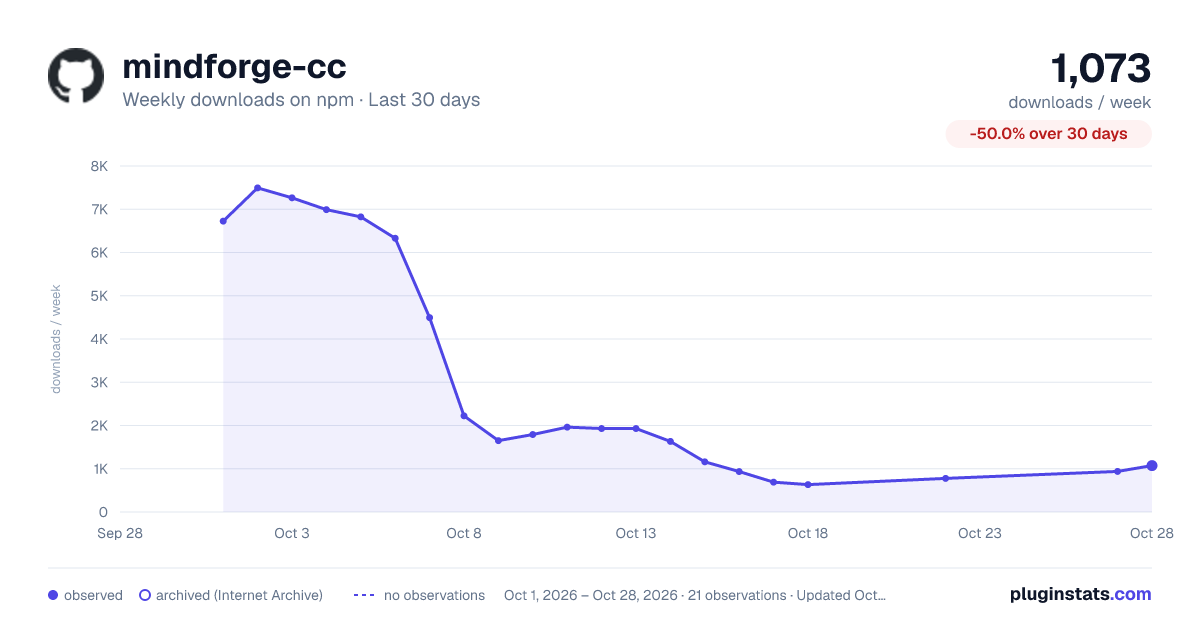
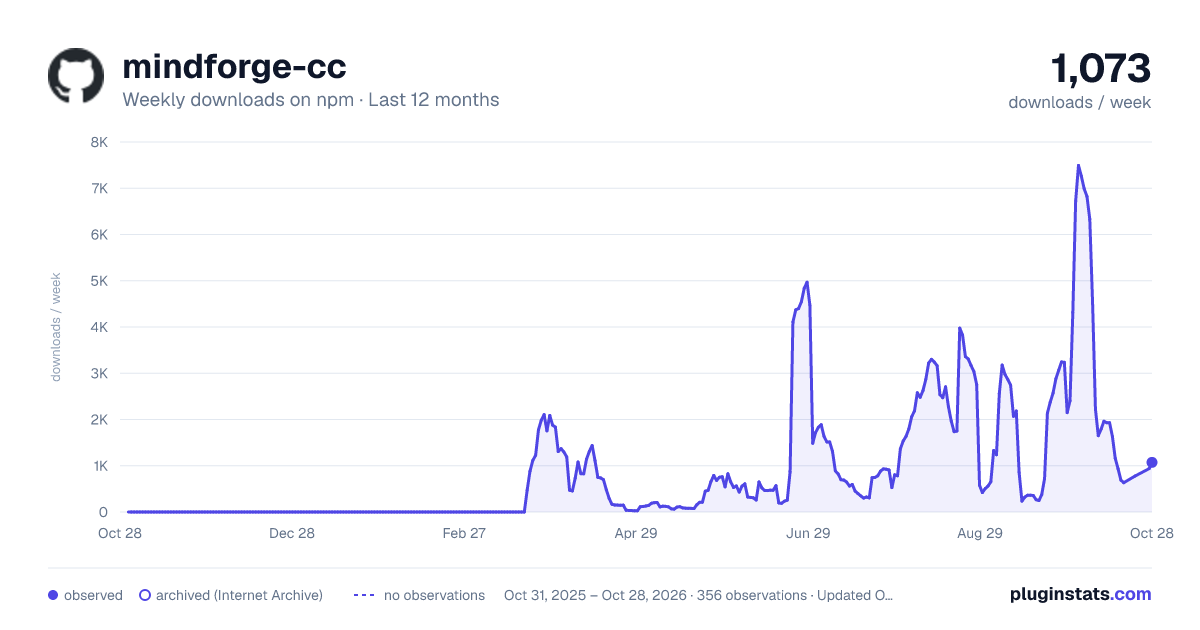
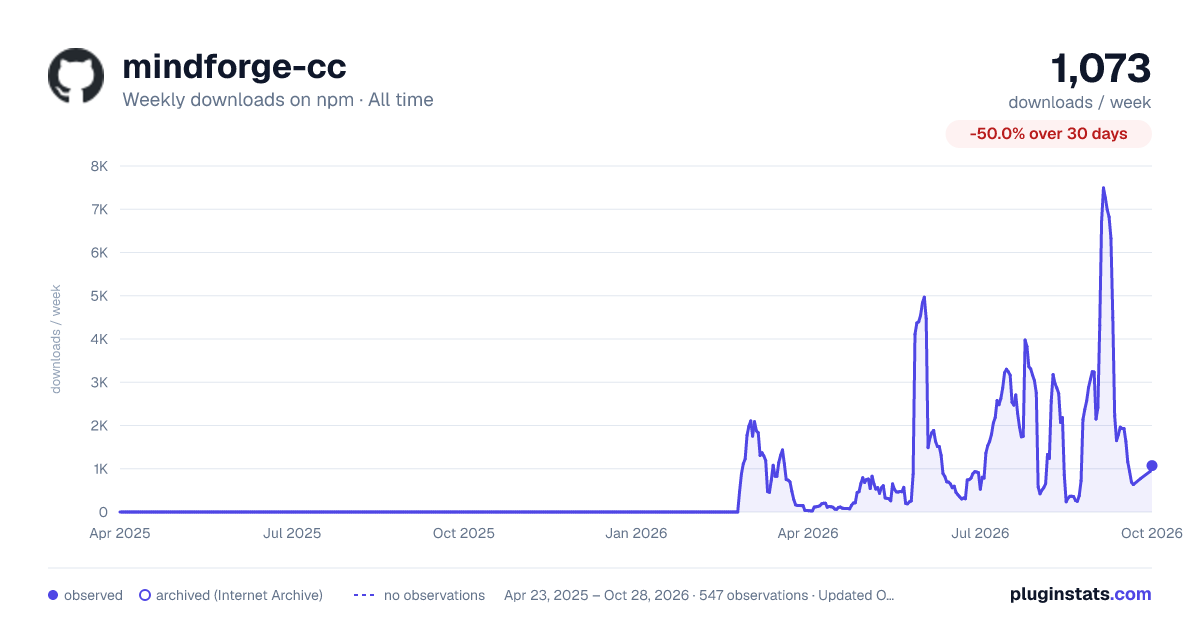

Adoption over time


7/30/90-day growth


Listing placement


Filled points are observed values; hollow points come from Internet Archive snapshots of the listing page. Dashed segments span periods with no observations — values between points are not interpolated.
Each band is one page of 20. Weekly downloads on a log scale. Placement is projected from weekly downloads, so it can differ from the marketplace's own sort order. Hover a dot to see the listing.
Recent observations
Full history (543)Similar npm Claude Code plugins
All 20 mindforge-cc alternativesData source
Weekly downloads (trailing 7 complete days) come from the official npm downloads API. Downloads include CI and mirrors and are not equivalent to installs or users. npm publishes no ratings.
Listing: https://www.npmjs.com/package/mindforge-cc. First seen Oct 16, 2026; last successful collection Oct 19, 2026. See the methodology.