 PluginStats
@gnldev/queue has 406 recorded weekly downloads on npm, ranking #1581 of 2,322 tracked listings.
About @gnldev/queue
@gnldev/queue
Durable background-task queue + worker on top of the journal. Each job runs as a durable run → if the process crashes mid-job it resumes from the journal, and a side effect already recorded as done is not run again (at-most-once). acquireRunLock keeps two workers off the same job at once: a worker whose process is frozen (a GC pause, a VM migration, SIGSTOP) keeps its job however long, and a worker whose process died loses it at once. The process is asked through the storage's process liveness (SqliteStorage/PostgresStorage answer for themselves); without one, the lease's TTL decides.
Install:
pnpm add @gnldev/queue— or use it from a repo clone:pnpm install && pnpm -r build.
npm i @gnldev/queue # peer: @gnldev/durable
import { enqueue, createWorker } from '@gnldev/queue';
import { SqliteStorage } from '@gnldev/durable/sqlite';

const storage = new SqliteStorage('runs.db');

// Producer: idempotent enqueue (same id → single job). Takes the WORK store, not the run journal.
await enqueue(storage.work, 'send-email', { to: 'a@x.com' }, { id: 'email:order-1' });

// Consumer: retried on handler crashes (dead-letter after maxAttempts). Takes the whole storage —
// it needs the work store to lock jobs and the run journal to keep the side effect at-most-once.
const worker = createWorker(storage, {
  // A bare `await sendEmail(...)` here is AT-LEAST-once: a crash after the send but before the
  // job is acked reclaims the lock and calls the handler again. Route it through the job's durable
  // run (`ctx.run`, a runDurable on a stable runId), and the send happens once.
  'send-email': async (payload, ctx) => ctx.run({ model, tools, prompt: '...' }),
});
await worker.runOnce();   // or worker.start() (poll loop)
One queue: enqueue here, run here
createQueue is the two calls above in one: the handlers, and a worker that runs them, started in this process. Pass worker: false when the workers run elsewhere.
import { createQueue } from '@gnldev/queue';
import { SqliteStorage } from '@gnldev/durable/sqlite';
const storage = new SqliteStorage('runs.db');

const queue = createQueue(storage, { 'send-email': async (payload, ctx) => { /* ... */ } });
await queue.enqueue('send-email', { to: 'a@x.com' }, { id: 'email:order-1' });
// on shutdown: await queue.close();
A job still waiting after NO_WORKER_NOTICE_MS (10 s) with no worker polling its store is reported once per type (console.warn): enqueued where nothing consumes it, it would otherwise wait without a word.
Delays, retries, cancelling, concurrency
import { enqueue, createWorker, cancelJob } from '@gnldev/queue';
import { InMemoryStorage } from '@gnldev/durable';
declare function sendReminder(p: unknown, signal: AbortSignal): Promise<void>;
const storage = new InMemoryStorage();

// Not before a time (epoch ms or a Date). Stored in the job record, so it survives restarts.
const id = await enqueue(storage.work!, 'remind', { to: 'a' }, { runAt: Date.now() + 60 * 60_000 });

// Changed your mind: no worker starts it after this returns true.
await cancelJob(storage.work!, id);

createWorker(storage, { remind: async (p, ctx) => sendReminder(p, ctx.signal) }, {
  retryDelayMs: (attempt) => 1_000 * 2 ** (attempt - 1), // 1s, 2s, 4s… between failed attempts
  concurrency: 4, // this worker runs up to 4 jobs at once
  typeConcurrency: { remind: 2 }, // at most 2 `remind` jobs at once across ALL workers
});
retryDelayMs(number or(attempt, err) => ms, default 0): after a failed attempt the job may not run again beforenow + delay. The time is stored with the job (qtry:<id>), so every worker honours it, also after a restart. The last attempt dead-letters without waiting.- Attempts are counted when they start, so an attempt the process died in counts too: a handler that
takes its worker down every time is dead-lettered after
maxAttemptsstarts, not started forever.listJobs()reports attempts started (a job done on its first try shows 1). runAt: compared with the run journal's clock when it has one (now()), else the worker's. A waiting job does not hold up the jobs behind it. Re-enqueuing the same id keeps the firstrunAt.cancelJob(work, id)→trueif it cancelled the job,falsefor an unknown or already finished one. A job that is running is not killed: itsctx.signalaborts on the worker's next heartbeat tick (ttlMs/3; never withheartbeat: false), andctx.runpasses that signal on. If the handler finishes anyway the job showsdone; otherwisecancelled.retryJobdoes not take a cancelled job.concurrency(default 1): that many independent poll loops in one worker, afterstart().runOnce/drainstill run one job per call, anddrainruns only what is eligible now.typeConcurrency: a per-type limit for the whole fleet, kept as that many leases in the run journal. A dead worker's slot frees afterttlMs. Give every worker the same numbers.listJobsshowsstatus: 'cancelled'and, for a job that is waiting,notBefore.- During a rolling deploy, a 0.9 worker on the same storage ignores
runAt, retry delays and cancels.
Jobs for an end user
A job can say whose it is. The job's run belongs to that owner, and the handler does not pass it on:
ctx.run starts the run as the owner.
import { enqueue, createWorker } from '@gnldev/queue';
import { InMemoryStorage, user } from '@gnldev/durable';
declare const model: import('@ai-sdk/provider').LanguageModelV4;

const storage = new InMemoryStorage();
await enqueue(storage.work!, 'weekly-summary', { week: 39 }, { caller: user('ayse', 'acme') });
// the same job, in the shorthand: { resourceId: 'ayse', orgId: 'acme' }…
Description from the npm listing.
- ai
- agent
- llm
- typescript
- ai-sdk
- durable
- exactly-once
- jobs
- worker
- background-jobs
README badge
Show your rank in a README or on your website. The badge updates automatically.
Charts
Images: 30d · 1y · all time · 1600×900 dark
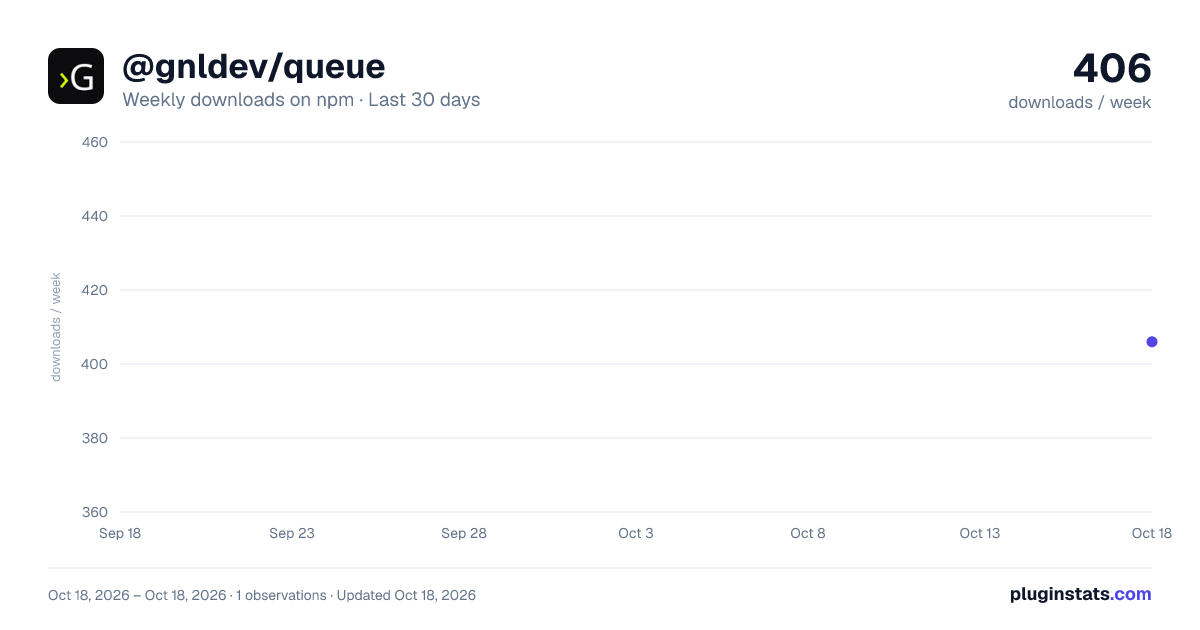
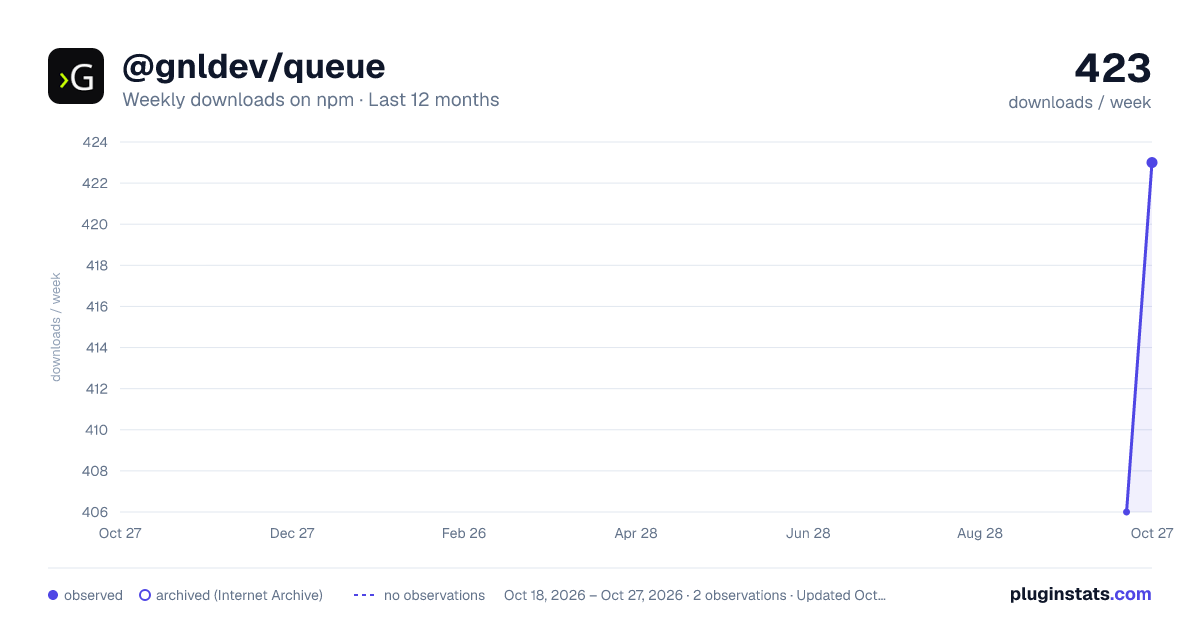
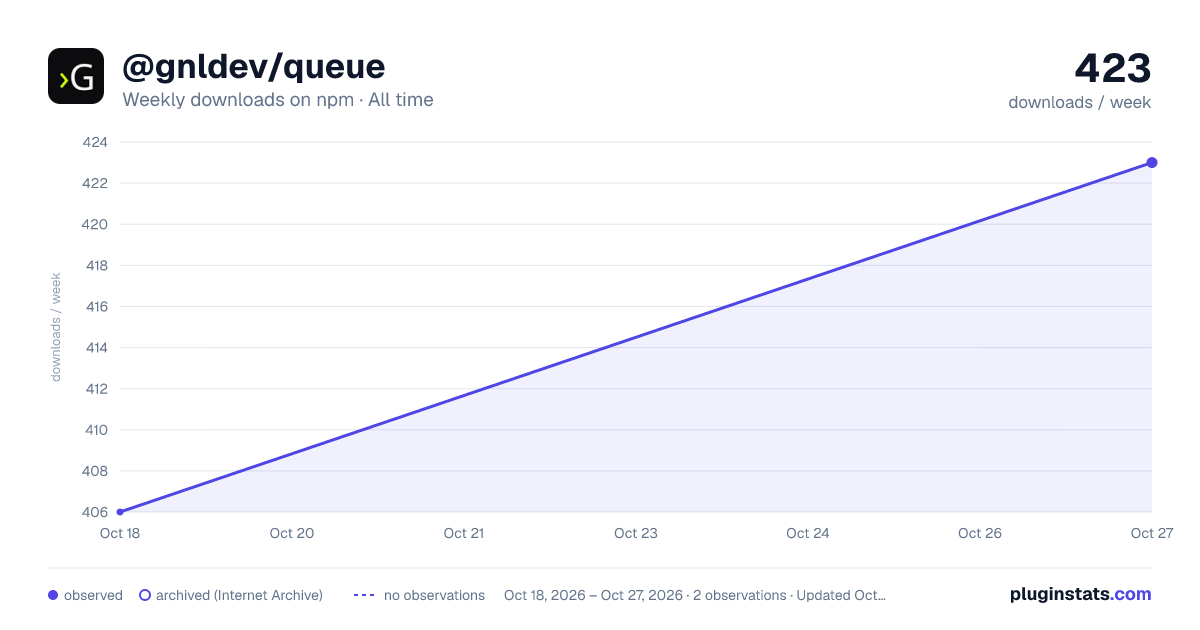

Adoption over time
7/30/90-day growth
Ranking history
Listing placement
Listing placement
Filled points are observed values; hollow points come from Internet Archive snapshots of the listing page. Dashed segments span periods with no observations — values between points are not interpolated.
Each band is one page of 20. Weekly downloads on a linear scale. Placement is projected from weekly downloads, so it can differ from the marketplace's own sort order. Hover a dot to see the listing.
Recent observations
Full history (1)Similar npm AI SDKs plugins
All 20 @gnldev/queue alternativesData source
Weekly downloads (trailing 7 complete days) come from the official npm downloads API. Downloads include CI and mirrors and are not equivalent to installs or users. npm publishes no ratings.
Listing: https://www.npmjs.com/package/@gnldev/queue. First seen Oct 20, 2026; last successful collection Oct 20, 2026. See the methodology.