 PluginStats
@gnldev/tool-schema has 378 recorded weekly downloads on npm, ranking #1593 of 2,322 tracked listings.
About @gnldev/tool-schema
@gnldev/tool-schema
Tool schemas that one provider accepts and another rejects, smoothed over.
The same JSON Schema does not travel cleanly between OpenAI, Gemini and Anthropic: one rejects
format on strings, another dislikes certain nested constructs. This package rewrites a tool's
schema for the model actually being called.
Install
Install:
pnpm add @gnldev/tool-schema— or use it from a repo clone:pnpm install && pnpm -r build.
npm i @gnldev/tool-schema
Use
It is opt-in from @gnldev/durable:
import { defaultRules } from '@gnldev/tool-schema';

const gnl = createGnl({ ...config, schemaCompat: defaultRules });
// or per call: runDurable({ runId, journal, model, tools, schemaCompat: true, prompt })
Or directly:
import { applyToolCompat, detectModel, defaultRules } from '@gnldev/tool-schema';

const safe = applyToolCompat(tools, detectModel(modelId), defaultRules);
Exports
| Export | What it is |
|---|---|
detectModel | Model id → which provider family it belongs to |
applyToolCompat | Applies the matching rules to a tool set |
shapeToolDefinitions | The same rules on the AI SDK's converted tool list, for a model chosen at call time (what @gnldev/durable uses per fallback candidate) |
chainToolCompat | Both halves for a model chosen at call time: shape (per candidate) and tools whose validators read an invited null back through what that candidate was sent |
ToolSchemaError | A rule's refusal (e.g. strict: true with an open object under OpenAI); it propagates instead of skipping the rule |
defaultRules | The bundled rule set (OpenAI / Gemini / Anthropic) |
ToolSchemaRule | The rule interface — add your own for a provider not covered here. transform(schema, model, ctx): a rule that widens a node to accept null as "not supplied" calls ctx.nullMeansAbsent(node) |
Rules are ordinary objects, so a provider the default set does not know about is a rule you write rather than a fork you maintain.
What the model is told changes; what the tool accepts does not
The rules rewrite the schema sent to the model. The tool still validates with its own schema:
zod checks, .default() and .transform() run as they do without this package, so execute receives
the same value with compat on or off, and invalid input never reaches it. A tool given as jsonSchema()
without a validate stays unvalidated, as it was.
One thing the OpenAI rule changes that you will see
OpenAI's strict mode has no notion of an optional property: every key of an object must be listed in
required. So the rule lists them all — and widens the ones that were optional to also accept
null, which is the only way strict mode can express "not supplied":
z.object({ to: z.string(), cc: z.string().optional() })
→  required: ["to", "cc"],  cc: { type: ["string", "null"] }
Without the second half the parameter is silently promoted to mandatory. Under strict: true the
model then has no way to leave it out; without strict, required is still what it is told the tool
wants. Keys that were genuinely required are left alone.
When the model takes up that offer and sends cc: null, the tool reads it as cc left out: a null
at a key your schema does not require, and does not allow to be null, is removed before your
validator runs. A field you declared .nullable() keeps its null; a null at a required key is
still an error. The reading comes from the rule's own record of the nodes it widened, read off the
schema that rule returned (a snapshot taken before any later rule runs), so it holds inside unions (a
z.discriminatedUnion, a z.union of objects, arrays of either), for a rule of your own that records
through ctx.nullMeansAbsent, and whatever the rules after it do — the gemini rule on an
OpenAI-compatible Gemini endpoint, or a rule of yours that rebuilds or clones nodes.
An object you declared open (z.record, .catchall(), z.looseObject) stays open; every other
object gets additionalProperties: false. OpenAI accepts an open object on any tool that does not set
strict: true. Under strict: true OpenAI refuses one, so the rule throws a ToolSchemaError before
the model is called: declare the keys with z.object, or drop strict from the tool.
An enum gets null added to its values too, and a const is wrapped in anyOf rather than
widened in place — in both cases changing only type would leave a node whose type admits null
while its value constraint forbids it, which nothing can satisfy.
License
Apache-2.0 — see LICENSE.
Description from the npm listing.
- ai
- agent
- llm
- typescript
- ai-sdk
- durable
- exactly-once
- json-schema
- provider-compatibility
README badge
Show your rank in a README or on your website. The badge updates automatically.
Charts
Images: 30d · 1y · all time · 1600×900 dark
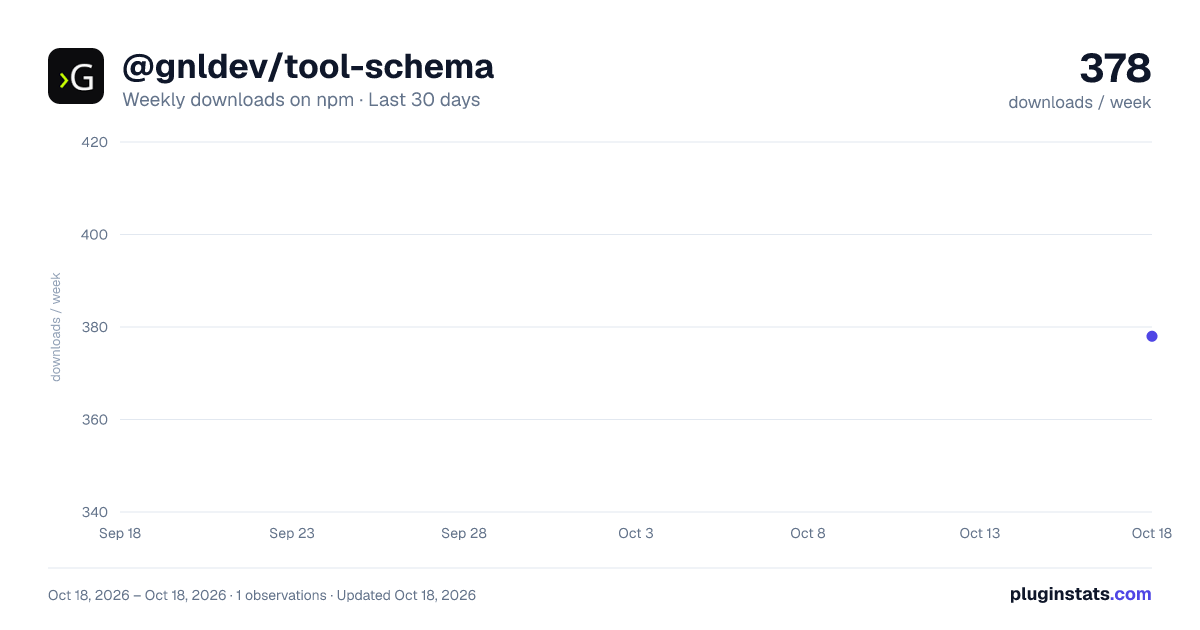
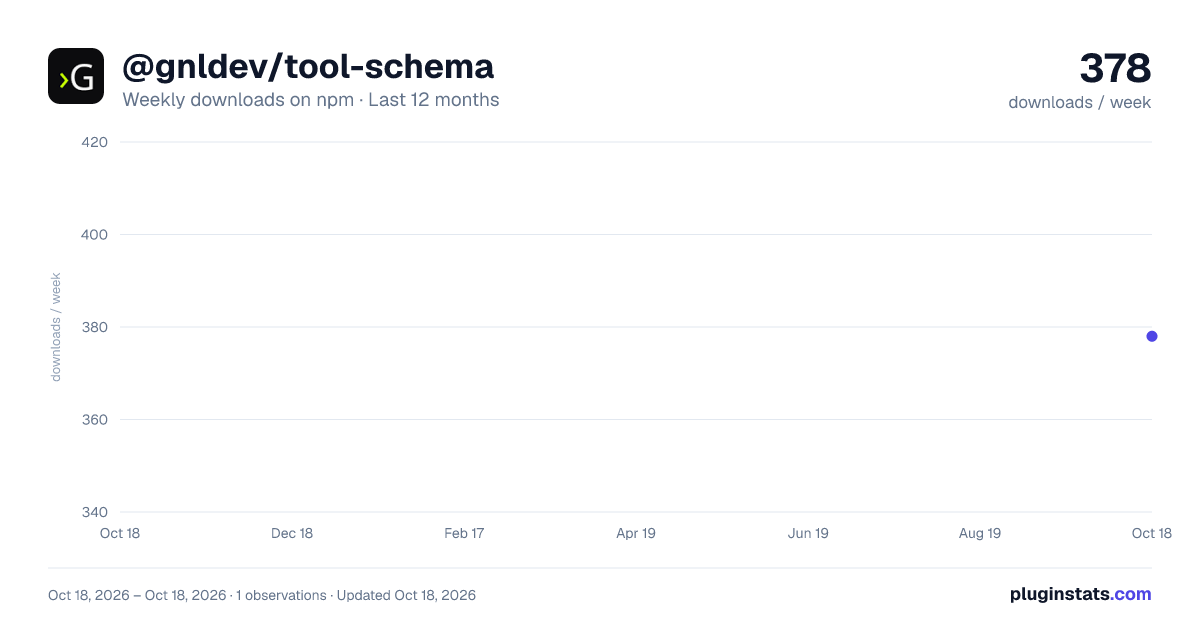
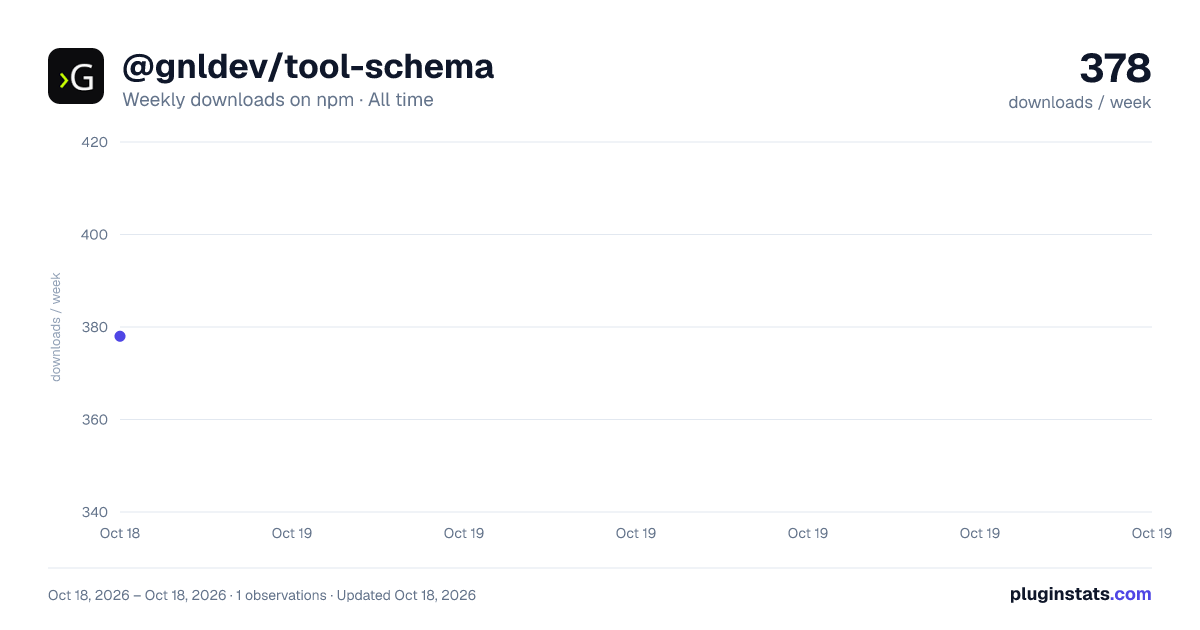

Adoption over time
7/30/90-day growth
Ranking history
Listing placement
Listing placement
Filled points are observed values; hollow points come from Internet Archive snapshots of the listing page. Dashed segments span periods with no observations — values between points are not interpolated.
Each band is one page of 20. Weekly downloads on a linear scale. Placement is projected from weekly downloads, so it can differ from the marketplace's own sort order. Hover a dot to see the listing.
Recent observations
Full history (1)Similar npm AI SDKs plugins
All 20 @gnldev/tool-schema alternativesData source
Weekly downloads (trailing 7 complete days) come from the official npm downloads API. Downloads include CI and mirrors and are not equivalent to installs or users. npm publishes no ratings.
Listing: https://www.npmjs.com/package/@gnldev/tool-schema. First seen Oct 20, 2026; last successful collection Oct 20, 2026. See the methodology.