 PluginStats
vite-plugin-entry-shaking weekly downloads statistics
By Dschungelabenteuer (2 listings) · npm · Vite plugins
Mimic tree-shaking behaviour when importing code from an entry file in development mode.
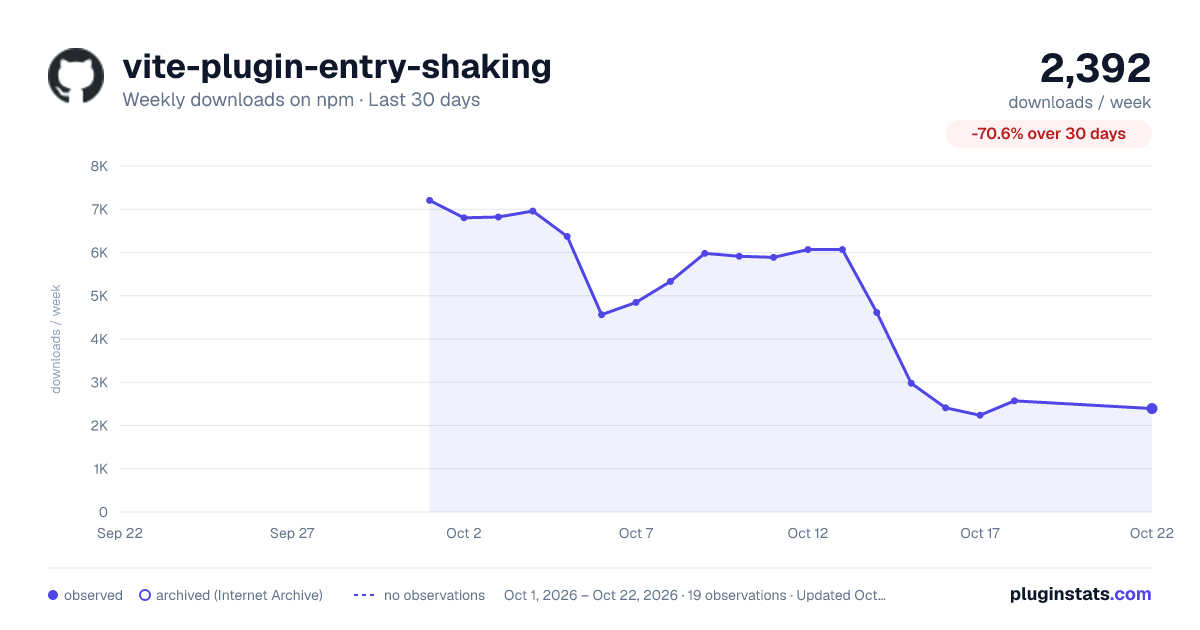
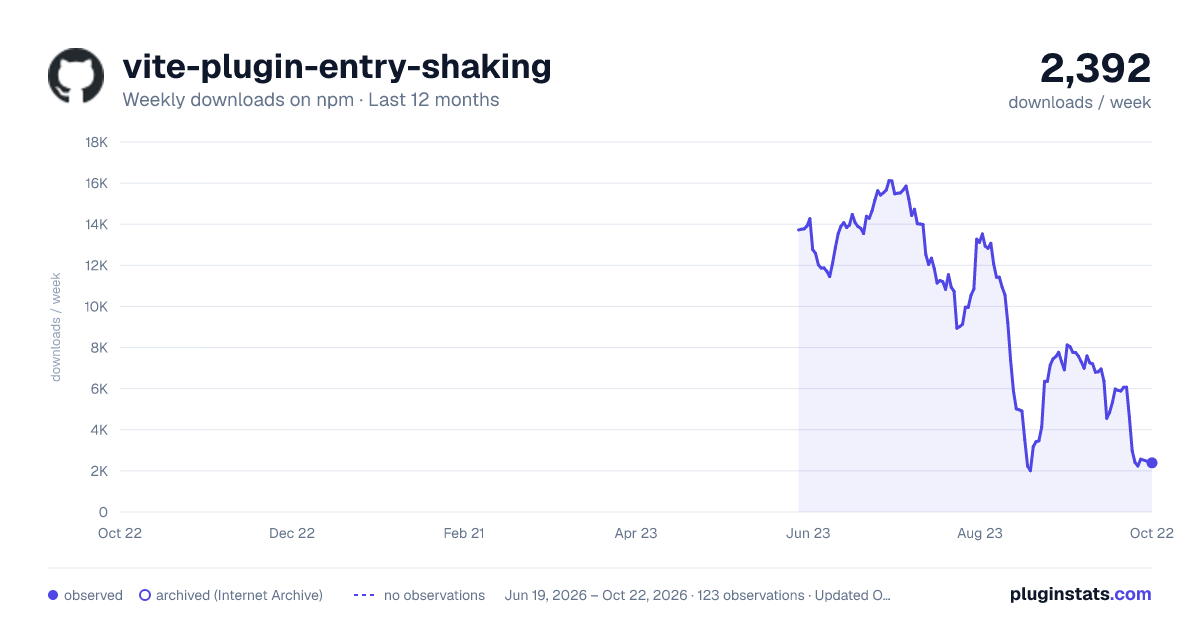
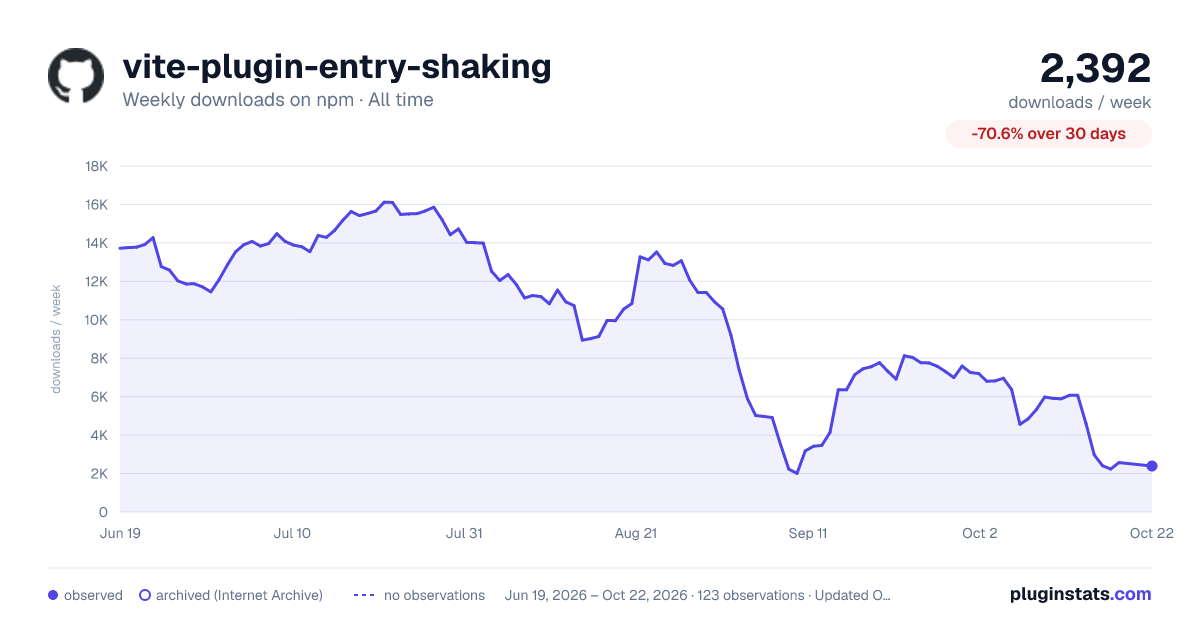
vite-plugin-entry-shaking has 2,237 recorded weekly downloads on npm, a decrease of 70.0% over the past 30 days.
It ranks #1261 of 2,256 tracked npm listings by weekly downloads.
Over 90 days, weekly downloads changed by -85.6%.
PluginStats has 121 daily observations since Jun 19, 2026; the latest is from Oct 17, 2026.
About vite-plugin-entry-shaking
vite-plugin-entry-shaking
Mimic tree-shaking behaviour when importing code from an entry file in development mode.
[!NOTE] The main execution logic of this plugin only applies to development mode because it addresses an issue which is specific to development mode. It _may_ be used in test environments that rely on Vite (e.g. Vitest) but should be used with caution as stated in limitations.
Install
Usage
Setup the plugin in your Vite configuration file.
Plugin options
Option name Type Default Description
targets (required) • string[] • { path: string }[] • { glob: string; globOptions: import('fast-glob').Options }[]
N/A You need to list all of the entry points you want this plugin to process.
extensions string[] ['js', 'jsx', 'mjs', 'ts', 'tsx', 'mts'] This specifies which file extensions you want this plugin to process.
ignorePatterns (string | RegExp)[] [/node_modules/] This specifies RegExp/string whose matched paths must be ignored by the plugin.
maxWildcardDepth number 0 How deep should this plugin run static analysis when encountering wildcards?
diagnostics boolean | DiagnosticsConfig true Toggles all diagnostics when set as a boolean, or specific diagnostics when set as an object.
debug boolean false Toggles debug mode. This will print debug logs if Vite's logLevel is set to any other value than 'silent'
Diagnostics configuration
Diagnostics are recommendations/warnings emitted by the plugin as it analyzes the specified entry files. They aim to help you improve the plugin's efficiency by suggesting changes and provide explanation on why they were emitted. See RESOURCES for a more in-depth insight about possible diagnostics.
Name Default Description
definedWithinEntry true Emit warning if an entry file defines code that may prevent tree-shaking.
maxDepthReached true Emits a warning when max analysis depth was reached when handling wildcard imports.
Examples
Examples illustrating usage and benefits can be found here. Feel free to fork and play around. For instance, you can toggle the plugin on and off their respective vite config file while serving in development mode and see how it affects the amount of requests made by your browser.
This repository provides a simple CLI to help you quickly scaffold a new example, simply run the following command from the project's root to get started:
Debugger (experimental)
Version 0.4.0 introduces a debugger as an optional dependency. When installed and attached to the plugin, a debugger application will open alongside your actual application in dev mode. This can help you get an overall idea of what the plugin is processing and its impacts on performances.
[!NOTE] This requires installing vite-plugin-entry-shaking-debugger and setting the debug option to true.
Motivation
The problem this plugin tries to address is well described by this Vite's github issue, so we'll stick to its author's example. Suppose your codebase contains an index file which is basically used as an entry point to dispatch code imported from other files. This is a rather common pattern which may be handy and avoid writing a lot of individual import statements:
Let's pretend you have a module which imports c from that entry point:
In development mode, when Vite serves the module.ts file, the browser loads the shared/index.ts file which initiates requests for all of the three a, b and c modules it relies on. The thing is, we actually only needed the c module, this results in both a and b requests being unnecessary!
As your projet and entry points grow, you end up paying the price for the ever-increasing amount of unnecessary requests and HMR updates, which consumes time and resources. Well, that escalated quickly. Let's try to work around this…
The idea
The main idea is to rewrite imports from a target entry point and replace them by individual imports of the actual module. Back with the above example:
This way, the shared/index.ts file is not loaded by the browser anymore and no additional requests are initiated.
How it works
First of all, the plugin reads all of the target entry files listed in the plugin's targets option. For each entry file :
• It uses es-module-lexer to get a list of imports and exports. • It stores named exports that are re-exports of code imported from another module and the path they resolve to. It also stores whether this re-exported code is the default or a named export of its origin. This lets us correctly rewrite the import using the adequate statement. • It also tracks a mutated version of the entry file where these stored named exports are removed. This is required because we might still import code which is actually defined within the entry file, rather than exported from another module. To make these work, we'll still need to serve this mutated version of the entry file so that this kind of code can be reached.
Whenever Vite serves a file which includes an import which resolved to one of the targets, this file is transformed to rewrite the relevant import statements. It extracts the list of entities imported from that entry file, and for each imported entity :
• it removes the import statement of that entry file. • if it has a matching stored named export, it adds a direct import to the relevant module's absolute path, taking into consideration whether it imports a named export or a default export. • If it has no matching stored named export, it is some code which is actually defined within the entry file. These are batched and eventually add a recomposed import of the target.
When encountering the above latest case, we have the browser still loading the shared/index.ts, which could therefore trigger unnecessary requests, as described earlier. To prevent this kind of scenario, any import of an entry point is caught and is forced to serve its mutated version we stored while parsing the entry point file. This ensures the entry point only imports what it needs to make the code it explicitly defines work.…
Description from the npm listing.
- vite
- vite-plugin
- entry
- tree shaking
Charts
Images: 30d · 1y · all time · 1600×900 dark

Adoption over time


7/30/90-day growth


Ranking history


Listing placement


Filled points are observed values; hollow points come from Internet Archive snapshots of the listing page. Dashed segments span periods with no observations — values between points are not interpolated.
Each band is one page of 20. Weekly downloads on a log scale. Placement is projected from weekly downloads, so it can differ from the marketplace's own sort order. Hover a dot to see the listing.
Recent observations
Full history (121)Similar npm Vite plugins plugins
All 20 vite-plugin-entry-shaking alternativesData source
Weekly downloads (trailing 7 complete days) come from the official npm downloads API. Downloads include CI and mirrors and are not equivalent to installs or users. npm publishes no ratings.
Listing: https://www.npmjs.com/package/vite-plugin-entry-shaking. First seen Oct 16, 2026; last successful collection Oct 19, 2026. See the methodology.