 PluginStats
@intentface/latch-net weekly downloads statistics
By intentface (9 listings) · npm · AI SDKs
Network-safety primitives for Latch — SSRF guards (private-IP blocklist + DNS-rebinding backstop) and a DNS-pinned egress fetch, shared by every host that opens an outbound connection.
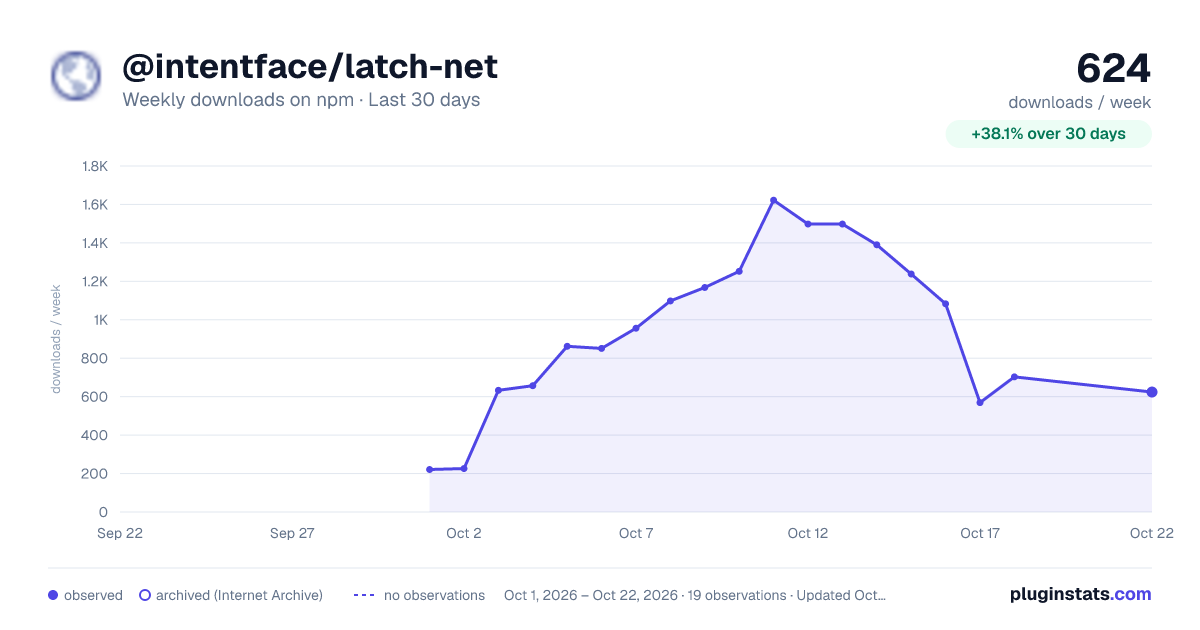
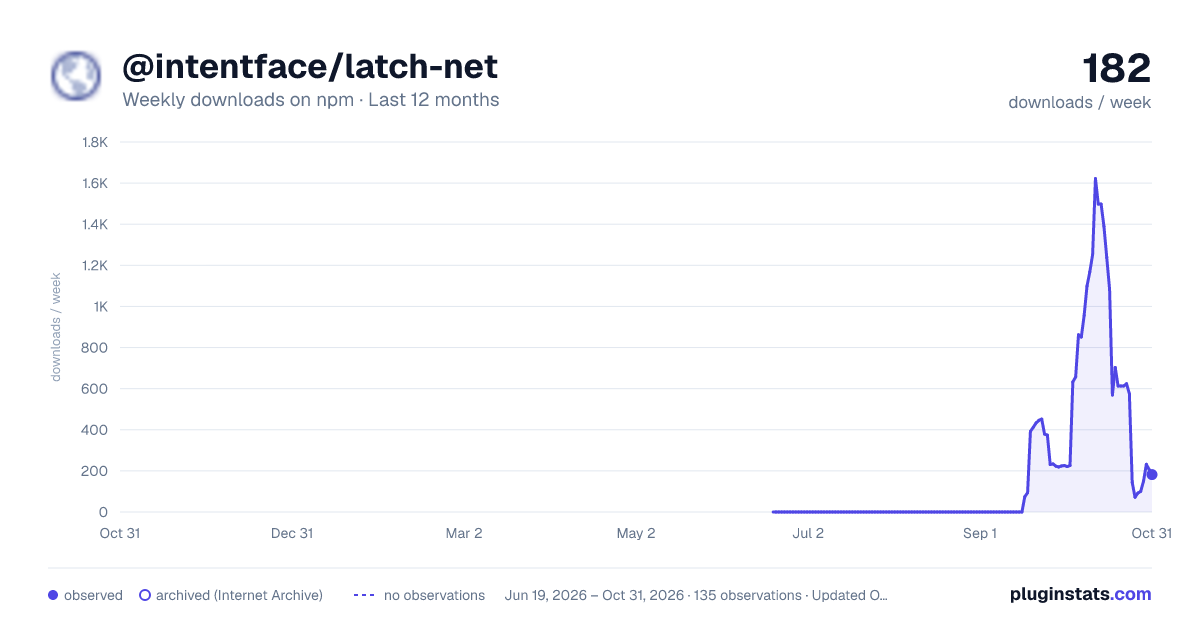
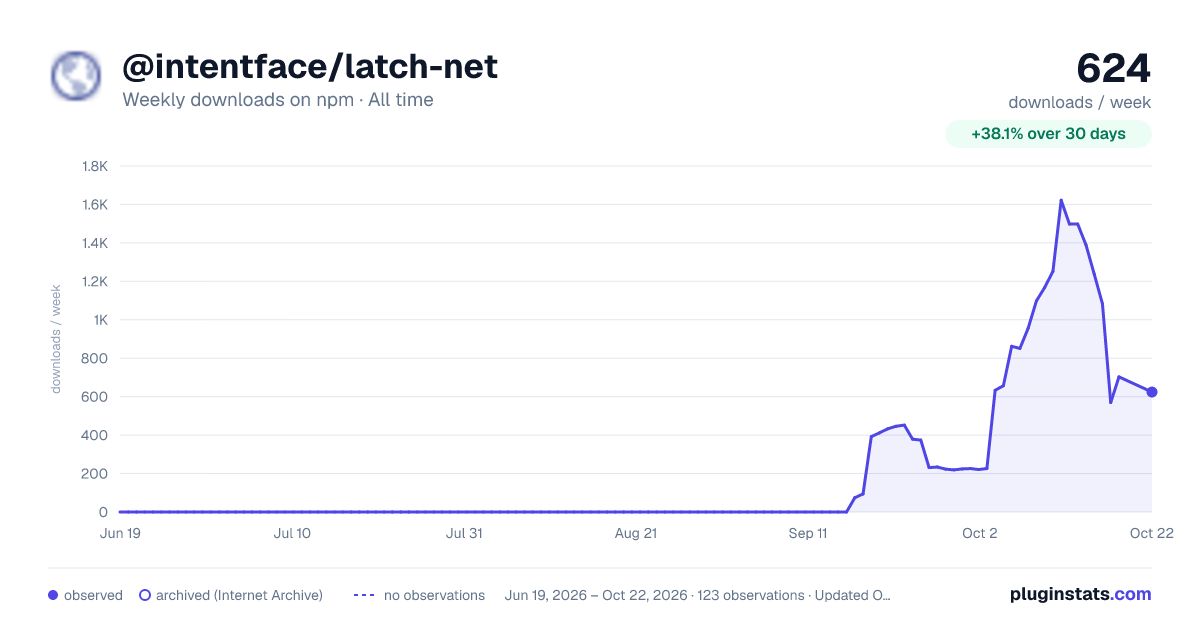
@intentface/latch-net has 569 recorded weekly downloads on npm, an increase of 505% over the past 30 days.
It ranks #1482 of 2,256 tracked npm listings by weekly downloads.
PluginStats has 121 daily observations since Jun 19, 2026; the latest is from Oct 17, 2026.
About @intentface/latch-net
@intentface/latch-net
Network-safety primitives for Latch — SSRF guards and a DNS-pinned egress fetch, shared by every host that opens an outbound connection on a model's behalf.
The root export has zero third-party dependencies (Node built-ins only), so any package can depend on it without pulling weight in. The pinned fetch, which needs undici, sits behind the /pinned subpath.
What it does
• assertPublicUrl — the front-line check. Parses the URL and rejects any host that is, or resolves to, a private, loopback, link-local or otherwise internal address. Returns the parsed URL so the caller can keep using it. • isBlockedHost / isBlockedResolved / isPrivateV4 — the predicates behind it. The string-level one is deliberately conservative, covering .localhost and .local names, IPv6 literals in any spelling, and the integer and hex encodings of an IPv4 address. The resolving one is the rebinding backstop. • isHostAllowed — positive allowlist matching (an exact host, or .suffix for subdomains), used to bound which hosts a tenant may reach at all. It complements the blocklist rather than replacing it. • createPinnedFetch / pinnedFetch (@intentface/latch-net/pinned) — a fetch that vets addresses inside the lookup the connection itself uses.
Why the pinned fetch exists
Checking a hostname and then handing it to fetch leaves a gap: fetch performs its own second DNS lookup, so a name that resolves public during the check and private when the socket opens defeats the guard. That is DNS rebinding, and it is a time-of-check/time-of-use bug, not a weak blocklist.
createPinnedFetch closes the gap by validating in the undici connector's lookup, so there is no distance between validating and connecting. TLS is untouched: SNI and certificate validation stay against the original hostname, and redirect hops dispatch through the same agent, so every hop is connect-vetted too.
Where it fits
An optional peer of @intentface/latch-core, required by its web_fetch harness tool. latch-mcp uses the allowlist to bound MCP server hosts, and any host tool that fetches a user-supplied URL should route through it.
Description from the npm listing.
- ai
- ai-sdk
- agents
- llm
- ssrf
- fetch
- security
Where @intentface/latch-net sits in the listing
Each band is one page of 20. Weekly downloads on a log scale. Placement is projected from weekly downloads, so it can differ from the marketplace's own sort order. Hover a dot to see the listing.


Charts
Images: 30d · 1y · all time · 1600×900 dark

Adoption over time


7/30/90-day growth


Filled points are observed values; hollow points come from Internet Archive snapshots of the listing page. Dashed segments span periods with no observations — values between points are not interpolated.
Recent observations
Full history (121)Similar npm AI SDKs plugins
Data source
Weekly downloads (trailing 7 complete days) come from the official npm downloads API. Downloads include CI and mirrors and are not equivalent to installs or users. npm publishes no ratings.
Listing: https://www.npmjs.com/package/@intentface/latch-net. First seen Oct 16, 2026; last successful collection Oct 19, 2026. See the methodology.