 PluginStats
@microsoft/eslint-plugin-sdl weekly downloads statistics
By microsoft (224 listings) · npm · ESLint plugins
ESLint plugin focused on common security issues and misconfigurations discoverable during static testing as part of Microsoft Security Development Lifecycle (SDL)
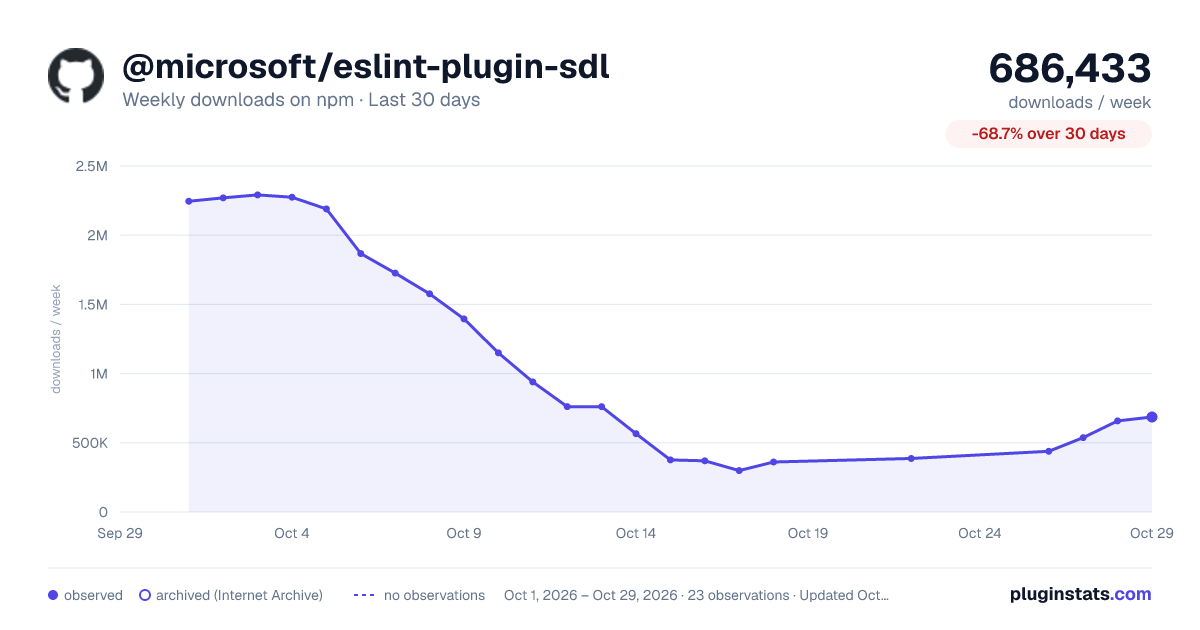
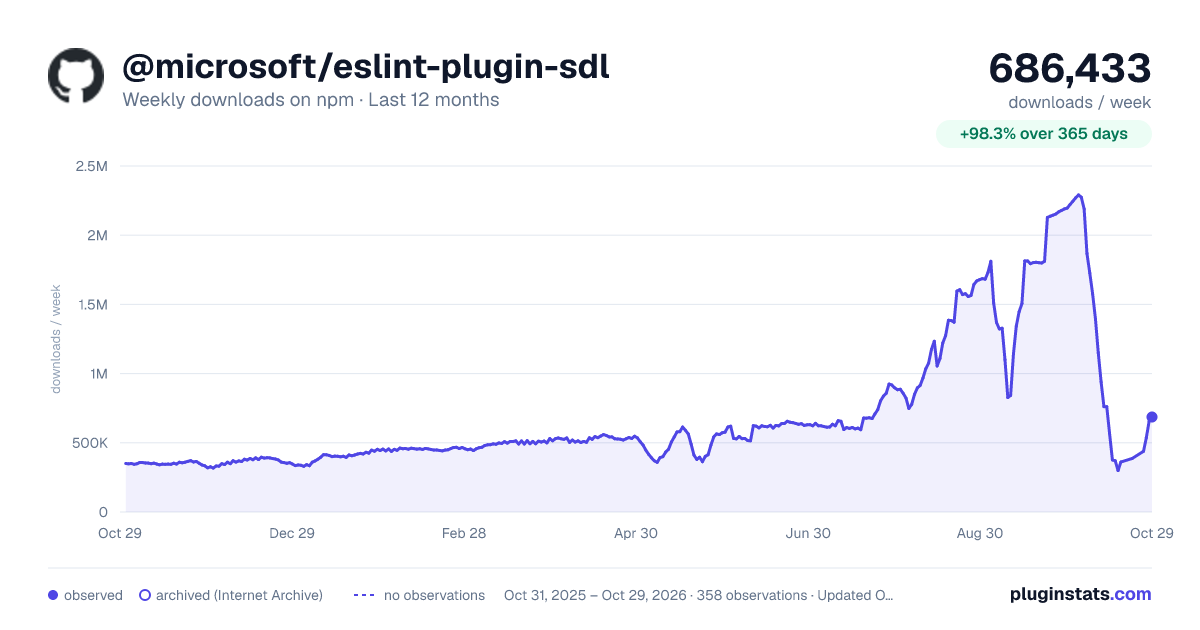
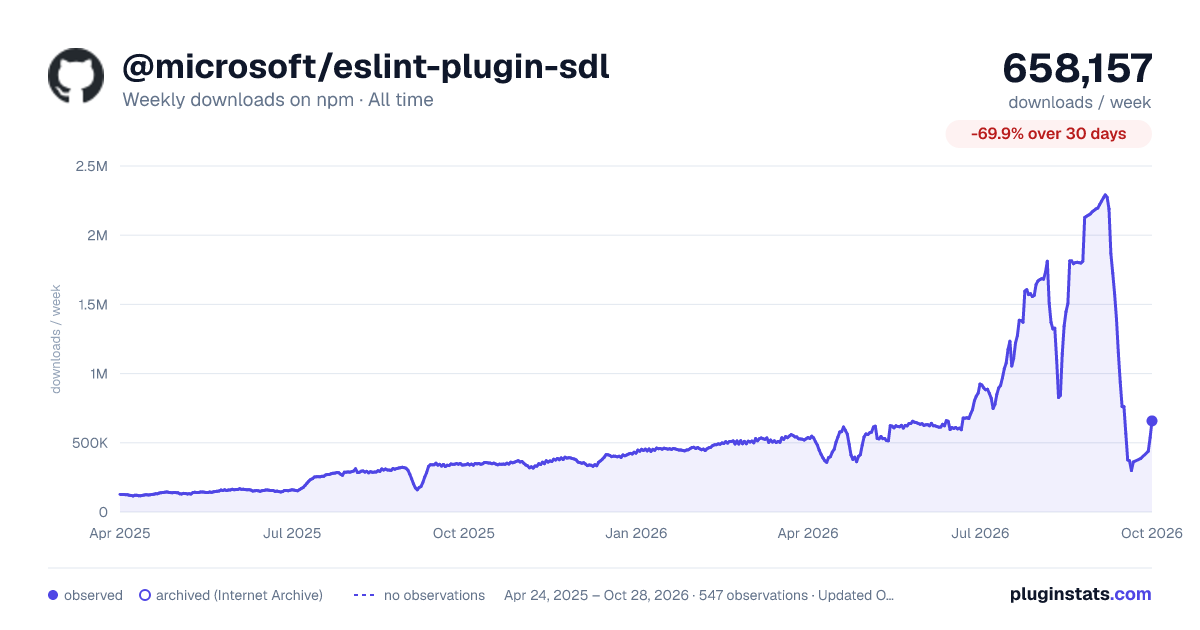
@microsoft/eslint-plugin-sdl has 299,227 recorded weekly downloads on npm, a decrease of 83.4% over the past 30 days.
It ranks #303 of 2,256 tracked npm listings by weekly downloads.
Over 90 days, weekly downloads changed by -55.9%.
PluginStats has 542 daily observations since Apr 24, 2025; the latest is from Oct 17, 2026.
About @microsoft/eslint-plugin-sdl
eslint-plugin-sdl
ESLint Plugin focused on common security issues and misconfigurations.
Plugin is intended as a baseline for projects that follow Microsoft Security Development Lifecycle (SDL) and use ESLint to perform Static Analysis Security Testing (SAST).
Installation
or
Configs
Including an ESLint configuration file in your project allows you to customize how ESLint applies rules to your project. You can include the plugin in your configuration file as described in examples for recommended and required configurations.
ESLint will then only enforce rules you specify in the rules section of your configuration file at the severity level you designate. For example:
You can also used the below Shareable Config files using flat config model as guidelines depending on the type of project.
Plugin is shipped with following Shareable Configs:
• angular - Set of rules for modern Angular applications • angularjs - Set of rules for legacy AngularJS applications • common - Set of rules for common JavaScript applications • electron - Set of rules for Electron applications • node - Set of rules for Node.js applications • react - Set of rules for ReactJS applications • recommended - SDL Recommended rules for all applications • required - SDL Required rules for all applications • typescript - Set of rules for TypeScript applications
Rules
Where possible, we leverage existing rules from ESLint and community plugins such as react, typescript-eslint or security.
We also implemented several custom rules where we did not find sufficient alternative in the community.
| Name | Description |
| no-caller | Bans usage of deprecated functions arguments.caller() and arguments.callee that could potentially allow access to call stack. | | no-delete-var | Bans usage of operator delete on variables as it can lead to unexpected behavior. | | no-eval | Bans usage of eval() that allows code execution from string argument. | | no-implied-eval | Bans usage of setTimeout(), setInterval() and execScript(). These functions are similar to eval() and prone to code execution. | | no-new-func | Bans calling new Function() as it's similar to eval() and prone to code execution. | | node/no-deprecated-api | Bans usage of deprecated APIs in Node. | | @microsoft/sdl/no-angular-bypass-sanitizer | Calls to bypassSecurityTrustHtml, bypassSecurityTrustScript and similar methods bypass DomSanitizer in Angular and need to be reviewed. | | @microsoft/sdl/no-angularjs-bypass-sce | Calls to $sceProvider.enabled(false), $sceDelegate.trustAs(), $sce.trustAs() and relevant shorthand methods (e.g. trustAsHtml or trustAsJs) bypass Strict Contextual Escaping (SCE) in AngularJS and need to be reviewed. | | @microsoft/sdl/no-angularjs-enable-svg | Calls to $sanitizeProvider.enableSvg(true) increase attack surface of the application by enabling SVG support in AngularJS sanitizer and need to be reviewed. | | @microsoft/sdl/no-angularjs-sanitization-whitelist | Calls to $compileProvider.aHrefSanitizationWhitelist or $compileProvider.imgSrcSanitizationWhitelist configure whitelists in AngularJS sanitizer and need to be reviewed. | | @microsoft/sdl/no-cookies | HTTP cookies are an old client-side storage mechanism with inherent risks and limitations. Use Web Storage, IndexedDB or other modern methods instead. | | @microsoft/sdl/no-document-domain | Writes to document.domain property must be reviewed to avoid bypass of same-origin checks. Usage of top level domains such as azurewebsites.net is strictly prohibited. | | @microsoft/sdl/no-document-write | Calls to document.write or document.writeln manipulate DOM directly without any sanitization and should be avoided. Use document.createElement() or similar methods instead. | | @microsoft/sdl/no-electron-node-integration | Node.js Integration must not be enabled in any renderer that loads remote content to avoid remote code execution attacks. | | @microsoft/sdl/no-html-method | Direct calls to method html() often (e.g. in jQuery framework) manipulate DOM without any sanitization and should be avoided. Use document.createElement() or similar methods instead. | | @microsoft/sdl/no-inner-html | Assignments to innerHTML or outerHTML properties manipulate DOM directly without any sanitization and should be avoided. Use document.createElement() or similar methods instead. | | @microsoft/sdl/no-insecure-url | Insecure protocols such as HTTP or FTP should be replaced by their encrypted counterparts (HTTPS, FTPS) to avoid sending potentially sensitive data over untrusted networks in plaintext. | | @microsoft/sdl/no-msapp-exec-unsafe | Calls to MSApp.execUnsafeLocalFunction()>) bypass script injection validation and should be avoided. | | @microsoft/sdl/no-postmessage-star-origin | Always provide specific target origin, not \* when sending data to other windows using postMessage to avoid data leakage outside of trust boundary. | | @microsoft/sdl/no-unsafe-alloc | When calling Buffer.allocUnsafe and Buffer.allocUnsafeSlow, the allocated memory is not wiped-out and can contain old, potentially sensitive data. | | @microsoft/sdl/no-winjs-html-unsafe | Calls to WinJS.Utilities.setInnerHTMLUnsafe()>) and similar methods do not perform any input validation and should be avoided. Use WinJS.Utilities.setInnerHTML()>) instead. | | react/iframe-missing-sandbox | The sandbox attribute enables an extra set of restrictions for the content in the iframe and should always be specified. | | react/no-danger | Bans usage of dangerouslySetInnerHTML property in React as it allows passing unsanitized HTML in DOM. | | @typescript-eslint/no-implied-eval | Similar to built-in ESLint rule no-implied-eval. Bans usage of setTimeout(), setInterval(), setImmediate(), execScript() or new Function() as they are similar to eval() and allow code execution from string arguments. |
Contributing…
Description from the npm listing.
- eslint
- eslintplugin
- eslint-plugin
- sdl
Charts
Images: 30d · 1y · all time · 1600×900 dark

Adoption over time


7/30/90-day growth


Ranking history


Listing placement


Filled points are observed values; hollow points come from Internet Archive snapshots of the listing page. Dashed segments span periods with no observations — values between points are not interpolated.
Each band is one page of 20. Weekly downloads on a log scale. Placement is projected from weekly downloads, so it can differ from the marketplace's own sort order. Hover a dot to see the listing.
Recent observations
Full history (542)Similar npm ESLint plugins plugins
All 20 @microsoft/eslint-plugin-sdl alternativesData source
Weekly downloads (trailing 7 complete days) come from the official npm downloads API. Downloads include CI and mirrors and are not equivalent to installs or users. npm publishes no ratings.
Listing: https://www.npmjs.com/package/@microsoft/eslint-plugin-sdl. First seen Oct 16, 2026; last successful collection Oct 19, 2026. See the methodology.