 PluginStats
skilld-harness weekly downloads statistics
By skilld-dev · npm · AI SDKs
Run skilld-maintained Skills with checked, atomic output
skilld-harness has 48 recorded weekly downloads on npm, a decrease of 89.7% over the past 30 days.
It ranks #1740 of 2,256 tracked npm listings by weekly downloads.
PluginStats has 121 daily observations since Jun 19, 2026; the latest is from Oct 17, 2026.
About skilld-harness
skilld-harness
Run visible skilld-maintained Skills through an AI SDK Harness.
The package checks output limits, paths, file types, and Skill frontmatter. It then promotes generated Skills with an atomic directory rename.
Install
Add one Harness adapter. The examples below use OpenCode:
Use Node 22 or newer. The sandbox must provide POSIX sh, rm, mkdir, and GNU find.
Run a Skill
Every run returns a tagged Ok or Err value. A PackageSkill run whose destination already holds the Skill runs update-package-skill, which tests only what the release changed. Without one it runs generate-package-skill. The input tag sets the Ok value: PackageSkill and ProjectSkill return a GeneratedSkill, and ReviewSkill returns a SkillReview. Both Ok and Err carry a report, so a failed run still reports its cost. report.usage holds input, cached input, and output tokens. report.steps is the number of model calls. A token count is undefined when the adapter does not report it. If the run fails before the Agent starts, steps is 0. report.warnings names each source file the Harness left out for size, each onEvent failure, and each cleanup problem. If the output fails a check, the Harness sends the issues back to the Agent in the same session, up to two times. Each repair turn adds its steps and usage to the report, and a warning names the issues. An InvalidSkill error lists each check that still fails in issues.
The Harness checks the rules that the generation Skills state:
• The frontmatter contains only name and description. • The description is one plain YAML line without double quotes, backticks, or %. • SKILL.md links every file under references/, by a Markdown link or an inline code path. • A package Skill keeps SKILL.md under 500 lines and writes at most eight reference files. • A project Skill points only at project files and gives at least one search command.
A run can take several minutes. Pass onEvent to follow the Agent:
The events are StepStart, ToolCall, and StepFinish. Steps count from 0. A ToolCall event arrives after the tool returns. If the adapter runs the tool itself, the event arrives when its step ends. The run does not wait for a promise that onEvent returns. If onEvent throws, or its promise or thenable rejects, the run continues, and report.warnings carries the error.
Pass fetch to createSkillHarness when the host owns HTTP access. The default adapter uses the Node global fetch implementation.
Local sandbox
createSkillHarness needs a sandbox. Import skilld-harness/sandbox-local to run a Skill on the computer that starts it, with no hosted sandbox account.
The session runs in a new temporary directory and exposes one port on 127.0.0.1 for bridge-backed Harness adapters. destroy kills every process the session started and removes the directory.
Each session gets its own HOME, XDG directories, and TMPDIR under the session root. Harness state, the adapter bootstrap, and installed Skills stay inside the session, and destroy removes them. The Agent does not load your own agent configuration, Skills, or MCP servers. Configure the adapter explicitly, for example through openCodeConfig.
Processes receive a minimal environment: PATH, locale, terminal, and proxy variables. Pass any other variable through the env option. The adapter reads its credentials from your environment and hands them to the processes it starts. For OpenCode Go, set OPENCODE_API_KEY. The adapter does not read the key that opencode auth login stores.
Each session installs the adapter bootstrap again, because nothing persists between sessions. With OpenCode, that is about 200 MB of downloads per run.
| Option | Default | Effect |
| root | a new temporary directory | Session root directory. | | port | a free port from the operating system | Bridge port. | | keepRoot | false | Keep the session root after destroy. | | env | none | More environment variables for every process. |
The adapter prints this warning on every local run: "credential brokering does not work. Falling back to less secure credential forwarding." It is expected. The local sandbox cannot rewrite requests, so the adapter gives the raw API key to the processes it starts. If the Agent must not see the key, use a hosted sandbox provider that supports request transformations.
The local sandbox needs POSIX sh at /bin/sh and GNU find, because the Harness inventories output with find -printf. It runs on Linux. It does not support macOS, whose find has no -printf, or Windows.
A Skill that carries a large reference tree will exceed the default output policy, which stops at 64 files. Raise it on createSkillHarness:
It applies no process isolation. A separate HOME keeps state apart. It does not stop a process from reading or writing any file your user account can reach. Use it for your own Skills on your own computer or on a self-hosted runner. Use a hosted sandbox provider when the Harness must contain what it runs.
A LocalPackage source copies the working tree, including uncommitted and untracked files. A symbolic link anywhere in it stops the run, and the error names the link. To use only committed files, pass a git archive export.
Visible Skills
Import skilld-harness/skills to load the published Skill instructions.
The same Skill files remain usable directly through an Agent. Direct runs remain user reviewed.
Develop against the local package
package.json exports dist files. Run pnpm build in packages/harness before you link the package into another project. A stale dist fails on import.
Description from the npm listing.
- agent
- skills
- harness
- ai-sdk
Where skilld-harness sits in the listing
Each band is one page of 20. Weekly downloads on a log scale. Placement is projected from weekly downloads, so it can differ from the marketplace's own sort order. Hover a dot to see the listing.


Charts
Images: 30d · 1y · all time · 1600×900 dark
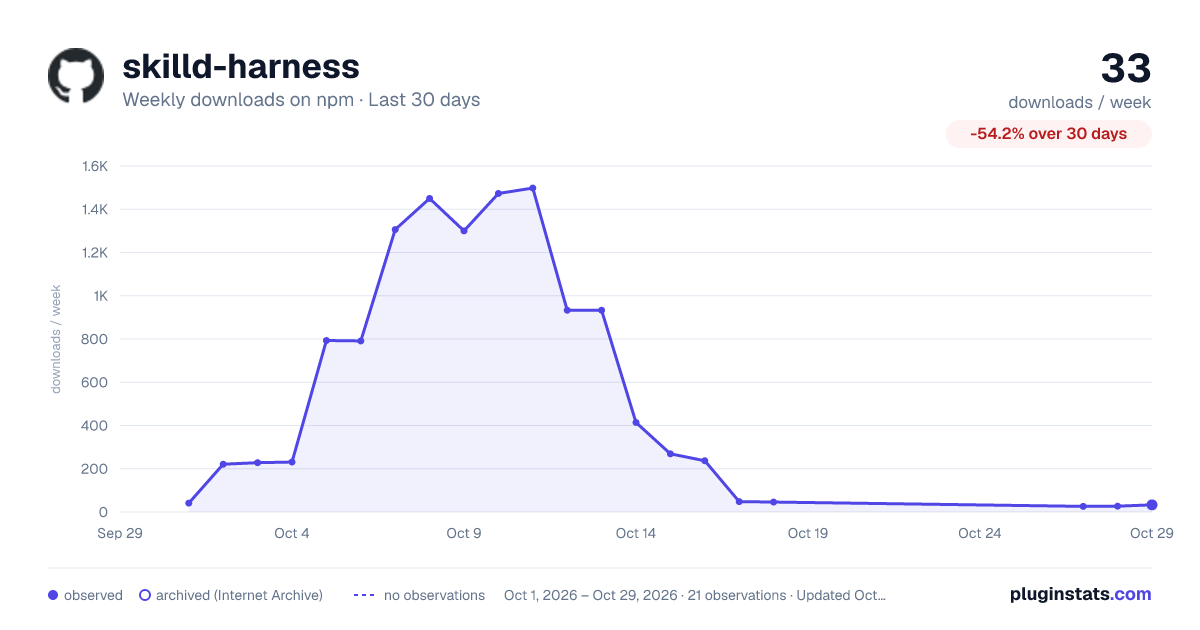
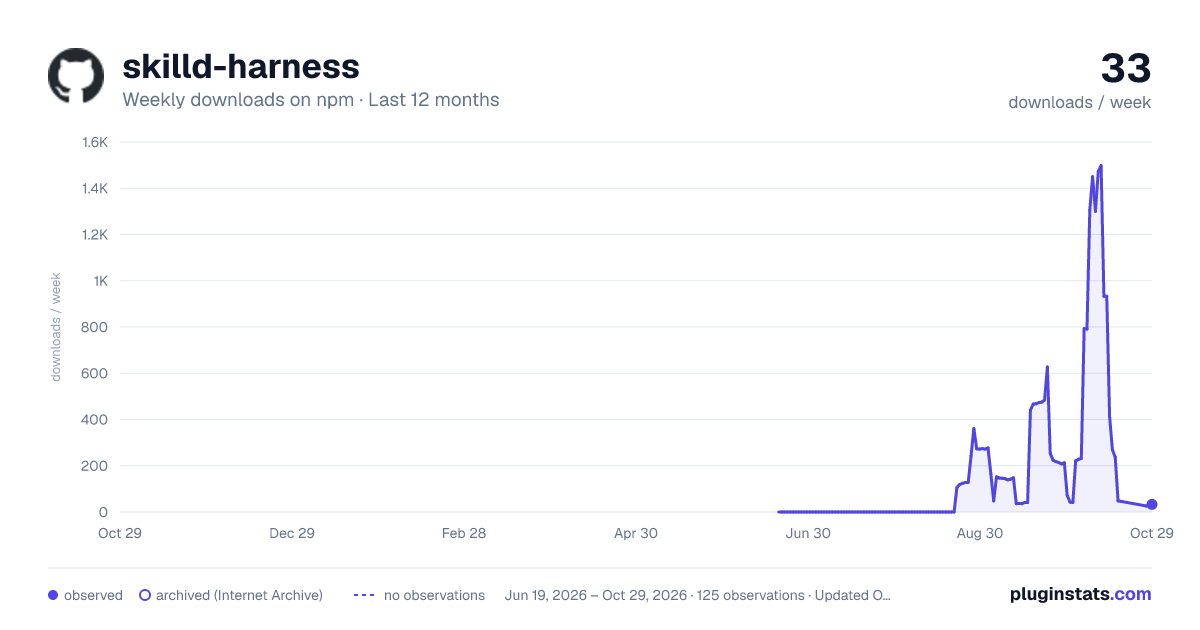
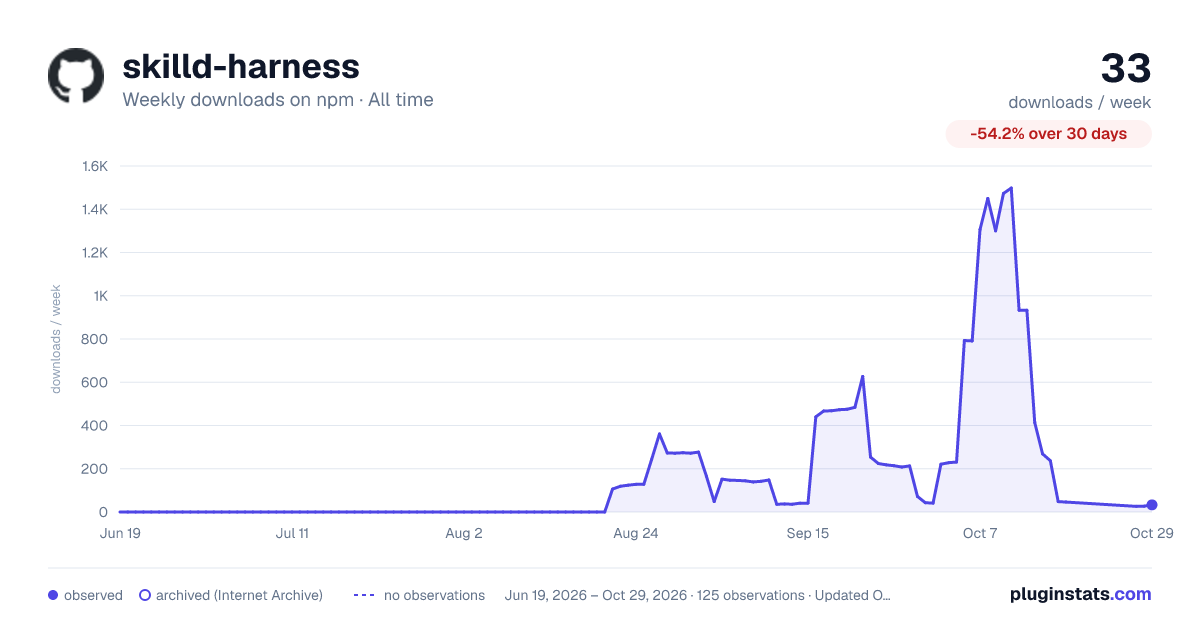

Adoption over time


7/30/90-day growth


Filled points are observed values; hollow points come from Internet Archive snapshots of the listing page. Dashed segments span periods with no observations — values between points are not interpolated.
Recent observations
Full history (121)Similar npm AI SDKs plugins
Data source
Weekly downloads (trailing 7 complete days) come from the official npm downloads API. Downloads include CI and mirrors and are not equivalent to installs or users. npm publishes no ratings.
Listing: https://www.npmjs.com/package/skilld-harness. First seen Oct 16, 2026; last successful collection Oct 19, 2026. See the methodology.