 PluginStats
ccdeck weekly downloads statistics
By BarganConstantin · npm · Claude Code
Local dashboard for Claude Code and Codex CLI sessions: which Claude Code session needs input, every tool call and Claude Code subagent live, token cost and quota, several Claude accounts. Run npx ccdeck.
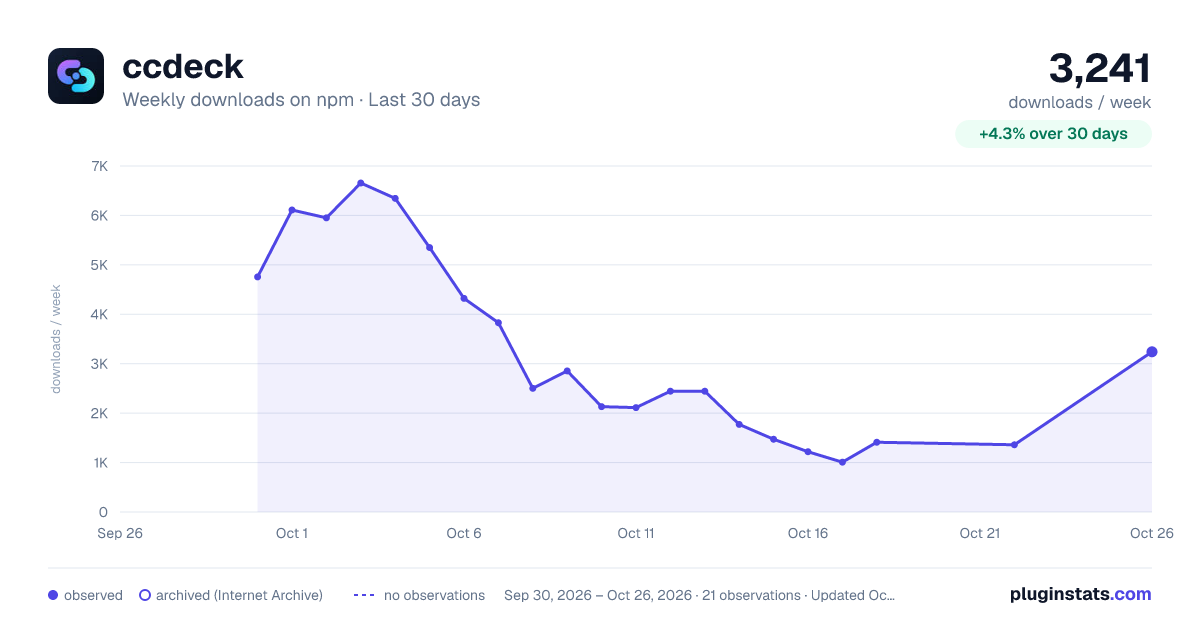
ccdeck has 1,008 recorded weekly downloads on npm, a decrease of 82.1% over the past 30 days.
It ranks #1392 of 2,256 tracked npm listings by weekly downloads.
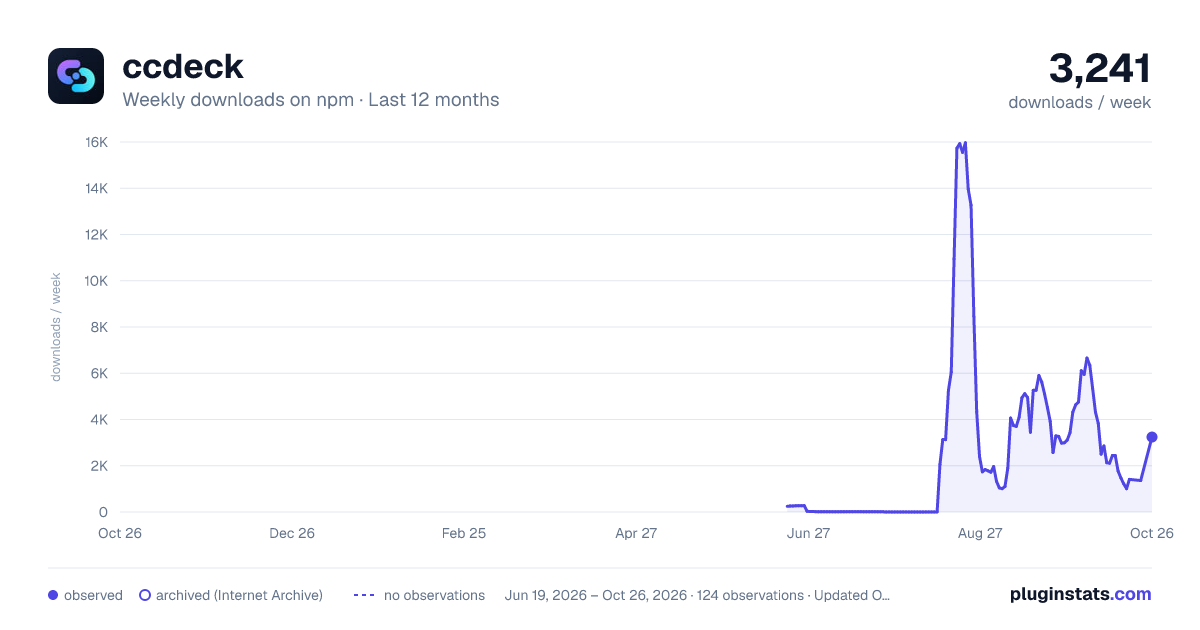
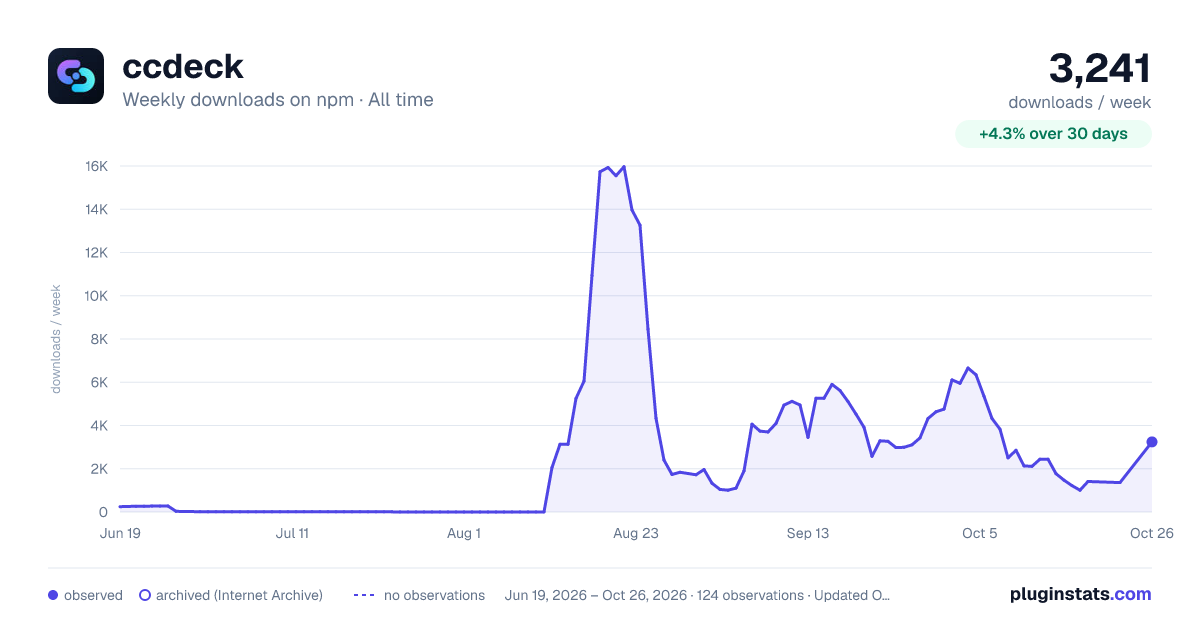
Over 90 days, weekly downloads changed by +9064%.
PluginStats has 121 daily observations since Jun 19, 2026; the latest is from Oct 17, 2026.
About ccdeck
ccdeck — a live dashboard for Claude Code and Codex
ccdeck is a free, open-source (AGPL-3.0) dashboard that runs on your machine and shows every Claude Code and OpenAI Codex CLI session, including ones started in a plain terminal: which Claude Code session needs input, each Claude Code subagent and every tool call as it runs, cost and quota left. Start it with npx ccdeck or the desktop app.
Step-by-step guides: ccdeck.dev/guides
Know which agent is waiting on you, and for how long.
ccdeck keeps them in one queue — every session stopped on a human, longest wait first. The topbar names them, and its count is one click to the oldest. That queue is Claude Code's, because the deck reads Codex from its rollout log and a rollout carries no such signal; the canvas under it is both, with every Claude Code subagent on a node of its own.
Or the desktop app, with the waiting count in your menu bar: macOS · Windows · Linux — every download
*Generated sessions and invented quota and spend, drawn by the deck itself: assets/canvas-demo.mjs writes the log, node assets/capture-hero.mjs takes the shot. Click through for full size.*
which Claude Code session is blocked on you · tool calls · one canvas · cost · quota · local · sessions never leave
ccdeck.dev · Guides · What you get · Quick start · How it works · What it touches · Accounts · Local network · Options · FAQ
Why
Four agents running, and the machine has been quiet for twenty minutes. One of them stopped to ask something and you did not see it go by. From the outside every terminal tab looks the same — the one that is working and the one that has been holding a permission prompt since the coffee — so you find it by clicking through them, and the agent that was closest to finished is the one that has been waiting longest.
ccdeck answers that in one place: every session stopped on a human is at the top of the sidebar with the wait beside it, longest first, and the topbar names them beside a count that goes straight to the oldest one. The question stops being *which tab* and becomes *this one*.
That is the sharp end of a wider problem. An agent session is a tree, but a terminal shows it as a scroll: five subagents working in parallel arrive as one interleaved column of text, and the questions you actually have — *what is running right now, what did that subagent do, which one is stuck, what is this costing* — are the ones the scroll answers worst.
ccdeck draws the tree instead. It is local and needs no configuration: it registers a hook, listens, and paints.
What you get
One canvas. No tabs. No kanban.
The deck opens on these eight pictures the first time it runs — they are the whole tour, and Take the tour on an empty canvas brings them back.
Sessions waiting on you top the session list, longest wait first. Every agent and subagent is a node. Tool calls light up as they run.
Double-click any node: its prompt, every tool call, tokens and timing. What each session costs, and how much quota is left.
Cores, memory and heat while the agents run, and what is hogging them. Several Claude accounts: switch, add one, share one to another machine.
Your machines repair each other's expired logins over the local network. Run claude or codex in any folder. It shows up here on its own.
| | |
| Blocked on you | A permission prompt, or a finished turn waiting for your next instruction, sorts that session to the top of the sidebar with how long it has been stuck — longest wait first, so the oldest block is the first row. A permission prompt also puts a count in the topbar that jumps straight to it, and the session's name beside it, with how long it has waited and on what — one click from its card. Claude Code only — the deck reads Codex from its rollout log, and a rollout carries no such signal. | | What each session is doing | The note tied to each session's card — and the line under its row in the sidebar — says it while it works: the sentence the newest reply wrote, or the description on the command it ran. Once the turn is over it keeps the last thing the session did, until Claude Code's recap takes its place. A background session (claude --bg, or one started from claude agents) shows Claude Code's own line instead, read from its job folder in ~/.claude/jobs: the question it is stuck on and the reply Claude Code suggests, or the headline of what it got done. No model is called for any of it. A Codex session, read from its rollout log, has the note only while a turn runs, and it says the first line of the prompt that began the turn: no line is taken from a Codex reply, and no recap follows. | | Live DAG | Nodes are agents and edges are spawns; each agent's latest tool calls sit beside its node and light up while they run. In-flight edges animate, settled ones dim. | | Both providers, one canvas | Claude Code through hooks, Codex through its rollout log. The model chip (Opus 5, GPT-5.5) tells them apart. Subagent cards are Claude Code only: a Codex session is one node with its tool calls. | | Cost and quota, live | Spend per model and per session, plus Claude and Codex quota windows as they refill. | | Double-click to inspect | Any node opens its prompt, tool calls, token usage and timing in the side panel. A single click selects it and frames its session. | | Survives restarts | Events are appended to this platform's log directory (see --history below) and replayed on open. | | Accounts without a terminal | Sign a new Claude account in, move one or your whole set to another machine, rename, reorder, remove — from the panel. | | Logins that repair each other | A Claude login that expires on one of your machines is copied back from another machine on the same network that still has it — see Local network. | | Knows when it is stale | Node caches modules at startup, so an upgraded-while-running deck keeps executing old code. This one says so, and can restart itself when nothing is running. | | Workspace scoping | --scope for the current…
Description from the npm listing.
- claude-code
- claude-code-dashboard
- claude
- anthropic
- codex
- codex-cli
- openai
- agents
- ai-agents
- subagents
- dashboard
- monitor
- monitoring
- cost
- quota
- hooks
- dag
- visualization
- claude-code-monitor
- claude-code-sessions
Charts
Images: 30d · 1y · all time · 1600×900 dark

Adoption over time


7/30/90-day growth


Listing placement


Filled points are observed values; hollow points come from Internet Archive snapshots of the listing page. Dashed segments span periods with no observations — values between points are not interpolated.
Each band is one page of 20. Weekly downloads on a log scale. Placement is projected from weekly downloads, so it can differ from the marketplace's own sort order. Hover a dot to see the listing.
Recent observations
Full history (121)Similar npm Claude Code plugins
All 20 ccdeck alternativesData source
Weekly downloads (trailing 7 complete days) come from the official npm downloads API. Downloads include CI and mirrors and are not equivalent to installs or users. npm publishes no ratings.
Listing: https://www.npmjs.com/package/ccdeck. First seen Oct 16, 2026; last successful collection Oct 19, 2026. See the methodology.