 PluginStats
al-buddy-memory weekly downloads statistics
Portable, governed, model-agnostic memory for AI agents: facts are invalidated rather than overwritten, raw text is the immutable source of truth, erasure on a governed handle runs through policy and is audited, embeddings are a disposable cache, and ever
al-buddy-memory has 374 recorded weekly downloads on npm, a decrease of 24.4% over the past 30 days, ranking #1529 of 2,256 tracked listings.
About al-buddy-memory
al-buddy-memory
Al Buddy — that's Al, a name, said like "pal". Not A.I.
A memory that's yours.
Portable, governed, model-agnostic memory for AI agents.
A fact is invalidated, never overwritten; on a governed handle, erasure runs through policy and is audited. Raw text is the source of truth and cannot be edited. Embeddings are a disposable, model-tagged cache. Every fact and every link exports to one documented format. The memory outlives whatever model, runtime or company produced it.
Why this exists
Every agent-memory product on the market answers one question well: what does the agent recall? None of them answers the four questions that decide whether you can trust and keep that memory:
| Question | This library | Letta | Mem0 | Zep |
| Where did this fact come from, and who asserted it? | Provenance on every node and edge (UserInput / AIInferred / GuardianAdded / SystemGenerated) | Memory-file git history | Metadata field | Graph episodes | | When was it true, and what replaced it? | Two queryable axes: validAt answers what was true at Y; getNodeAsOf / snapshotAsOf answer what the store believed at X from full before/after versions. They combine in one call (snapshotAsOf(X, { validAt: Y })), a read the history cannot vouch for is marked, and erasure removes the history too | Git history of files, not a fact model | Change history per memory (history(): old value, new value, event, timestamps) — transaction history, not valid time | Temporal graph (its real strength): Graphiti edges carry valid_at / invalid_at alongside created_at / expired_at | | Can I take it with me, losslessly, to another runtime? | One versioned JSON export with a published schema and conformance tests | .af (agent state, framework-shaped, archival memory not yet included) | Cloud export | Cloud-only since 2025 | | Does it run with no vendor, no key, no server? | SQLite on disk, on-device embeddings | Self-host possible; cloud is the product | Self-host possible (Apache-2.0, local vector stores); needs an LLM for extraction; cloud is the product | Zep is cloud; Graphiti self-hosts (graph DB + LLM key required) |
Sources for the cells above, each checked against the project's own code or announcement on 2026-09-18: Mem0's per-memory history is a SQLite table with old_memory, new_memory, event, created_at, updated_at (mem0/memory/storage.py); Mem0 is Apache-2.0 and runs against local vector stores including Qdrant, Chroma, pgvector and FAISS (vector-store docs), with an LLM called to extract facts on the default add() path. Zep stopped maintaining Community Edition on 2025-04-02, in its own words: "we've decided to stop maintaining and releasing Zep Community Edition." Graphiti, the engine under Zep, is Apache-2.0 and self-hosts, and its stated requirements are a graph database (Neo4j, FalkorDB, Amazon Neptune, or the deprecated Kuzu) plus an LLM key — it "defaults to OpenAI for LLM inference and embedding."
The three local, keyless ones people will name, read against their own code on 2026-09-21. They answer the fourth question the way this library does — your machine, your files, no account — and they are the honest comparison, not the cloud products.
• basic-memory (AGPL-3.0; Markdown notes on disk are the truth, SQLite is a rebuildable index). It has valid time, and that is worth saying plainly: an observation can carry @effective2026-06-10,2026-07-27) in the note itself, parsed into a time index ([models/knowledge.py) and rebuilt from the file, so the file stays the source of truth. What it does not carry on a local install is who asserted a fact: created_by / last_updated_by exist and hold a cloud user id, null for local and CLI use. Portability is the strongest kind and the least specified: the notes are the format, so nothing is trapped, and there is no versioned schema to import them into something else. Capture and full-text search need no key; semantic search is opt-in and does. • The MCP memory server (the reference implementation most agents meet first; one JSONL file). Entities, relations and observations, and nothing else: no field for who said it, no timestamps at all, and deleteObservations filters the old value out of the array, so what was true before is gone rather than closed. The file is its own export. Nothing calls a model; nothing leaves the machine. • Memori (Apache-2.0; your own SQL database — SQLite, Postgres, MySQL, Oracle). A fact in memori_entity_fact has content, an embedding, a count and a last-seen date; who asserted it is only recoverable by walking the foreign keys back to a conversation message, not a property of the fact, and there is no valid time — date_updated replaces. "Your data stays in your database" is the portability story, with no interchange format published. It is local in the sense that matters for your data, but capture is not keyless: extraction and embeddings call an LLM, and the default SDK path expects a Memori account as well.
Also worth naming: OpenMemory MCP (Mem0, launched May 2025) shipped the same distribution idea — one local memory store shared across MCP clients — and Mem0 archived it; its README now opens "This project has been archived." Its schema is the contrast this table is about: models.py gives a memory content, created_at, updated_at, archived_at, deleted_at and a state, with no field for who asserted the fact and no valid time, and content is rewritten in place on update. It does keep a state-transition history and an access log, and it does have a ZIP export — so it is not the absence of portability that separates the two, it is provenance, valid time and an immutable raw.…
Description from the npm listing.
- ai
- agents
- memory
- llm
- sqlite
- provenance
- portable
- local-first
- mcp
- mcp-server
- agent-memory
- long-term-memory
- ai-sdk
- vercel-ai
- langchain
- langgraph
- mastra
README badge
Show your rank in a README or on your website. The badge updates automatically.
Charts
Images: 30d · 1y · all time · 1600×900 dark
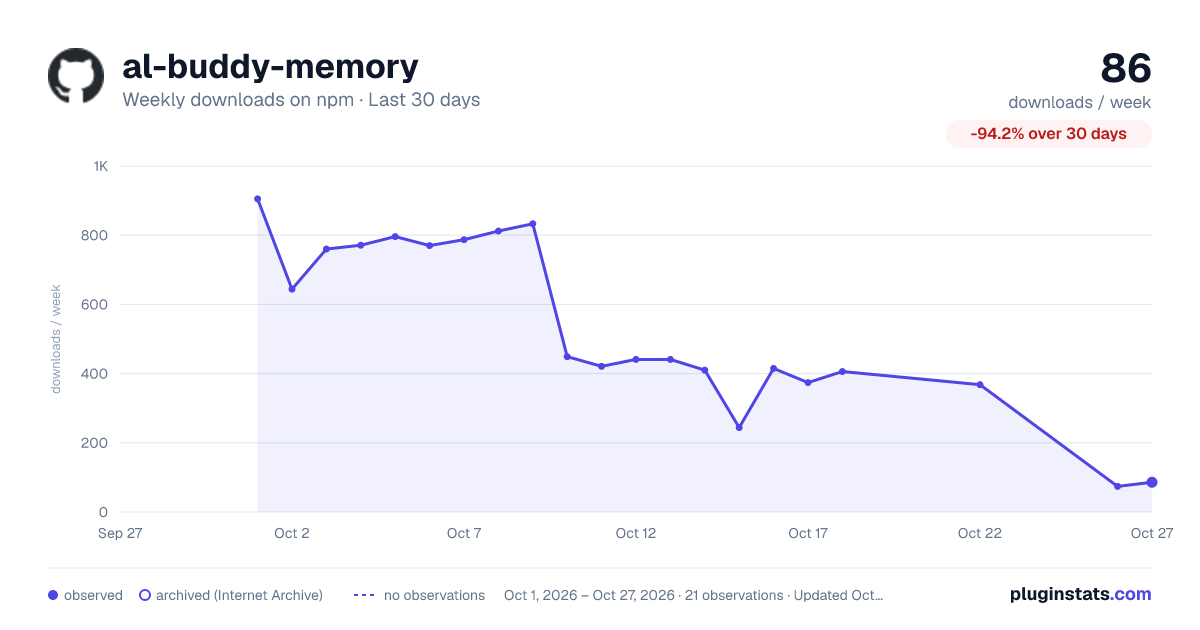
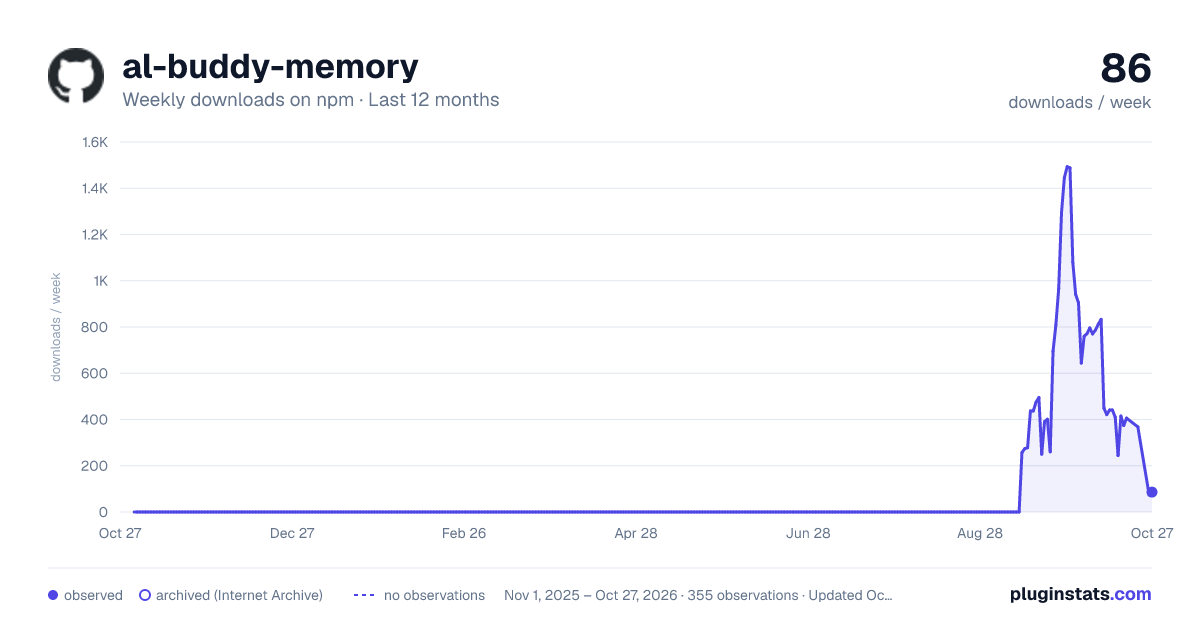
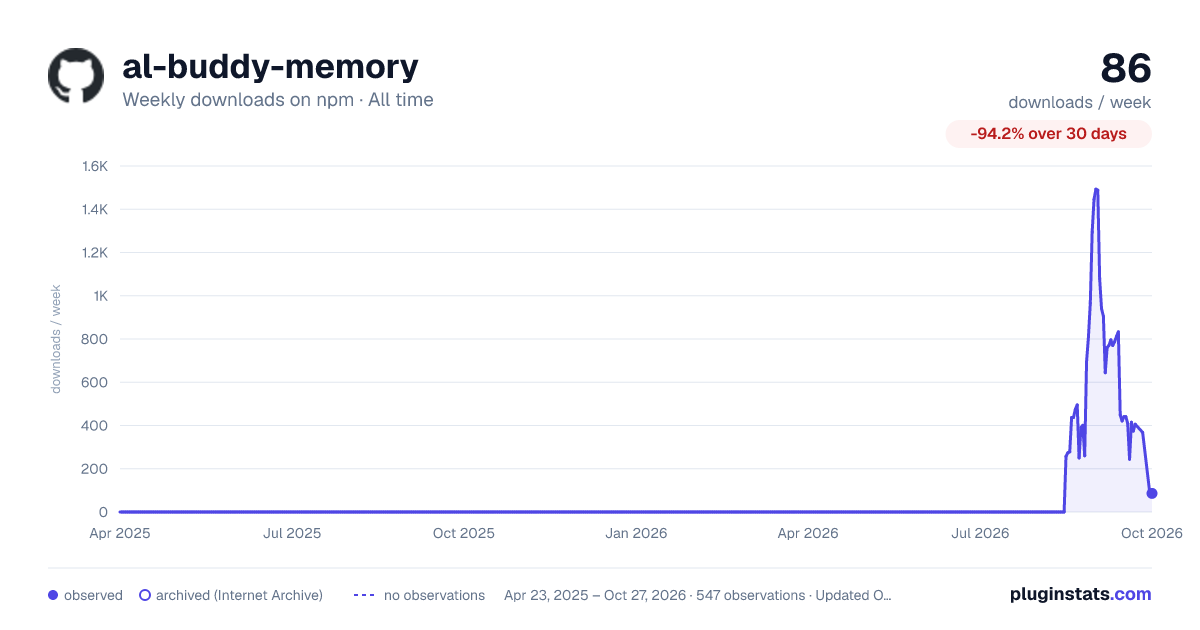

Adoption over time
7/30/90-day growth
Ranking history
Listing placement
Listing placement
Filled points are observed values; hollow points come from Internet Archive snapshots of the listing page. Dashed segments span periods with no observations — values between points are not interpolated.
Each band is one page of 20. Weekly downloads on a linear scale. Placement is projected from weekly downloads, so it can differ from the marketplace's own sort order. Hover a dot to see the listing.
Recent observations
Full history (543)Similar npm AI SDKs plugins
All 20 al-buddy-memory alternativesData source
Weekly downloads (trailing 7 complete days) come from the official npm downloads API. Downloads include CI and mirrors and are not equivalent to installs or users. npm publishes no ratings.
Listing: https://www.npmjs.com/package/al-buddy-memory. First seen Oct 16, 2026; last successful collection Oct 19, 2026. See the methodology.