 PluginStats
@postman/postman-plugin weekly downloads statistics
By postman (4 listings) · npm · Claude Code
Postman's API engineering skills for coding agents: a Pi package, and an npx installer that sets up Claude Code, Codex, Cursor, Kimi Code, Factory Droid, OpenCode and Pi.
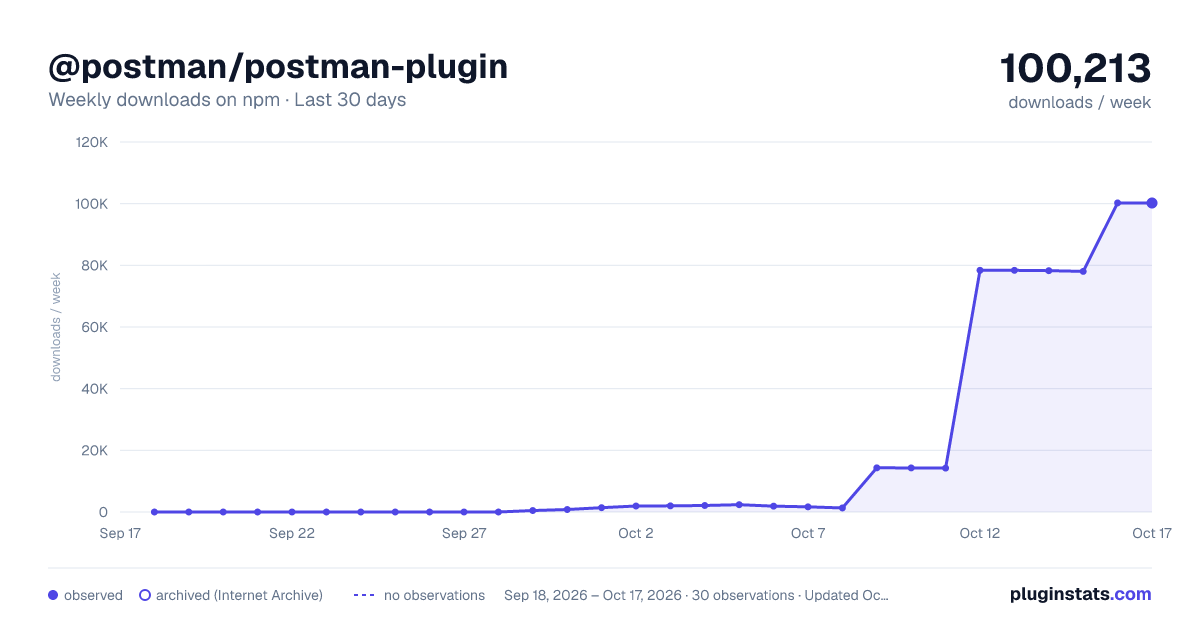
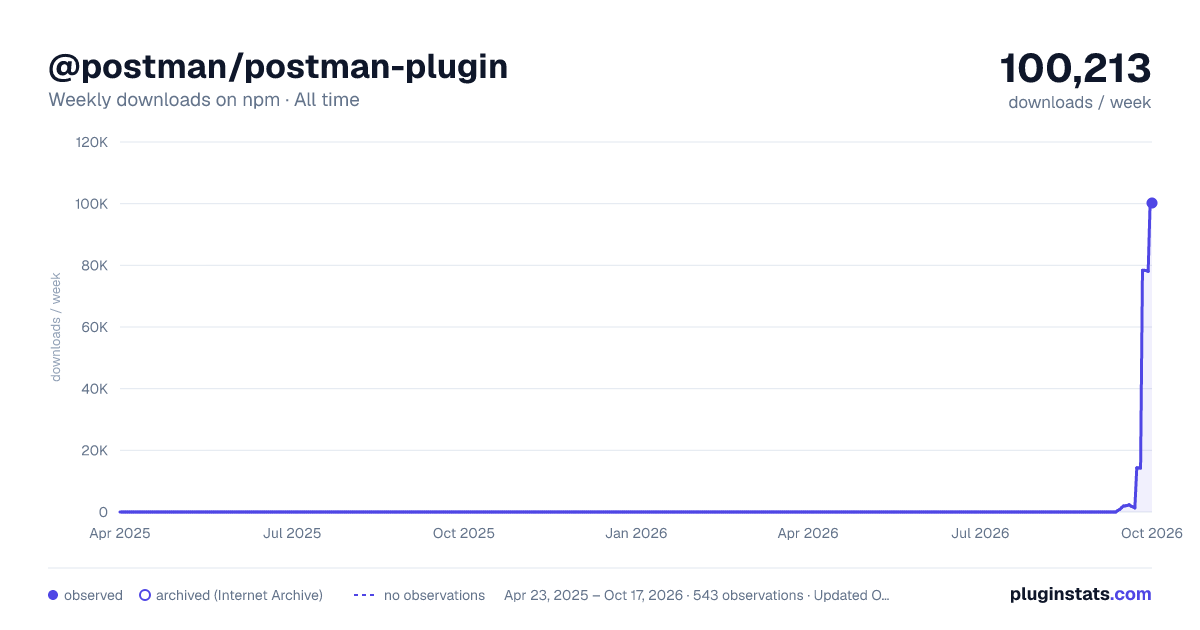
@postman/postman-plugin has 100,213 recorded weekly downloads on npm.
It ranks #452 of 2,251 tracked npm listings by weekly downloads.
Over the past 7 days it changed by +601%.
PluginStats has 543 daily observations since Apr 23, 2025; the latest is from Oct 17, 2026.
About @postman/postman-plugin
Postman Plugin
Powering API engineering for agents
The Postman plugin brings filesystem-first API development and organization-wide API context to coding agents. It enables agents to design, mock, test, document, monitor, and ship APIs directly from Claude Code, Cursor, and Codex. Every operation produces inspectable files or CLI commands that fit naturally into Git and CI, while the Postman Context Graph helps agents understand dependencies, ownership, runtime behavior, and the likely impact of a change.
Install · Highlights
Install
Install Postman in every compatible coding agent detected on your machine:
One command configures **Claude Code, Codex, Cursor, Factory Droid, Kimi Code, OpenCode and Pi**. Run it again to update, status to see what's installed, and remove to uninstall; --agent limits any of them to one agent.
You can also use the following commands to install individually:
Claude Code
View Postman on Claude Plugins
The first command registers Anthropic's official marketplace, which a fresh Claude Code doesn't have until an interactive session gets past sign-in. It does nothing where the marketplace is already registered.
Codex
View Postman on ChatGPT Plugins
Cursor
View Postman on the Cursor Marketplace
Factory Droid
droid plugin marketplace update postman-plugin, then droid plugin update postman@postman-plugin --scope user, updates it. Sign in to Postman's MCP server with /mcp inside a Droid session.
Kimi Code
Inside a Kimi Code session:
Then run /new to start a session with the plugin. Run the same command again, then /new, to update; /plugins remove postman removes it. Sign in to Postman's MCP server with /mcp-config login plugin-postman:postman.
OpenCode
That is OpenCode 2.0.4 or later. On OpenCode 1.14.33 or later the command is opencode plugin --global github:postmanlabs/postman-plugin. opencode/README.md has how to update and remove it, and the older clone-and-loader install.
Pi
View Postman in Pi's package gallery
pi update npm:@postman/postman-plugin updates it. Sign in to Postman's MCP server with /mcp login postman inside a Pi session. The shell's pi mcp login doesn't load extensions, so it reports no server named postman.
Highlights
Filesystem-first API development
All postman resources have a filesystem representation, so your agent can work with the API ecosystem through the interface it understands best: files. API specifications, collections, environments, examples, mocks, documentation, and Flows can live beside the application code.
The git-native v3 collection schema makes this especially agent-friendly. A collection is a directory tree under postman/collections/, where every request, folder definition, and saved example is its own YAML file. Environments use the same file-first model under postman/environments/. HTTP, GraphQL, gRPC, WebSocket, Socket.IO, MQTT, MCP, and LLM requests all have defined schemas the agent can follow.
That means the agent can:
• Read or change one request without rewriting a large collection export. • Generate requests and examples directly from an API specification. • Produce small, reviewable Git diffs and resolve changes with normal code review workflows. • Lint and test the files locally before anything is shared with a Postman workspace.
Context Graph: know what breaks before you make a change
A repository can show what an endpoint calls, but rarely who calls it, whether those consumers are active in production, where they are deployed, or which team owns them. The Context Graph fills that gap with a private, authenticated, organization-wide map of your API ecosystem.
It reconciles signals from the systems where API knowledge already lives:
• Postman workspaces: specifications, collections, monitors, and mocks • GitHub: repositories, API definitions, and source-level call sites • New Relic: deployments, runtime traffic, latency, errors, and telemetry
The api-discovery skill lets the agent start with the thing you plan to change and ask one natural-language question:
The graph discovers the surrounding scope—including repositories that are not checked out locally—before the agent starts editing code. It refreshes nightly as services, deployments, ownership, and runtime relationships change.
In Postman's controlled benchmark across 468 repositories, starting with this map used up to 74% fewer tokens, 52% fewer tool calls, and 72% lower cost. Accuracy also improved in 18 of 21 scored prompt-model pairs. Most graph queries completed in roughly 20–40 seconds. Read the methodology and results in Introducing the Context Graph API: One Map of Your API Ecosystem.
File-first API mocks
The api-mocking skill creates a working mock from an OpenAPI specification or collection and stores the implementation beside the API code. The agent can run it locally, add success and failure scenarios, and test consumers without waiting for the real service to be ready or available.
The mock stays local until you choose to push and deploy it. When teammates or external systems need access, the same mock can become a durable hosted URL without rebuilding it in another tool.
Develop against simulated dependencies
The api-simulation skill is the local loop for a service change: find every dependency the service calls, mock each one (reusing the owning team's mock when they publish one), serve them on one port from one .sim.yaml, run the real service against them, test, and push. It needs Postman CLI 1.70.0 or later:
The service under test is never mocked. It runs for real, so a passing run shows the change works against what the mocks model; it doesn't replace a run against the real upstreams. The simulation can also run in CI, and any dependency can take injected latency, error, rate-limit, or chaos conditions to exercise failure paths.
How Postman builds context…
Description from the npm listing.
- pi-package
- pi
- postman
- claude-code
- codex
- cursor
- factory.ai
- kimi
- opencode
- agent-plugin
Where @postman/postman-plugin sits in the listing
Each band is one page of 20. Weekly downloads on a log scale. Placement is projected from weekly downloads, so it can differ from the marketplace's own sort order. Hover a dot to see the listing.


Charts
Images: 30d · 1y · all time · 1600×900 dark


Adoption over time


7/30/90-day growth


Filled points are observed values; hollow points come from Internet Archive snapshots of the listing page. Dashed segments span periods with no observations — values between points are not interpolated.
Recent observations
Full history (543)Similar npm Claude Code plugins
Data source
Weekly downloads (trailing 7 complete days) come from the official npm downloads API. Downloads include CI and mirrors and are not equivalent to installs or users. npm publishes no ratings.
Listing: https://www.npmjs.com/package/@postman/postman-plugin. First seen Oct 16, 2026; last successful collection Oct 18, 2026. See the methodology.