 PluginStats
@openchamber/opencode-claude weekly downloads statistics
By openchamber · npm · Claude Code
Claude Code in OpenCode — local CLI auth, Agent SDK harness, effort variants, tools/MCP, images & compact.
@openchamber/opencode-claude has 5,378 recorded weekly downloads on npm, ranking #1123 of 2,322 tracked listings.
About @openchamber/opencode-claude
opencode-claude


Use your Claude Pro or Max plan in OpenCode and OpenChamber.
The plugin adds a Claude Code provider. Pick Opus, Fable, Sonnet or Haiku in OpenCode like any other model, and every request runs through the official Claude Agent SDK on top of the claude CLI installed on your machine. No API key, and the plugin never touches your Claude credentials.
This is an independent community project. It isn't affiliated with, endorsed by, or supported by Anthropic. Claude and Claude Code are trademarks of Anthropic.
Terms of use: read this first
Anthropic lets third-party apps use your Claude plan through the Agent SDK. Their guide, Use the Claude Agent SDK with your Claude plan, says how that usage is counted: it draws from your plan's usage limits, the same as claude -p. Anthropic has said the billing for third-party apps may change and that they'll announce it first, so check that page now and then.
The plugin is built to stay inside those rules:
- Claude Code does all the talking to Anthropic. The plugin calls the Agent SDK, the SDK runs your local
claudeCLI, and the CLI sends the requests. The plugin makes no calls to Anthropic itself. - Your login stays with Claude Code. Sign-in is
claude auth login, run by the CLI. The plugin never reads, copies, stores or sends tokens. - No disguise. Claude is told plainly that it runs in OpenChamber (or OpenCode, when OpenChamber didn't start it) through the Claude Code harness, and its tools are named after that app. The plugin doesn't fake headers, rewrite Claude Code's system prompt, or hide that it's a third-party app.
- One person, one machine. The proxy the plugin starts listens on
127.0.0.1only and refuses requests from web pages. Don't expose it or share your plan with other people. - Limits are respected. When your plan hits a limit, you see the real error and the reset time. The plugin doesn't retry into a limit or route around it.
- Plans only. If
claudeis signed in with a Console API key, or set up for Bedrock or Vertex, the plugin refuses. For API keys, use OpenCode's built-in Anthropic provider instead.
You're responsible for how you use your own account. If you're unsure whether something is allowed, ask Anthropic.
How it works
OpenCode / OpenChamber
  │  OpenAI-style chat request
  ▼
opencode-claude  (local proxy on 127.0.0.1)
  │  Claude Agent SDK query()
  ▼
claude CLI  (your login, your plan)
  │
  ▼
Anthropic
OpenCode sends the plugin an ordinary chat request. The plugin turns it into an Agent SDK call. Claude Code runs the turn with its own system prompt, and the plugin streams the answer, thinking and tool calls back to OpenCode.
Tools stay OpenCode's. Claude Code's built-in tools (its own Bash, Edit and so on) are switched off. OpenCode's tools are handed to Claude instead, so every file edit and shell command goes through OpenCode and its permissions. When Claude asks for several read-only tools at once, like reads, greps or subagents, they run in parallel.
Each OpenCode chat maps to one Claude Code session and resumes it on every message. That keeps Anthropic's prompt cache warm, which is what makes long sessions affordable on a plan.
Install
You need OpenCode 2.x and the Claude Code CLI signed in to a Claude plan. OpenCode 1.x users stay on @openchamber/opencode-claude@0.14.
-
Add the plugin:
opencode plugin add @openchamber/opencode-claudeOr add it to
~/.config/opencode/opencode.jsonyourself:{ "plugins": ["@openchamber/opencode-claude"] } -
Sign in. If you already use Claude Code in a terminal, you're probably signed in. Check with
claude auth status. Otherwise:claude auth login --claudeaiYou can also sign in from OpenCode or OpenChamber: choose Claude Code, then Sign in with Claude Code CLI. It opens the same Claude sign-in page and passes the code you paste to the CLI. If
claudeisn't installed, the same menu offers to install it. -
Restart OpenCode and pick a model under Claude Code:
opencode run "Summarise this repository in five bullets." --model claude-code/claude-sonnet-5
Using it
Models. The list comes from your own claude CLI, so you see what your account can use and it updates when Claude Code does. Opus, Fable and some Sonnet models come in 1M-context versions. Context limits and effort levels show up in OpenCode's model details.
Effort. Pick an effort variant (low, medium, high, xhigh, max) where the model supports it. While Claude thinks, a summary of its reasoning streams into the reasoning block.
Plan mode. OpenCode's Plan agent works as usual: Claude is told it's in plan mode, and OpenCode blocks file edits.…
Description from the npm listing.
- opencode
- opencode-plugin
- claude
- claude-code
- anthropic
- oauth
- agent-sdk
- openai-compatible
- ai
- llm
- streaming
- agent
README badge
Show your rank in a README or on your website. The badge updates automatically.
Charts
Images: 30d · 1y · all time · 1600×900 dark
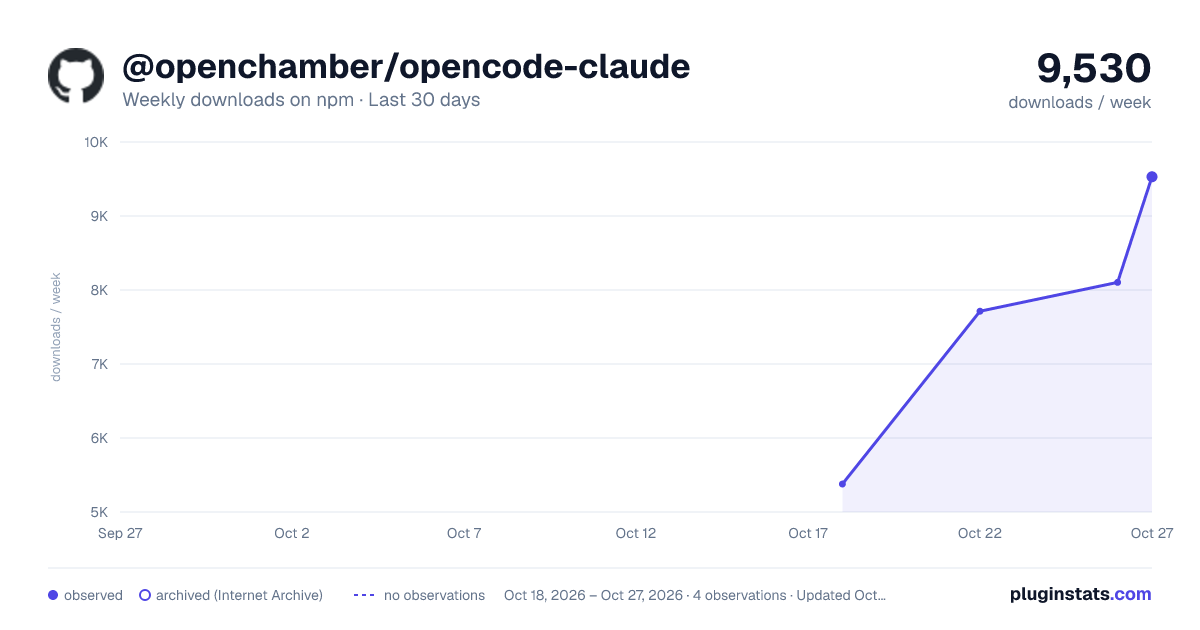
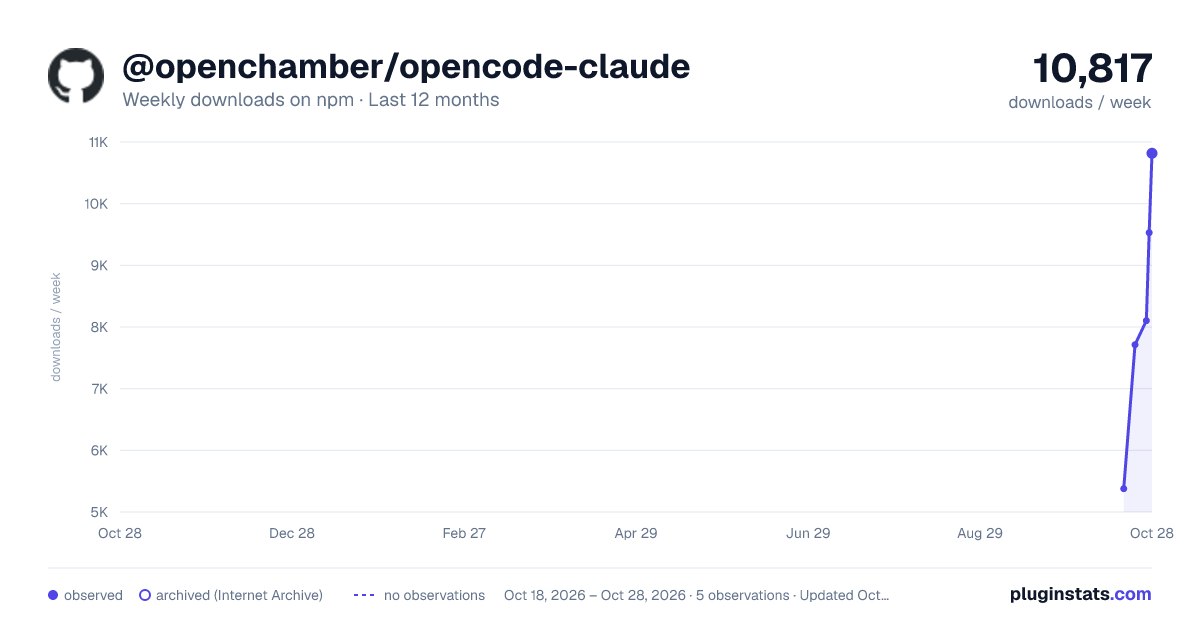
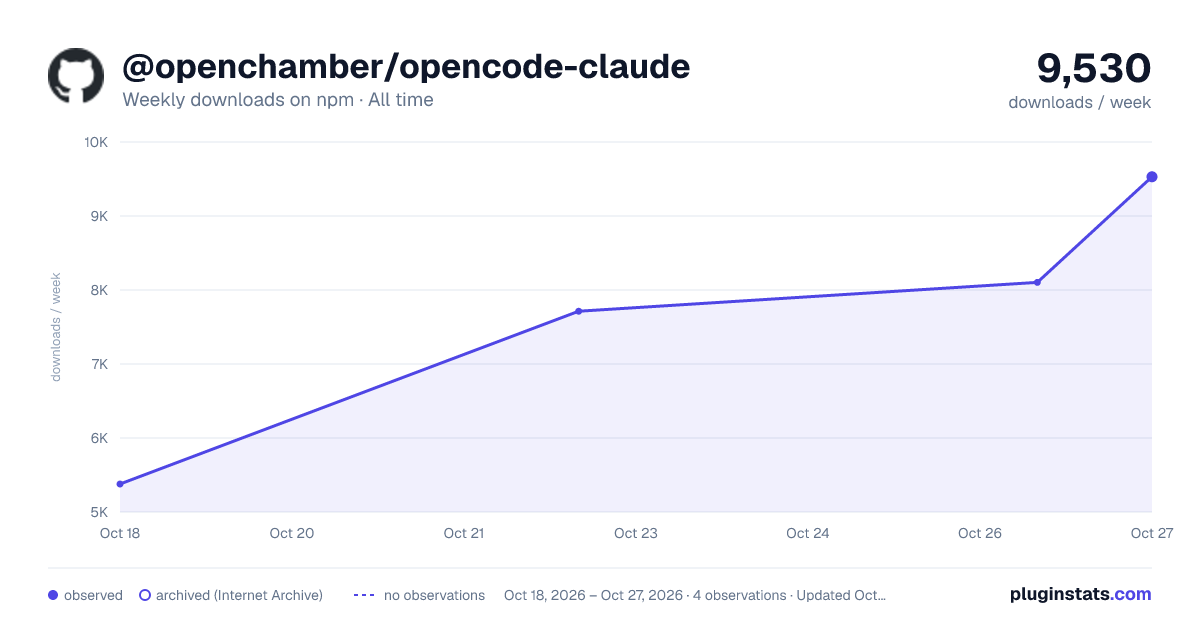

Adoption over time
7/30/90-day growth
Ranking history
Listing placement
Listing placement
Filled points are observed values; hollow points come from Internet Archive snapshots of the listing page. Dashed segments span periods with no observations — values between points are not interpolated.
Each band is one page of 20. Weekly downloads on a linear scale. Placement is projected from weekly downloads, so it can differ from the marketplace's own sort order. Hover a dot to see the listing.
Recent observations
Full history (1)Similar npm Claude Code plugins
All 20 @openchamber/opencode-claude alternativesData source
Weekly downloads (trailing 7 complete days) come from the official npm downloads API. Downloads include CI and mirrors and are not equivalent to installs or users. npm publishes no ratings.
Listing: https://www.npmjs.com/package/@openchamber/opencode-claude. First seen Oct 20, 2026; last successful collection Oct 20, 2026. See the methodology.