 PluginStats
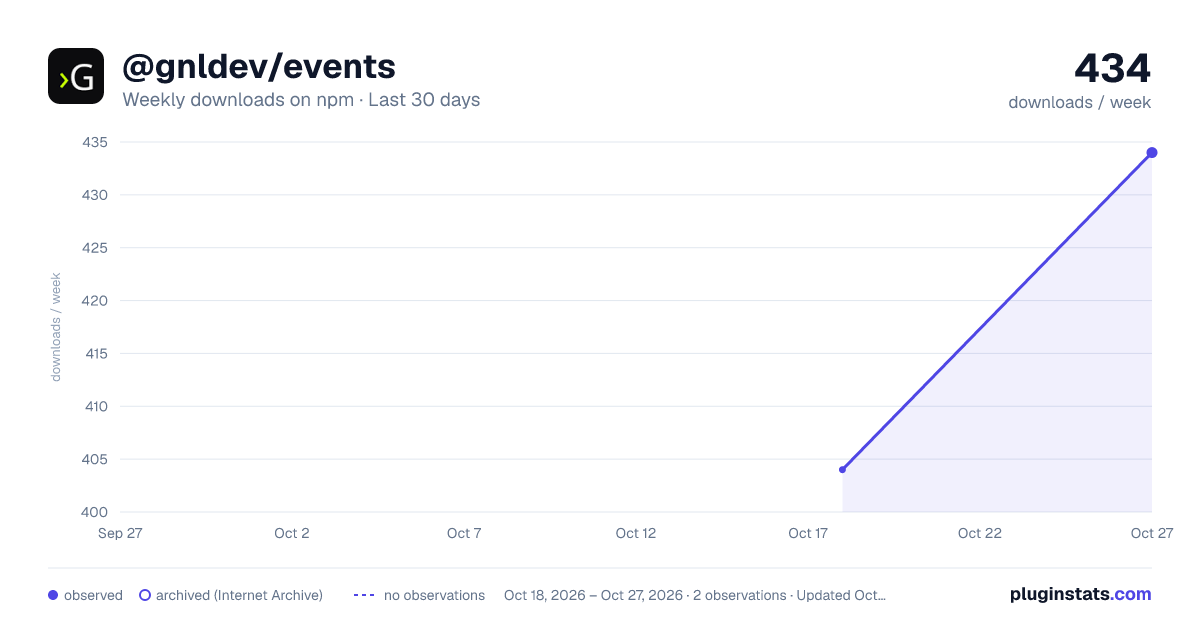
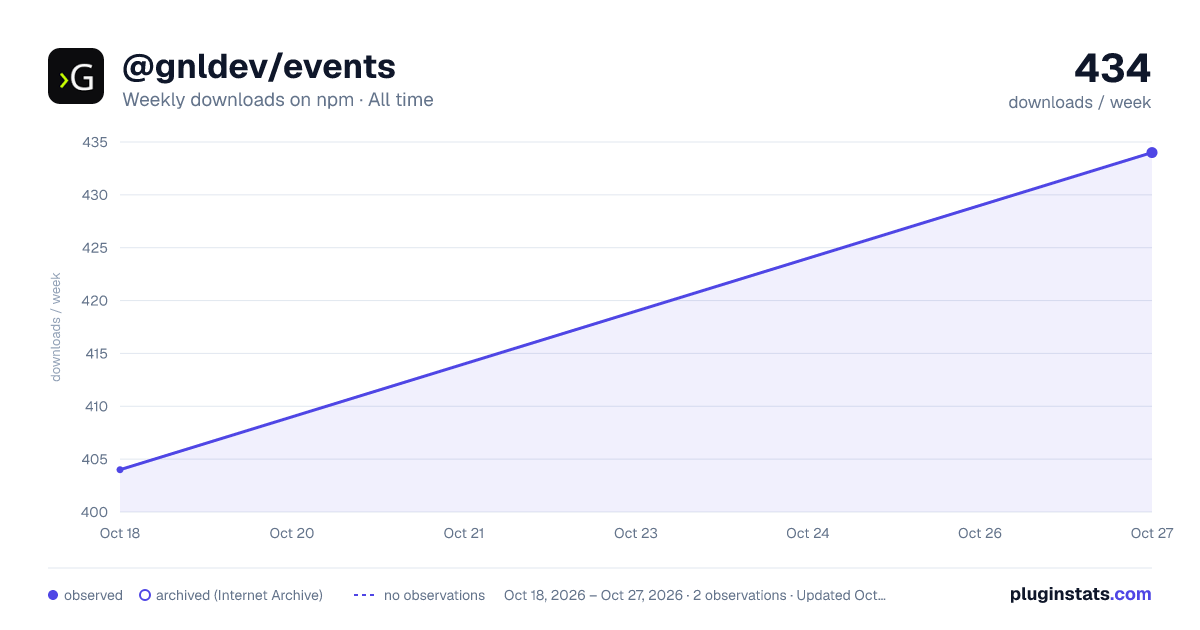
@gnldev/events has 404 recorded weekly downloads on npm.
About @gnldev/events
@gnldev/events
A durable event/notification bus on top of the journal. emit writes to an append-only log; each
consumer processes events with its own ack marker: exactly-once marking + at-least-once delivery. The
marker is written after the handler succeeds — if the handler throws or the process dies, the event
isn't lost, a later poll retries it (on the backoff schedule below, until maxAttempts). The cost: between handler success and marking, a crash (or a
concurrent poll race) can cause redelivery → write the handler as idempotent, or use something durable
inside it (runDurable/claim). Fan-out: N consumers → each gets every event at least once, via its own
marker stream.
Install:
pnpm add @gnldev/events— or use it from a repo clone:pnpm install && pnpm -r build.
npm i @gnldev/events # peer: @gnldev/durable
import { emit, createConsumer } from '@gnldev/events';
import { SqliteStorage } from '@gnldev/durable/sqlite';

const storage = new SqliteStorage('runs.db');   // emit/createConsumer take the WORK store

// Publish (idempotent: same id → a single event).
await emit(storage.work, 'refunds', { orderId: 'o1', amount: 50 }, { id: 'refund-o1' });

// Consume (each consumer name gets its own marker stream; the handler must be idempotent).
const consumer = createConsumer(storage.work, 'refunds', (payload, meta) => notify(payload), { name: 'emailer' });
await consumer.poll();   // or consumer.start()
API
emit(work, topic, payload, { id?, maxDepth?, resourceId?, orgId? }) → eventId—workisstorage.work. With an owner, the handler'smetacarriesresourceId/orgId, so the run it starts is that user's. An explicitidis then a name within that owner (the returned id is the stored one),maxDepthis counted per organization, and an organization-scoped work store is refused (no consumer polls it). A system event (no owner) is stored and delivered exactly as before. The owner never travels in the payload. It is recorded in the id the engine writes (ownedName), andmetais read from that id. A payload that carries its own "owner" field — a forwarded webhook, say — is delivered as bytes, never read as someone's. A systemidor a topic cannot start with the owned-name marker (~o~), so no caller can spell one either.createConsumer(work, topic, handler, { name, pollMs?, backoff?, maxPollMs?, maxAttempts?, retryDelayMs?, leaseMs?, maxHoldMs? }) → { poll, start, stop }—nameis required to separate fan-out acks;maxAttempts/retryDelayMsgovern the dead-letter below.eventEraser(work)erases one person's events on every topic, with every consumer's ack, attempt and dead-letter marker for them, without knowing a topic or consumer name. Pass it toeraseSubjectfrom@gnldev/durablewith the queue's and the scheduler's erasers (example). An owned event's markers are keyed by its id first (evtack:<id>:<topic>:<consumer>); a system event's keys are unchanged. The work store needsdeleteIdPrefixanddeletePrefix, or the eraser throws.listDeadEvents(work, topic, consumer) → DeadEvent[]— everything quarantined for that consumer, withstatus(quarantined|released|delivered),attempts,error,releasesand the originalpayload. A management call: it reads the whole topic log, so don't put it in a poll loop.retryDeadEvent(work, topic, consumer, eventId) → boolean— hands a quarantined event back for delivery to that one consumer (fresh attempt budget, no backoff wait). Calling it again on an event that is stillreleasedis safe and re-asserts the release.falsehas three causes, and the third is not "nothing to do":- the event was never quarantined;
- it has already been delivered (the ack marker is the single source of truth for that);
- the release was abandoned — the dead-letter record kept being rewritten underneath the
read-modify-write faster than it could complete (5 lost compare-and-swaps in a row: two
operators, two tabs, a retry script racing a human). Nothing was overwritten, it is logged on
console.warn, and the remedy is to call it again. Silently clobbering the other writer is the alternative, and the compare-and-swap exists to refuse it: without it, two releases landing together both read the same record and both wrotereleases: n + 1from it — both returnedtrueand the record showedreleases: 1(measured). Distinguish it from (1) and (2) by the record itself: it is still there and stillquarantined.
How it works
An append-only log per topic; consumer ack markers are separated by name → the same event flows to
multiple consumers. Since the marker is written after handler success, the delivery guarantee is
at-least-once: on a handler error the marker isn't written, that consumer's page cursor doesn't advance
past the event, and a later poll retries it; marking itself is exactly-once via CAS (ackOnce).
One failing event does not hold back the ones behind it: the pass keeps going through the rest of the log, only the persisted bookmark stays parked. That parking is what makes retries safe, and it is also why retries are finite — see the dead-letter below.…
Description from the npm listing.
- ai
- agent
- llm
- typescript
- ai-sdk
- durable
- exactly-once
- pubsub
- streaming
README badge
Show your rank in a README or on your website. The badge updates automatically.
Charts
Images: 30d · 1y · all time · 1600×900 dark

Adoption over time
7/30/90-day growth
Ranking history
Listing placement
Listing placement
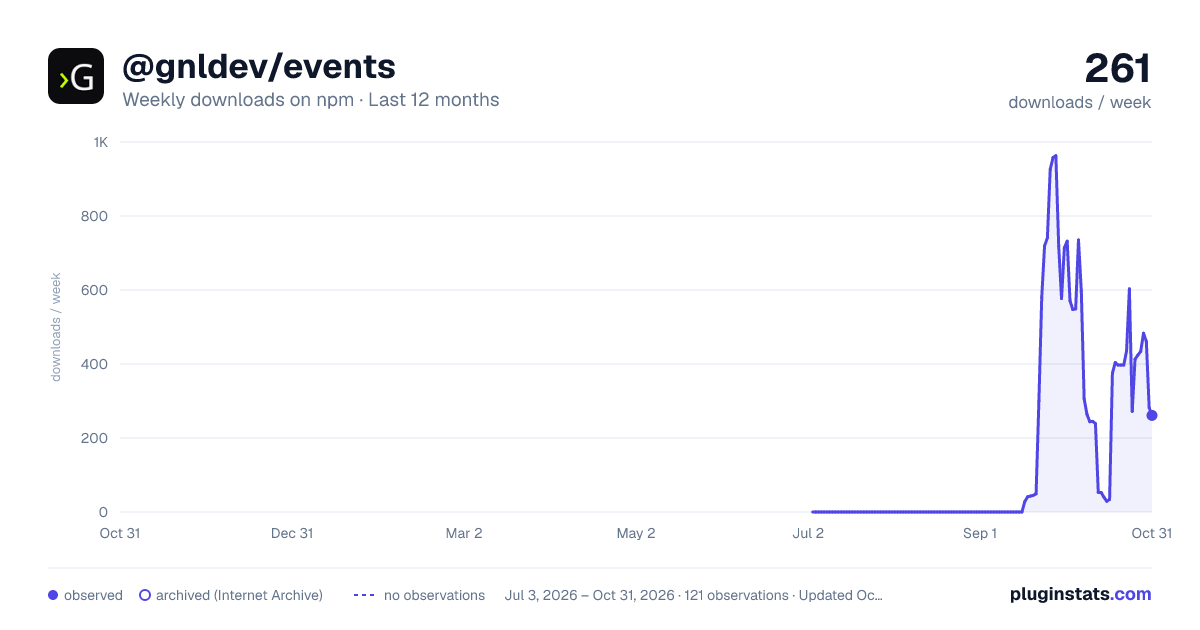
Filled points are observed values; hollow points come from Internet Archive snapshots of the listing page. Dashed segments span periods with no observations — values between points are not interpolated.
Each band is one page of 20. Weekly downloads on a linear scale. Placement is projected from weekly downloads, so it can differ from the marketplace's own sort order. Hover a dot to see the listing.
Recent observations
Full history (1)Similar npm AI SDKs plugins
All 20 @gnldev/events alternativesData source
Weekly downloads (trailing 7 complete days) come from the official npm downloads API. Downloads include CI and mirrors and are not equivalent to installs or users. npm publishes no ratings.
Listing: https://www.npmjs.com/package/@gnldev/events. First seen Oct 22, 2026; last successful collection Oct 22, 2026. See the methodology.