 PluginStats
ruvnet-brain weekly downloads statistics
By stuinfla · npm · Claude Code
One-command installer for RuvNet Brain — a portable, source-grounded brain over rUv's RuvNet building blocks, delivered as a Claude Code plugin so Claude uses the stack instead of fighting it.
ruvnet-brain has 1,430 recorded weekly downloads on npm, ranking #1415 of 2,391 tracked listings.
About ruvnet-brain
Updated: 2026-10-10 10:41:47 EDT | Version 4.6.2 Created: 2026-06-29 22:36:38 EDT
<div align="center">
🧠 RuvNet Brain
Discover the stack. Read the source. Build with confidence.

A source-grounded companion for Claude Code and Codex that helps you find and use Reuven Cohen's (rUv's) RuvNet ecosystem.




▶ Explore the visual walkthrough

<sub>Built by Stuart Kerr at Isovision.ai · open source · MIT licensed</sub>
</div>The RuvNet ecosystem spans agent orchestration, vector search, memory, model routing, testing and more. Finding the right building block is often harder than writing the first line of code. Brain puts the source within reach of your coding assistant and helps it recognize capabilities you may not yet know to ask for.
Ask for the outcome you want. Brain helps connect it to the real tools and code.
Our north star: useful capability discovery. A good answer should explain what helps, why it fits, where it is implemented, and what remains unproven. Retrieval supports that conversation; the goal is helping you build.
Get started · Try it · How it works · Capabilities · Updates · Evidence
What is Brain?
Brain brings three things together:
- A local knowledge bundle built from public RuvNet source and documentation, with searchable passages, source paths, implementation bodies, symbols and capability cards.
- A coding companion delivered through native Claude Code and Codex plugins: the
search_ruvnetMCP tool, skills and lifecycle hooks that encourage source-grounded work. - A local control panel, the RuvNet Brain Console (RNBC), for inspecting your installed environment, choosing supported settings and seeing what actually ran.
It gives the assistant a practical way to read the stack instead of relying on remembered APIs. You can ask by product name, describe a problem, or ask where a capability is implemented. Results identify the repository and file so the answer can be checked.
You keep control. Recommendations, saved settings, executed tools and verified outcomes are different things. Brain's evidence surfaces are designed to show those differences.
Get started
You need Node.js 18 or newer, npm, and a supported Claude Code or Codex installation. Run the installer from your terminal:
npx ruvnet-brain@latest
The installer downloads the signed public knowledge bundle, installs its local reader and
configures the supported hosts it detects. The default Brain home is
~/.cache/ruvnet-brain; the knowledge bundle lives in its kb/ directory. Follow the
installer's host/trust instructions and restart when it reports changed plugin declarations.
Local knowledge retrieval does not require an external embedding API or its API key. Installation and updates download dependencies and release artifacts; your coding host and any optional model providers retain their own account and billing requirements.
Then ask your assistant:
How does Ruflo coordinate agents? Show the source that implements it.
Open the Console in Claude Code or Codex with /rnbc (also /rnb). It opens a local
page and scans your environment. Actions explain their effect before you apply them.
For an installed command, inspect the actual installation:
ruvnet-brain --doctor
If you used the one-shot installer and have no ruvnet-brain command on your PATH, use
npx ruvnet-brain@latest --doctor. Keep routine updates on the installation's existing owner
and path; see stay current.
The installer and local search support macOS, Linux and Windows. Hook delivery and optional executors depend on the host, OS and installed tools. Use
--doctorand actual task receipts to inspect your environment; a registered hook or tool alone does not establish delivery.
Try it on your next task
You do not need to know the repository names first. Start with a concrete need:
- Find a building block: “I need persistent memory for my agents. Which RuvNet options fit, and where are their APIs implemented?”
- Understand a mechanism: “Show me how RVF stores and queries vectors. Cite the source, and separate working implementation from design documents.”
- Plan with evidence: “Compare the RuvNet approaches for routing model calls. Explain the tradeoffs before recommending one.”
- Improve a codebase: “Review this project's agent workflow. Identify a useful capability we already have, then propose the smallest change and how we would verify it.”
- Build with a bounded request: “Use
/brain-buildto add a read-only report to this app, keep existing data intact, and verify the rendered result.” - Resume work: “Come up to speed on this project: what changed, what is still open, and which decisions have source or test evidence?”…
Description from the npm listing.
- ruvnet
- ruv
- ruflo
- ruvector
- rvf
- agentdb
- grounding
- brain
- mcp
- claude-code
- installer
README badge
Show your rank in a README or on your website. The badge updates automatically.
Charts
Images: 30d · 1y · all time · 1600×900 dark
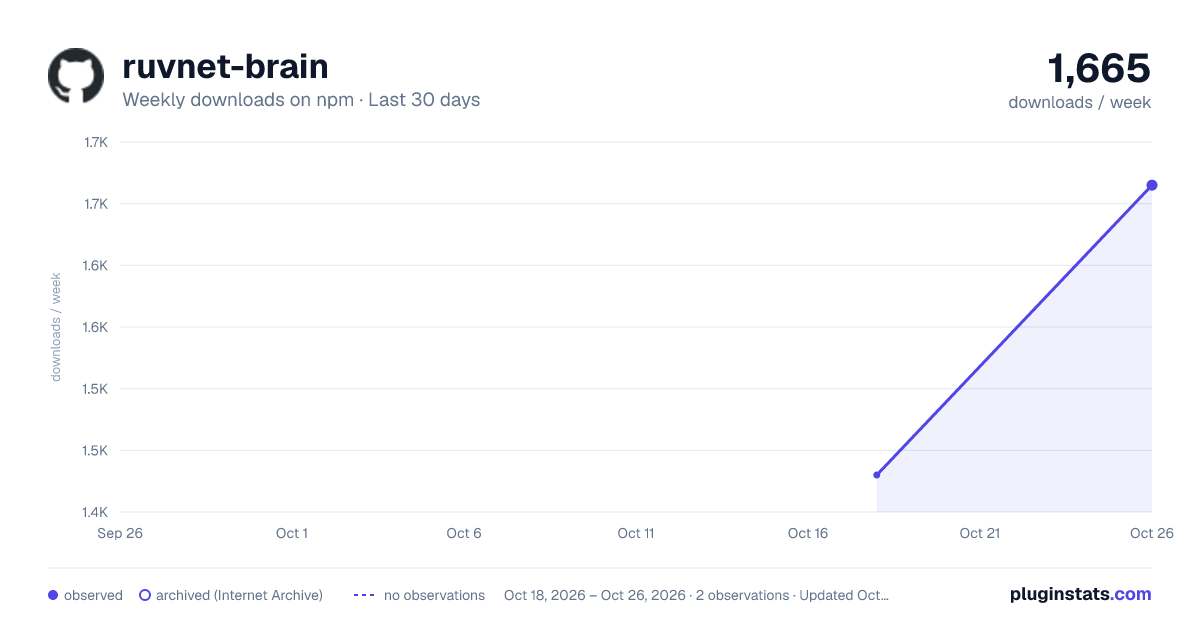
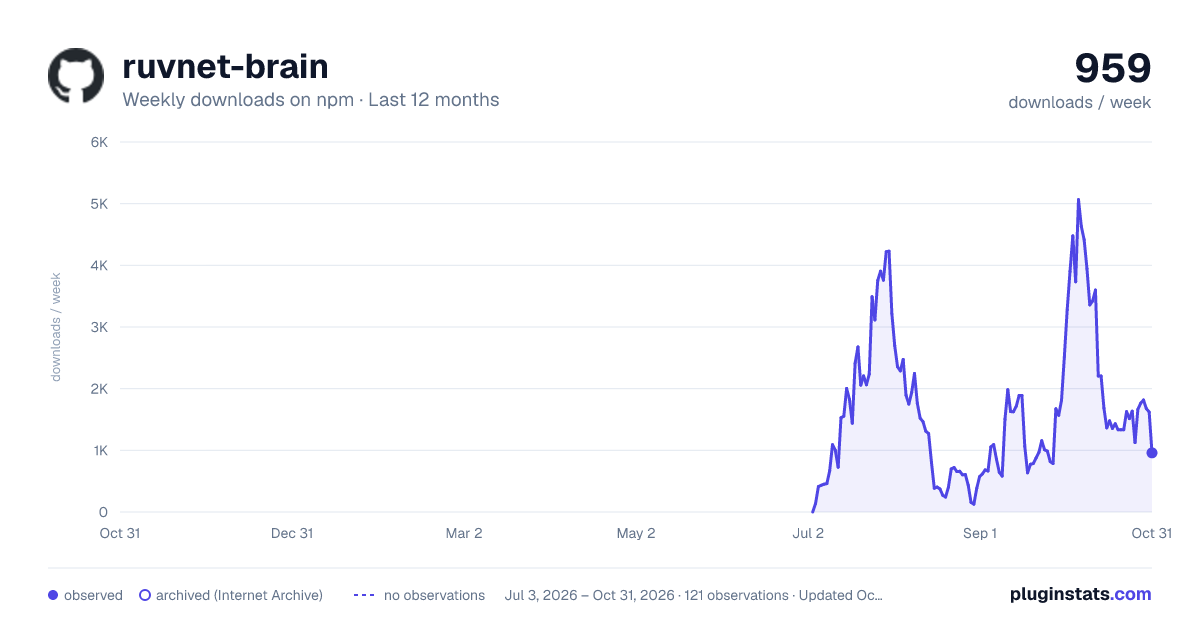
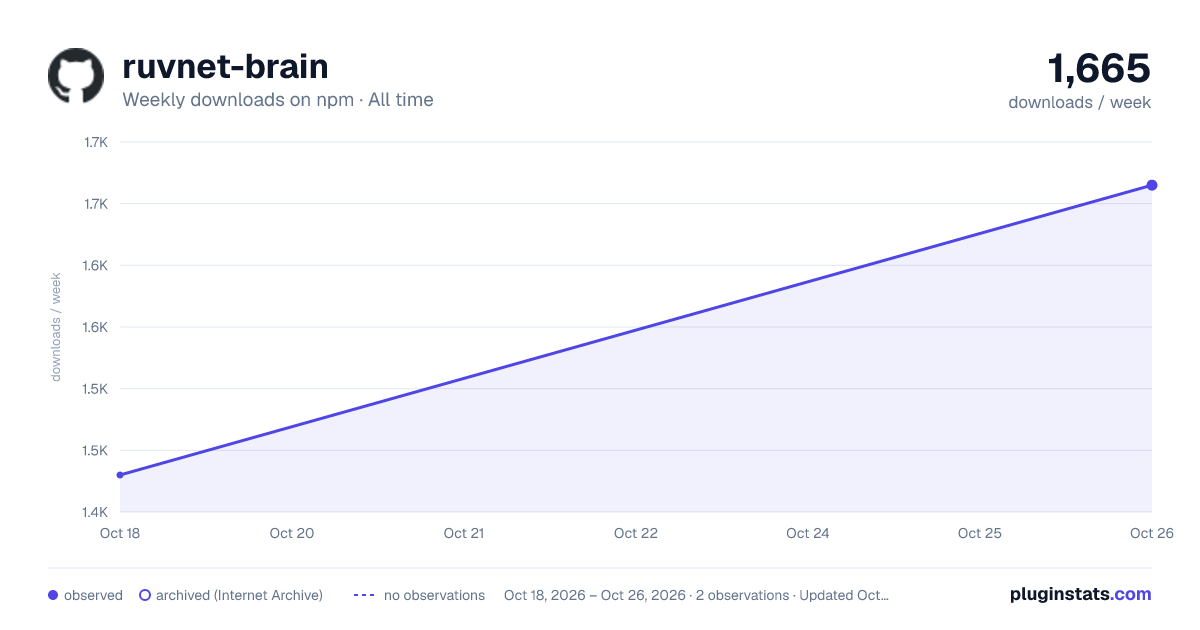

Adoption over time
7/30/90-day growth
Ranking history
Listing placement
Listing placement
Filled points are observed values; hollow points come from Internet Archive snapshots of the listing page. Dashed segments span periods with no observations — values between points are not interpolated.
Each band is one page of 20. Weekly downloads on a linear scale. Placement is projected from weekly downloads, so it can differ from the marketplace's own sort order. Hover a dot to see the listing.
Recent observations
Full history (1)Similar npm Claude Code plugins
All 20 ruvnet-brain alternativesData source
Weekly downloads (trailing 7 complete days) come from the official npm downloads API. Downloads include CI and mirrors and are not equivalent to installs or users. npm publishes no ratings.
Listing: https://www.npmjs.com/package/ruvnet-brain. First seen Oct 21, 2026; last successful collection Oct 21, 2026. See the methodology.