 PluginStats
@modelcontextprotocol/sdk weekly downloads statistics
By modelcontextprotocol (8 listings) · npm · MCP servers
Model Context Protocol implementation for TypeScript
@modelcontextprotocol/sdk has 32,084,621 recorded weekly downloads on npm, a decrease of 35.1% over the past 30 days.
It ranks #12 of 2,251 tracked npm listings by weekly downloads.
Over 90 days, weekly downloads changed by -26.0%.
PluginStats has 543 daily observations since Apr 23, 2025; the latest is from Oct 17, 2026.
About @modelcontextprotocol/sdk
MCP TypeScript SDK
This is v1.x of the MCP TypeScript SDK, the maintenance line. It implements the MCP spec up to 2025-11-25. Support for the 2026-07-28 spec is not planned for v1.x: it is in v2, the current stable release, which ships as separate packages, @modelcontextprotocol/server and @modelcontextprotocol/client. See the v2 documentation and the migration guide.
Staying on v1.x? It continues to receive bug fixes and security updates for at least six months after the v2 release (2026-07-27). The v1 documentation is at .
Table of Contents
• Overview • Installation • Quick Start • Core Concepts • Examples • Documentation • Contributing • License
Overview
The Model Context Protocol allows applications to provide context for LLMs in a standardized way, separating the concerns of providing context from the actual LLM interaction. This TypeScript SDK implements the 2025-11-25 MCP specification, making it easy to:
• Create MCP servers that expose resources, prompts and tools • Build MCP clients that can connect to any MCP server • Use standard transports like stdio and Streamable HTTP
Installation
This SDK has a required peer dependency on zod for schema validation. The SDK internally imports from zod/v4, but maintains backwards compatibility with projects using Zod v3.25 or later. You can use either API in your code by importing from zod/v3 or zod/v4:
Quick Start
To see the SDK in action end-to-end, start from the runnable examples in src/examples:
1. Install dependencies (from the SDK repo root):
2. Run the example Streamable HTTP server:
3. Run the interactive client in another terminal:
This pair of examples demonstrates tools, resources, prompts, sampling, elicitation, tasks and logging. For a guided walkthrough and variations (stateless servers, JSON-only responses, SSE compatibility, OAuth, etc.), see docs/server.md and docs/client.md.
Core Concepts
Servers and transports
An MCP server is typically created with McpServer and connected to a transport such as Streamable HTTP or stdio. The SDK supports:
• Streamable HTTP for remote servers (recommended). • HTTP + SSE for backwards compatibility only. • stdio for local, process-spawned integrations.
Runnable server examples live under src/examples/server and are documented in docs/server.md.
Tools, resources, prompts
• Tools let LLMs ask your server to take actions (computation, side effects, network calls). • Resources expose read-only data that clients can surface to users or models. • Prompts are reusable templates that help users talk to models in a consistent way.
The detailed APIs, including ResourceTemplate, completions, and display-name metadata, are covered in docs/server.md, with runnable implementations in simpleStreamableHttp.ts.
Capabilities: sampling, elicitation, and tasks
The SDK includes higher-level capabilities for richer workflows:
• Sampling: server-side tools can ask connected clients to run LLM completions. • Form elicitation: tools can request non-sensitive input via structured forms. • URL elicitation: servers can ask users to complete secure flows in a browser (e.g., API key entry, payments, OAuth). • Tasks (experimental): long-running tool calls can be turned into tasks that you poll or resume later.
Conceptual overviews and links to runnable examples are in:
• docs/capabilities.md
Key example servers include:
• toolWithSampleServer.ts • elicitationFormExample.ts • elicitationUrlExample.ts
Clients
The high-level Client class connects to MCP servers over different transports and exposes helpers like listTools, callTool, listResources, readResource, listPrompts, and getPrompt.
Runnable clients live under src/examples/client and are described in docs/client.md, including:
• Interactive Streamable HTTP client (simpleStreamableHttp.ts) • Streamable HTTP client with SSE fallback (streamableHttpWithSseFallbackClient.ts) • OAuth-enabled clients and polling/parallel examples
Node.js Web Crypto (globalThis.crypto) compatibility
Some parts of the SDK (for example, JWT-based client authentication in auth-extensions.ts via jose) rely on the Web Crypto API exposed as globalThis.crypto.
See docs/faq.md for details on supported Node.js versions and how to polyfill globalThis.crypto when running on older Node.js runtimes.
Examples
The SDK ships runnable examples under src/examples. Use these tables to find the scenario you care about and jump straight to the corresponding code and docs.
Server examples
| Scenario | Description | Example file(s) | Related docs |…
Description from the npm listing.
- modelcontextprotocol
- mcp
Where @modelcontextprotocol/sdk sits in the listing
Each band is one page of 20. Weekly downloads on a log scale. Placement is projected from weekly downloads, so it can differ from the marketplace's own sort order. Hover a dot to see the listing.


Charts
Images: 30d · 1y · all time · 1600×900 dark
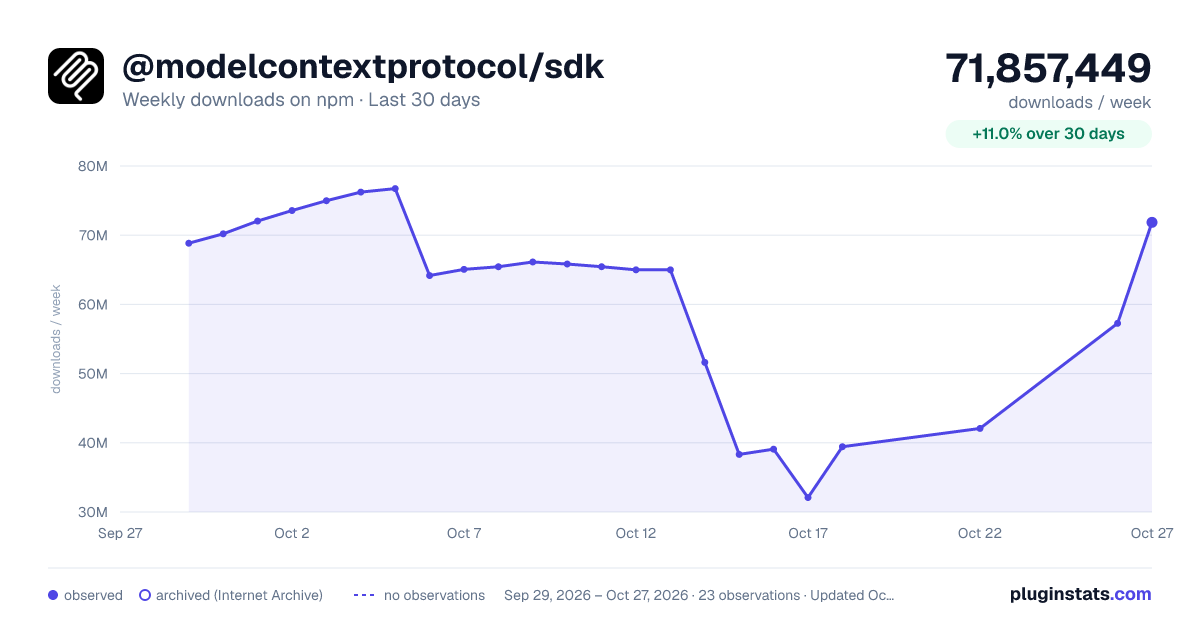

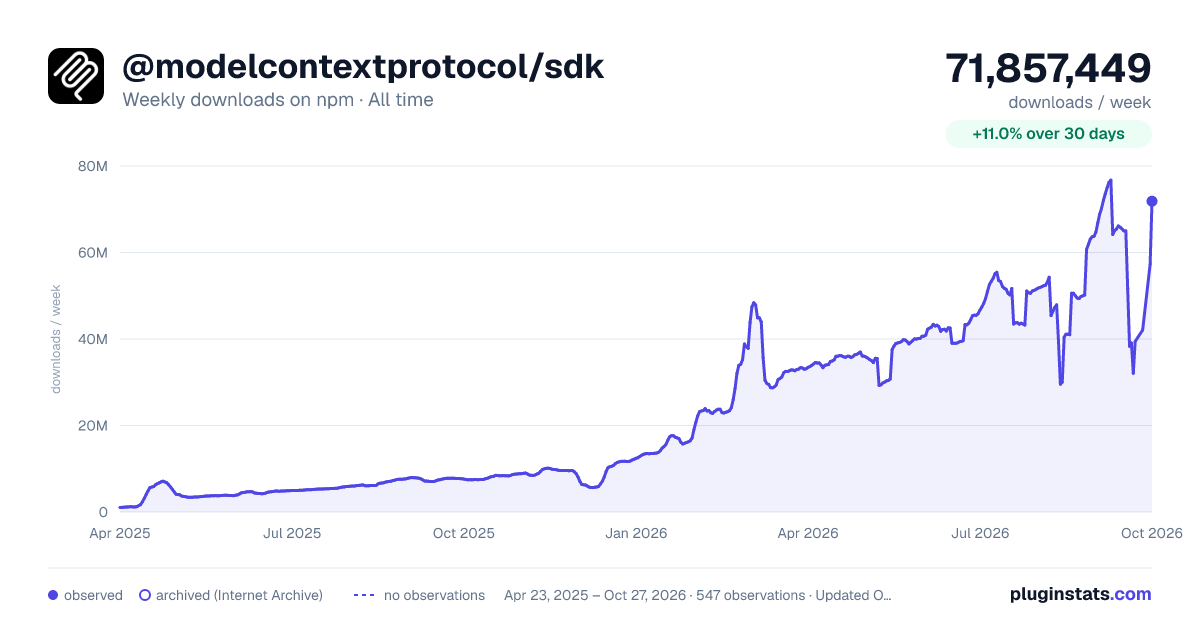

Adoption over time


7/30/90-day growth


Filled points are observed values; hollow points come from Internet Archive snapshots of the listing page. Dashed segments span periods with no observations — values between points are not interpolated.
Recent observations
Full history (543)Similar npm MCP servers plugins
Data source
Weekly downloads (trailing 7 complete days) come from the official npm downloads API. Downloads include CI and mirrors and are not equivalent to installs or users. npm publishes no ratings.
Listing: https://www.npmjs.com/package/@modelcontextprotocol/sdk. First seen Oct 16, 2026; last successful collection Oct 18, 2026. See the methodology.