 PluginStats
rea-agents weekly downloads statistics
By morluto · npm · MCP servers
Reverse engineer anything from your terminal or agent with one CLI and MCP server.
rea-agents has 272,444 recorded weekly downloads on npm, an increase of 204745% over the past 30 days.
It ranks #314 of 2,251 tracked npm listings by weekly downloads.
Over 90 days, weekly downloads changed by +12183%.
PluginStats has 121 daily observations since Jun 19, 2026; the latest is from Oct 17, 2026.
About rea-agents
English · 简体中文 · 繁體中文 · 日本語 · 한국어 · Türkçe · Русский · Tiếng Việt · ไทย · Deutsch · Español · Français · Українська · Polski · Português (Brasil) · العربية · فارسی · Bahasa Indonesia · Italiano · Ελληνικά
REA: Reverse Engineer Anything
One MCP for reverse engineering across binaries, applications, and runtime behavior.
See a feature you like. Understand how it works, down to the binary level.
Website · Guides · Showcases
Quick start · How REA works · What you can analyze · Showcases · FAQ · Documentation
npx rea-agents setup
[!IMPORTANT] Get REA from morluto/rea, rea.tools, or the rea-agents npm package. Follow the installation and release links from these official sources. A similar repository name or copied README does not establish that a download is official.
Join the Reverse Engineering Community Discord · Q&A · Show and Tell
See a feature in an app that you want in your own product? Ask your agent to investigate it with REA. It can inspect the app without its source code, explain how the feature works, show the evidence, and build a version for your project.
REA connects your agent to tools for inspecting native binaries, JavaScript and Electron apps, .NET assemblies, and websites. You can also use the same tools from your terminal. Analysis runs locally, and results include the evidence and limitations behind each conclusion.
Setup registers REA with your agent and installs matching workflow instructions. Native analysis can use an existing Hopper, Ghidra, or IDA installation; setup can optionally install Hopper with approval. Static JavaScript analysis needs no native analysis engine.
Visit the REA website for setup instructions, illustrated guides, and real case studies.
Quick start
On Linux, Ghidra, JADX, firmware tool launches and static JavaScript/Electron analysis require a procps-compatible ps on REA's PATH for process ownership checks. Recovery steps are in docs/installation.md under "Linux owned-process prerequisite".
Set up your agent
With Node.js and npm installed, run:
Choose your agents, review the proposed changes, and approve them. Setup adds REA's MCP server and matching workflow instructions, with backups of existing configuration. Restart your agent afterward.
Setup supports Claude Code, Codex, Cursor, Gemini CLI, Grok Build and other agents. See installation and setup for provider configuration and manual MCP registration.
Ask your agent
Replace Notes with your target app and the feature you want to understand.
Use the terminal
Inspect an extracted JavaScript/Electron app directory or ASAR:
The result includes modules, imports, Electron boundaries and their evidence. Replace the path with your target, such as "D:/apps/example" on Windows.
To install the rea command for regular use:
For native analysis, configure a provider first. See the CLI and Evidence guide for native commands, provider selection, snapshots and scripting.
Update REA
REA changes quickly, and new releases include frequent bug fixes. Keep your installation up to date.
For a CLI installed with npm install --global or bun add --global:
Bun global updates require Bun 1.2.17 or later. With an older Bun release, upgrade Bun manually before running rea update.
To refresh your agent registrations and skill, run the setup command printed by the update.
If you use npx, update your agent setup with:
Review the setup changes and restart your agent. For one-off CLI commands, use npx rea-agents@latest followed by the command. With Bun, use bunx rea-agents@latest in place of npx rea-agents@latest.
How REA works
Your agent calls REA through MCP to inspect the target and trace relevant code. REA returns findings with their evidence. The agent uses them to ask follow-up questions, explain the behavior, or write and test an implementation. CLI commands use the same workflows.
Open the full-size figure.
What you can analyze
REA requires Node.js 22.x (>=22.19), 24.x (>=24.11), or 26+, plus npm. Additional tools and host support depend on the target:
| Target | What REA returns | Requirements and guide |…
Description from the npm listing.
- reverse-engineering
- binary-analysis
- agents
- agent-skills
- cli
- mcp-server
- model-context-protocol
- static-analysis
- rea
- decompiler
- mcp
- hopper
- electron
- javascript-analysis
- ghidra
- ida
Where rea-agents sits in the listing
Each band is one page of 20. Weekly downloads on a log scale. Placement is projected from weekly downloads, so it can differ from the marketplace's own sort order. Hover a dot to see the listing.


Charts
Images: 30d · 1y · all time · 1600×900 dark
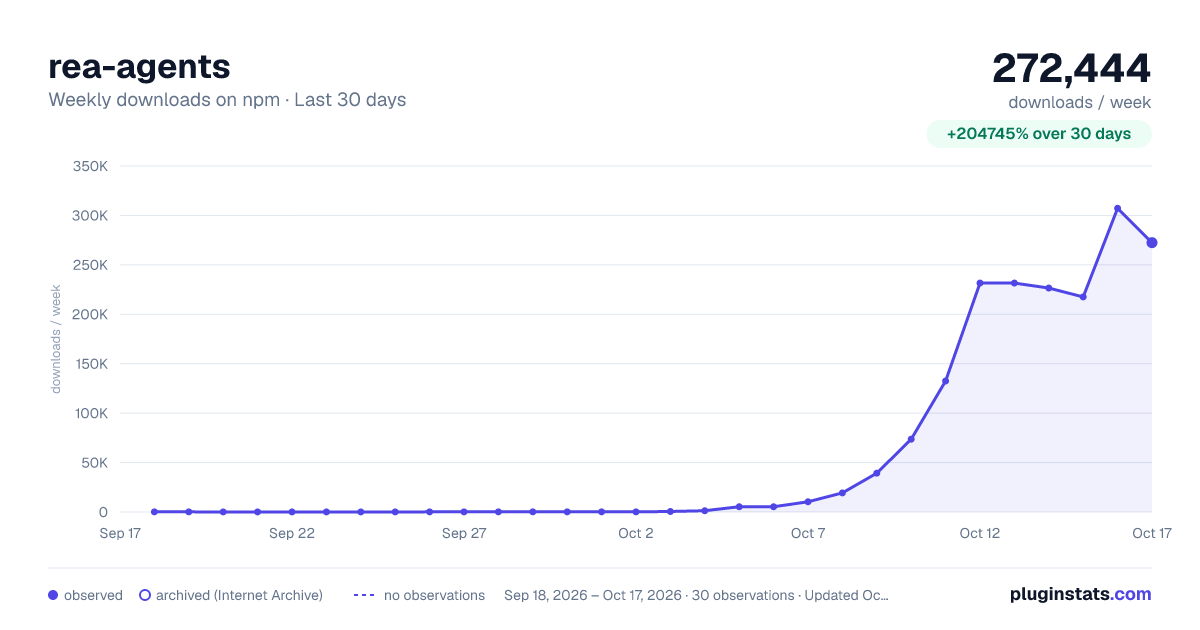

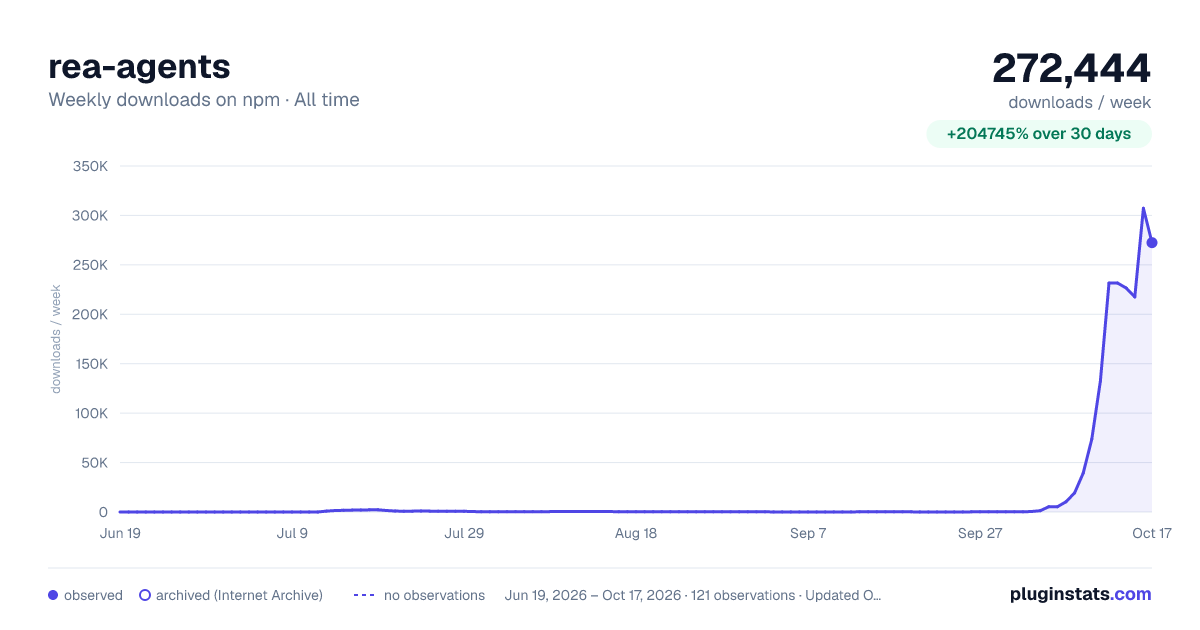

Adoption over time


7/30/90-day growth


Filled points are observed values; hollow points come from Internet Archive snapshots of the listing page. Dashed segments span periods with no observations — values between points are not interpolated.
Recent observations
Full history (121)Similar npm MCP servers plugins
Data source
Weekly downloads (trailing 7 complete days) come from the official npm downloads API. Downloads include CI and mirrors and are not equivalent to installs or users. npm publishes no ratings.
Listing: https://www.npmjs.com/package/rea-agents. First seen Oct 16, 2026; last successful collection Oct 18, 2026. See the methodology.