 PluginStats
@byokit/realtime has 695 recorded weekly downloads on npm.
About @byokit/realtime
@byokit/realtime
Realtime voice sessions with injected audio and provider adapters in a child process. First consumer: muxr.
import { realtimeClient, type AudioPorts, type RealtimeHostFrame, type RealtimeStream } from '@byokit/realtime';
import { realtimeEngine, toolBridge } from '@byokit/realtime/node';

// The app supplies its sign-in, carrier, audio implementation and authorized planner.
declare const accounts: { access(member: number, signal?: AbortSignal): Promise<{ access: string; accountId: string }> };
declare const emit: (frame: RealtimeHostFrame) => void;
declare const runPlanner: (request: string, signal: AbortSignal) => Promise<string>;
declare const openVoiceStream: () => Promise<RealtimeStream>;
declare const audio: AudioPorts;
const member = 1;
const tools = [{ name: 'delegate', description: 'Handle a spoken request', parameters: { type: 'object', properties: { request: { type: 'string' } } } }];
const bridge = toolBridge({
  tools, handlers: { delegate: async (args, { signal }) => runPlanner(String(args.request), signal) },
  emit, failure: () => 'That request could not be completed.',
});
const engine = realtimeEngine({
  engine: 'chatgpt', auth: { kind: 'plan', access: signal => accounts.access(member, signal) },
  tools, bridge, instructions: 'Answer briefly.', emit,
});
// Forward device frames to engine.receive(frame); engine.close() ends the child.
const client = realtimeClient({
  open: openVoiceStream, audio,
  onStatus: status => console.log(status),
  onTurn: (role, text) => console.log(role, text),
});
For ChatGPT voice register a delegate tool handler receiving { request } and supply the app's planner. API routes use auth: { kind: 'key', key }, with billing per use. The subscription route uses the person's ChatGPT sign-in from @byokit/accounts; it never reads Codex credentials or starts the Codex CLI. Backend refusal is reported as not-included.
Structured delegation and named targets
delegationHandler dispatches a JSON request of the form { name, arguments }
directly through an app-supplied toolBridge. For ordinary spoken requests it
uses the optional app planner. Invalid structured requests never enter the planner.
Keep the action bridge separate from the outer delegate bridge:
import { delegationHandler, toolBridge } from '@byokit/realtime/node';
import type { ToolHandler } from '@byokit/realtime/node';
import type { RealtimeHostFrame } from '@byokit/realtime';

declare const emit: (frame: RealtimeHostFrame) => void;
declare const sendAuthorizedMessage: ToolHandler;
declare const plan: (request: string, context: Parameters<ToolHandler>[1]) => Promise<string>;
const actionTools = [{ name: 'message', description: 'Message a named agent', parameters: {
  type: 'object', properties: { agent: { type: 'string' }, text: { type: 'string' } },
  required: ['agent', 'text'], additionalProperties: false,
} }];
const actions = toolBridge({ tools: actionTools, handlers: { message: sendAuthorizedMessage },
  emit, failure: () => 'The message could not be confirmed.', timeoutFor: () => 75000 });
const delegate = delegationHandler({ bridge: actions, plan });
const tools = [{ name: 'delegate', description: 'Delegate a spoken request', parameters: { type: 'object' } }];
const bridge = toolBridge({ tools, handlers: { delegate }, emit,
  timeoutFor: () => 340000, failure: () => 'The request could not be confirmed.' });
// Pass the outer bridge and its delegate tool to realtimeEngine.
// A structured request can be:
// {"name":"message","arguments":{"agent":"Avery","text":"Please report progress"}}
// Close actions as well as the outer bridge when the session ends.
The kit preserves arguments and operation ids; retries with the same call id
share a result. Named targets, target lookup, ambiguity checks, authorization,
argument validation and mutation receipts belong to the app's handlers. Tool
JSON schemas describe the provider catalog; they are not runtime authorization.
The app planner owns its model, conversation memory, tool budget and deadline;
the kit does not add a planner model or any agent runtime dependency. Aborted
calls must stop in the app too; completed side effects are never rolled back.
The host bridge owns every tool watchdog and failure message; the child has no
second deadline. A 340-second planner or a 290-second watch can therefore use
the app's declared budget. An ordinary ChatGPT user turn preserves unfinished
delegations and their retransmission cache. Explicit interrupt or close aborts
them; a new turn id still identifies a new request.
Advisory auth check
Pass a read-only saved-sign-in lookup as authCheck on the engine. It starts
independently, is never awaited by startup, and cannot close the session. It
does not call auth.access, refresh a token, run a CLI or initiate login.
The app's peek callback must also never refresh, prompt or start login.
import { realtimeEngine, toolBridge } from '@byokit/realtime/node';
import type { RealtimeAuth, RealtimeHostFrame, RealtimeTool, RealtimeAuthPeekResult, RealtimeAuthResult } from '@byokit/realtime';

declare const auth: Extract<RealtimeAuth, { kind: 'plan' }>;
declare const tools: RealtimeTool[];
declare const bridge: ReturnType<typeof toolBridge>;
declare const emit: (frame: RealtimeHostFrame) => void;
declare const peekSavedSignIn: (signal: AbortSignal) => Promise<RealtimeAuthPeekResult>;
declare const updateSettingsBadge: (status: 'ready' | 'signed-out' | 'unknown') => void;
declare const showSignInMessage: (result: RealtimeAuthResult) => void;
const engine = realtimeEngine({
  engine: 'chatgpt', auth,
  tools, bridge, emit,
  authCheck: { peek: peekSavedSignIn, onStatus: status => updateSettingsBadge(status), onResult: showSignInMessage },
});
```…
Description from the npm listing.
- typescript
- ai
- ai-sdk
- react-native
- web
- privacy
README badge
Show your rank in a README or on your website. The badge updates automatically.
Charts
Images: 30d · 1y · all time · 1600×900 dark
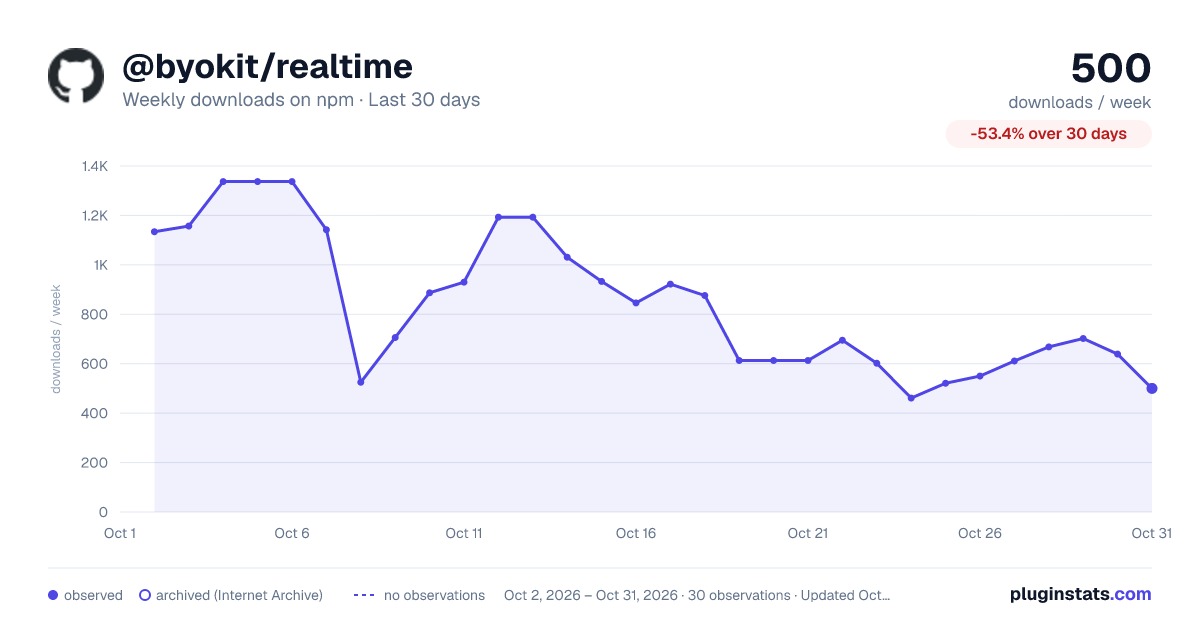
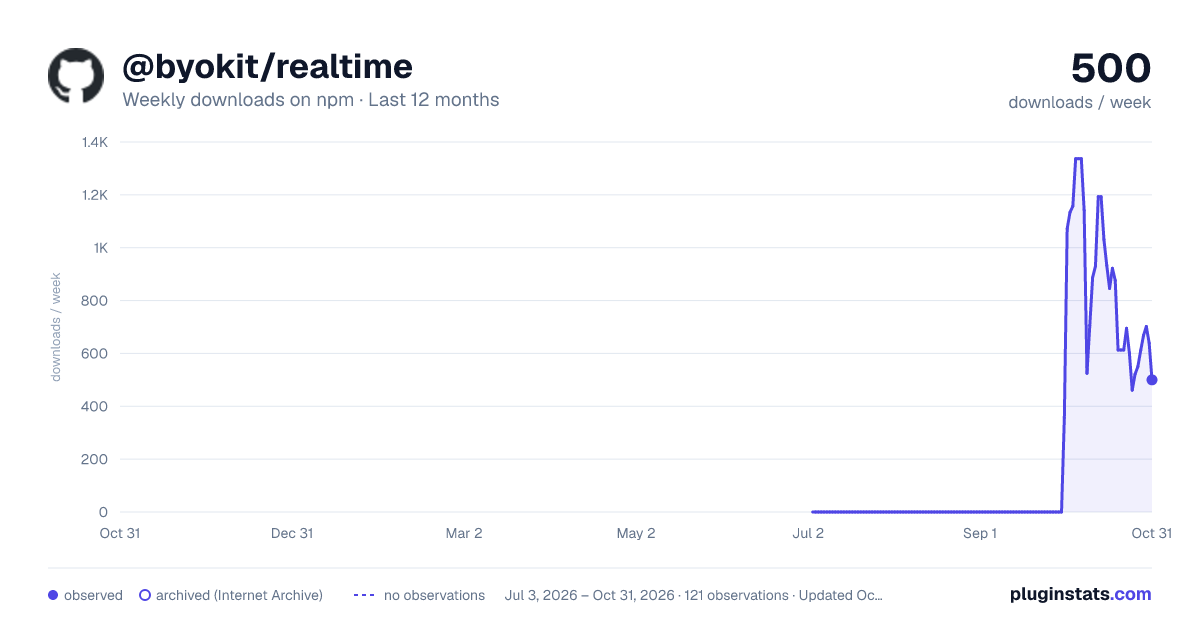
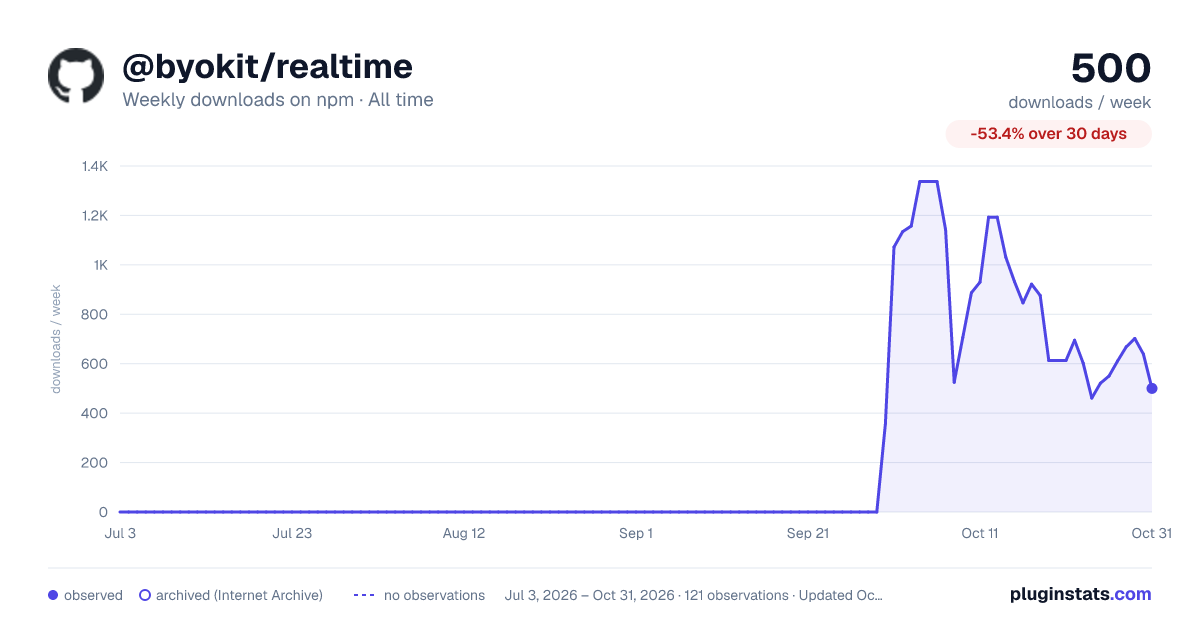

Adoption over time
7/30/90-day growth
Ranking history
Listing placement
Listing placement
Filled points are observed values; hollow points come from Internet Archive snapshots of the listing page. Dashed segments span periods with no observations — values between points are not interpolated.
Each band is one page of 20. Weekly downloads on a linear scale. Placement is projected from weekly downloads, so it can differ from the marketplace's own sort order. Hover a dot to see the listing.
Recent observations
Full history (1)Similar npm AI SDKs plugins
All 20 @byokit/realtime alternativesData source
Weekly downloads (trailing 7 complete days) come from the official npm downloads API. Downloads include CI and mirrors and are not equivalent to installs or users. npm publishes no ratings.
Listing: https://www.npmjs.com/package/@byokit/realtime. First seen Oct 26, 2026; last successful collection Oct 26, 2026. See the methodology.