 PluginStats
@miller-tech/uap weekly downloads statistics
By miller-tech · npm · Claude Code
Autonomous AI agent memory system with CLAUDE.md protocol enforcement
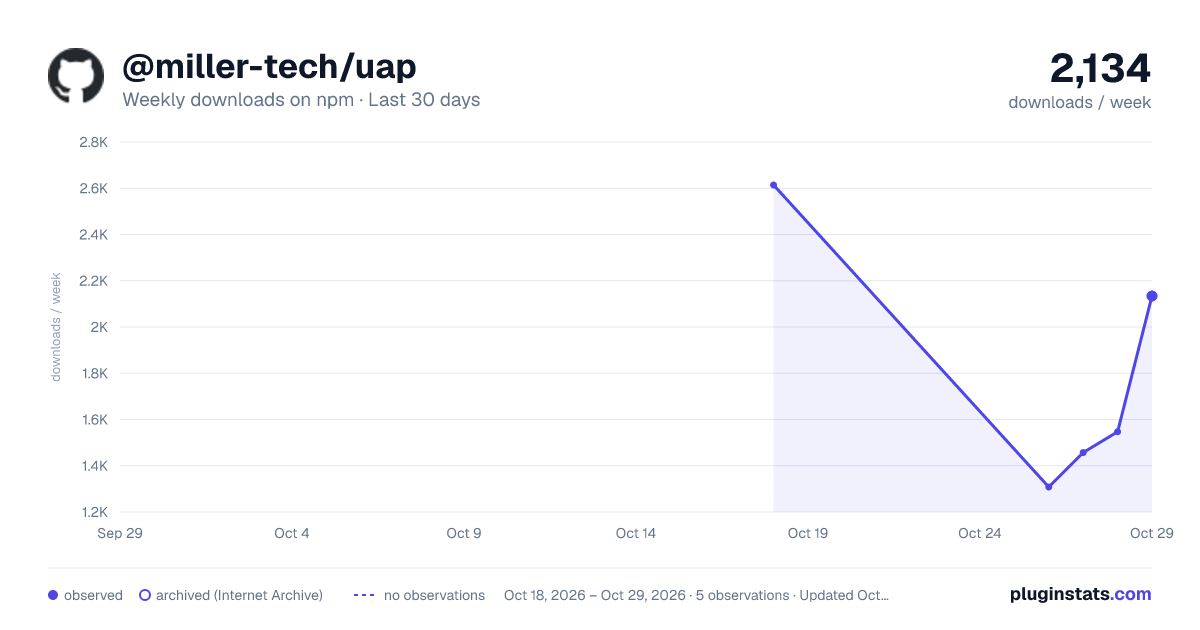
@miller-tech/uap has 2,614 recorded weekly downloads on npm, ranking #1297 of 2,391 tracked listings.
About @miller-tech/uap
Universal Agent Protocol (UAP)
The discipline layer that turns a talented-but-unreliable AI coding agent into a dependable member of your software delivery line.




447 TypeScript modules across 34 subsystems · 530 vitest suites (~6,250 tests, + a ~1,400-test Python enforcer/proxy suite) · 9 agent harnesses
Quickstart · Why UAP? · Origin & principle · The delivery pipeline · uap deliver · Docs
Origin & principle
UAP is a Miller-Tech tool built for real delivery floors. The failures it targets are the ones that keep recurring in agentic development — "done" code that never ran, edits on main, forgotten decisions, prose architecture rules that blocked nothing, agents that stall on any question or silently decide for you. The fix that works, every time, is the same: turn the software-engineering practice into an executable check the agent cannot route around. Enforce, don't suggest.
That principle became UAP — a discipline layer installed underneath the agent harness, putting a verification station at every point where agentic development actually breaks. It is hardened under its own gates (worktree isolation, parallel review, evidence-bound shipping), which makes the tool the proof of its own thesis. Design decisions are recorded in the ADR set; inspirations and prior art are credited in docs/ATTRIBUTION.md.
Why UAP?
Shipping software with an AI agent is a lot like running a small factory floor. Intent comes in one end; working, verified, merged code should come out the other. In between are stations — understand the job, set up a bench, build it, check it actually works, ship it — and a jam at any one of them quietly ruins everything downstream.
Coding agents are capable but undisciplined line workers. They forget yesterday's shift, grab the wrong tool, build something that looks right, stamp it "done" without plugging it in, and trip over the other workers on the floor. That's not a problem you fix by swapping in a smarter model — it's a process problem. UAP is the process: it sits underneath your agent harness (Claude Code, Factory, Cursor, OpenCode, and more) and puts a station at every point where the line usually breaks — no model change required.
| Where the line jams | What UAP puts there | What you get |
|---|---|---|
| Agent starts every session amnesiac | 4-tier memory with semantic recall + write-gates | It remembers your codebase and past decisions |
| Tool output floods the context window | MCP Router — tool-hiding + output compression | Up to ~98% smaller on big tool calls |
| "Looks right" but doesn't run | uap deliver — a loop against your real gates | Code that compiles, not a mock-up of it |
| Agent grades its own homework | Execution/runtime verify + a separate acceptance judge | "Done" means verified done |
| Two agents clobber each other | Worktree isolation + live file coordination | Conflict-free parallel work |
| "Guidelines" get ignored | Policy gates as executable hooks, not prose | Violations are blocked, not politely suggested |
| Same mistake, every session | Memory promotion + pattern learning | The floor gets better every run |
| The agent stalls on any question — or silently decides for you | Attention queue + AFK auto-decider | Asks are recorded with a safe default and work continues; unattended adoption is logged, never silent |
| Fast tasks idle behind slow siblings | Completion-triggered dispatch | A finished task's slot refills instantly; dependents start the moment their last dependency settles |
| Plans the agent can't follow; it guesses its own tooling | Plan readability gate + self-knowledge card | Legible plans; the agent answers "how do I X" from its own version-pinned card |
→ Take the full station-by-station tour: The UAP Delivery Pipeline.
Quickstart
# Install globally
npm install -g @miller-tech/uap

# One friendly, arrow-key guided setup in your project
cd your-project
uap setup
uap setup walks you through the whole line — memory, patterns, policy gates, model routing, multi-agent coordination, and the verification gates — and wires it into every agent session. Take the defaults and you're one Enter away from a disciplined agent.
uap memory query "how did we handle auth last time?"   # semantic recall
uap deliver "add rate limiting to the API"             # drive a model to verified completion
uap dashboard overview                                  # live task / agent / memory state
The deliver harness
The two stations that matter most are Build and QC, and uap deliver owns both. It's a convergence loop that iterates a model against your project's real completion gates until the work is actually delivered — build passes, tests pass, lint is clean — not until the model thinks it's done.
uap deliver "implement the password reset flow"
What happens under the hood:…
Description from the npm listing.
- claude
- claude-code
- factory-ai
- opencode
- forgecode
- vscode
- ai-agent
- context
- memory
- worktree
- cli
README badge
Show your rank in a README or on your website. The badge updates automatically.
Charts
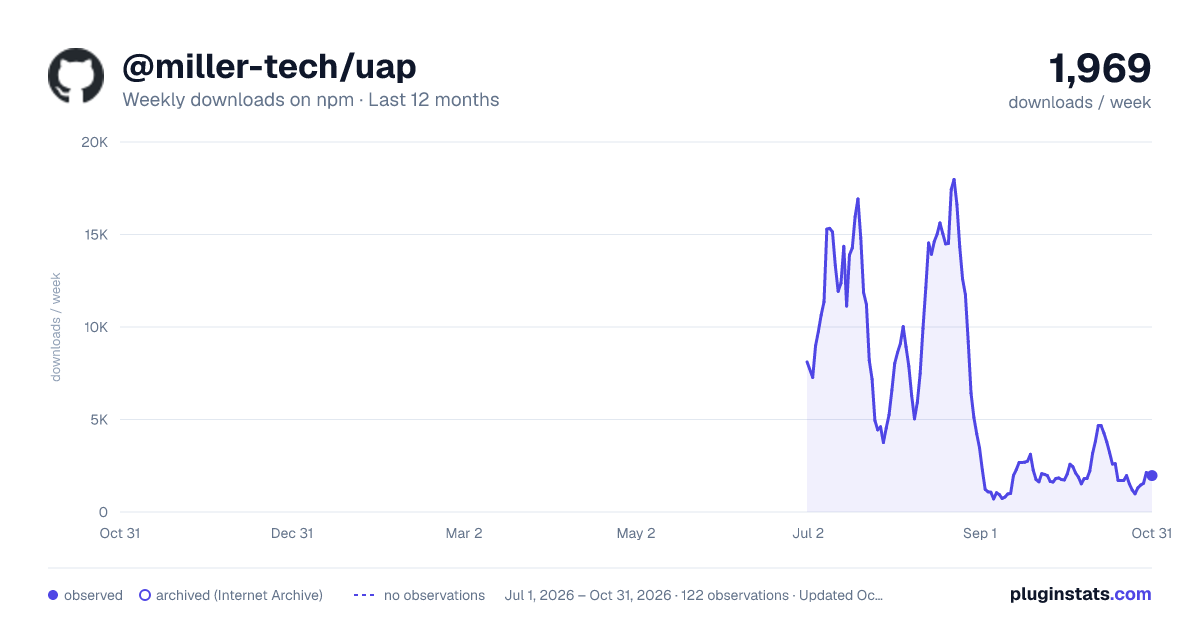
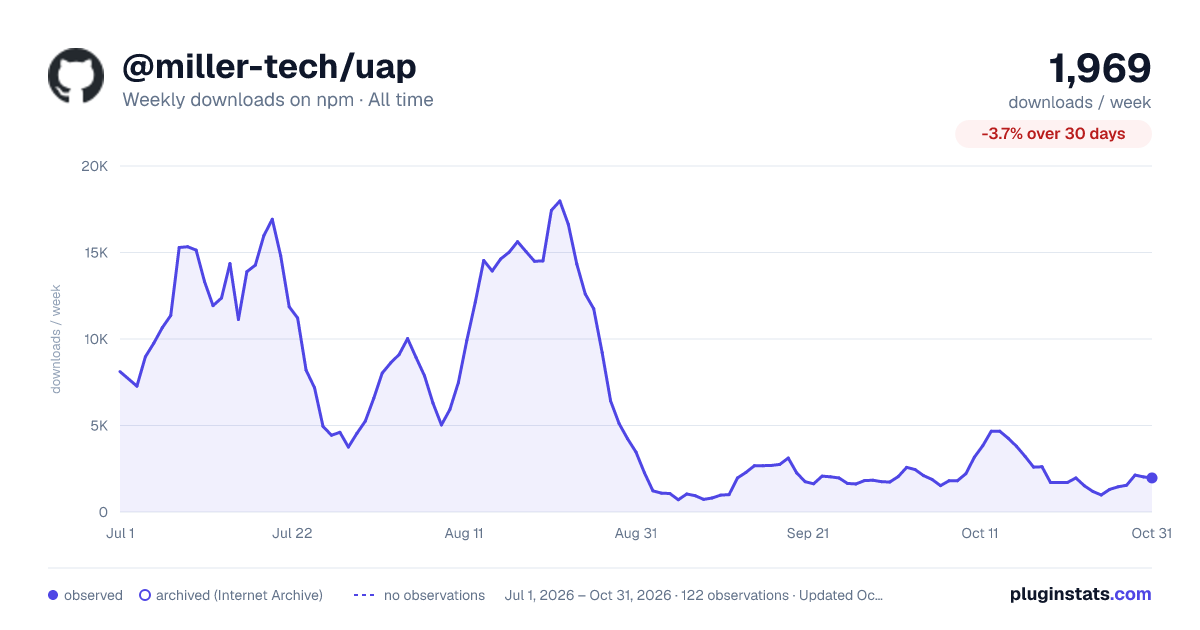
Images: 30d · 1y · all time · 1600×900 dark

Adoption over time
7/30/90-day growth
Ranking history
Listing placement
Listing placement
Filled points are observed values; hollow points come from Internet Archive snapshots of the listing page. Dashed segments span periods with no observations — values between points are not interpolated.
Each band is one page of 20. Weekly downloads on a linear scale. Placement is projected from weekly downloads, so it can differ from the marketplace's own sort order. Hover a dot to see the listing.
Recent observations
Full history (1)Similar npm Claude Code plugins
All 20 @miller-tech/uap alternativesData source
Weekly downloads (trailing 7 complete days) come from the official npm downloads API. Downloads include CI and mirrors and are not equivalent to installs or users. npm publishes no ratings.
Listing: https://www.npmjs.com/package/@miller-tech/uap. First seen Oct 21, 2026; last successful collection Oct 21, 2026. See the methodology.