 PluginStats
eharness weekly downloads statistics
Build your own agent harness on AI SDK v7: plugins, context, messages, streaming, sessions, compaction.
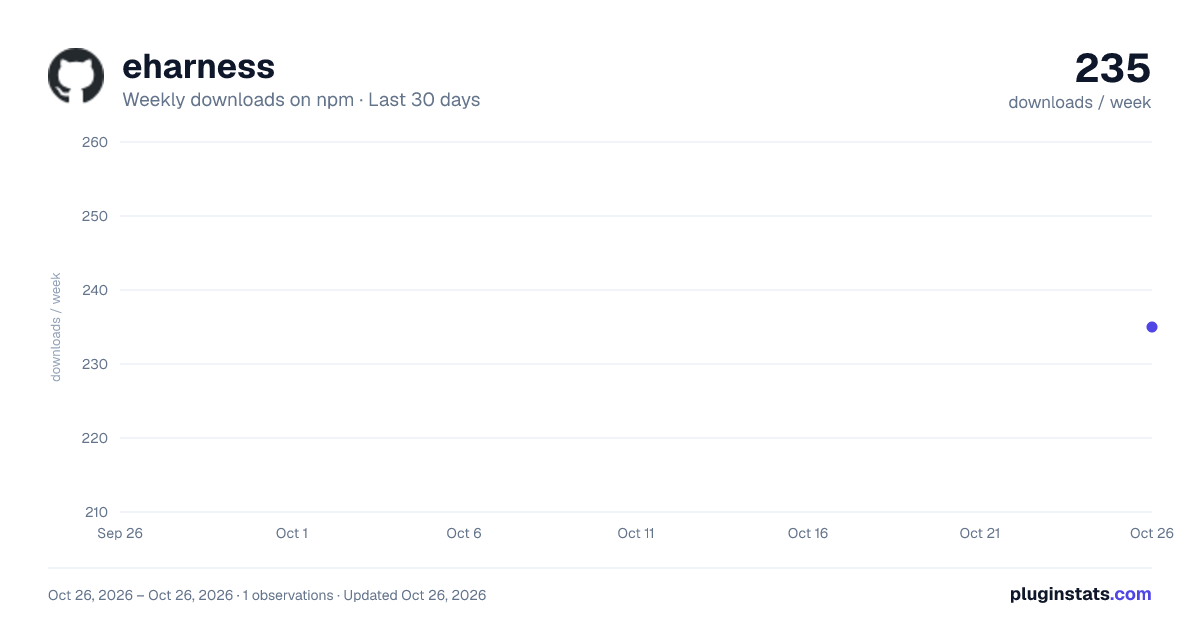
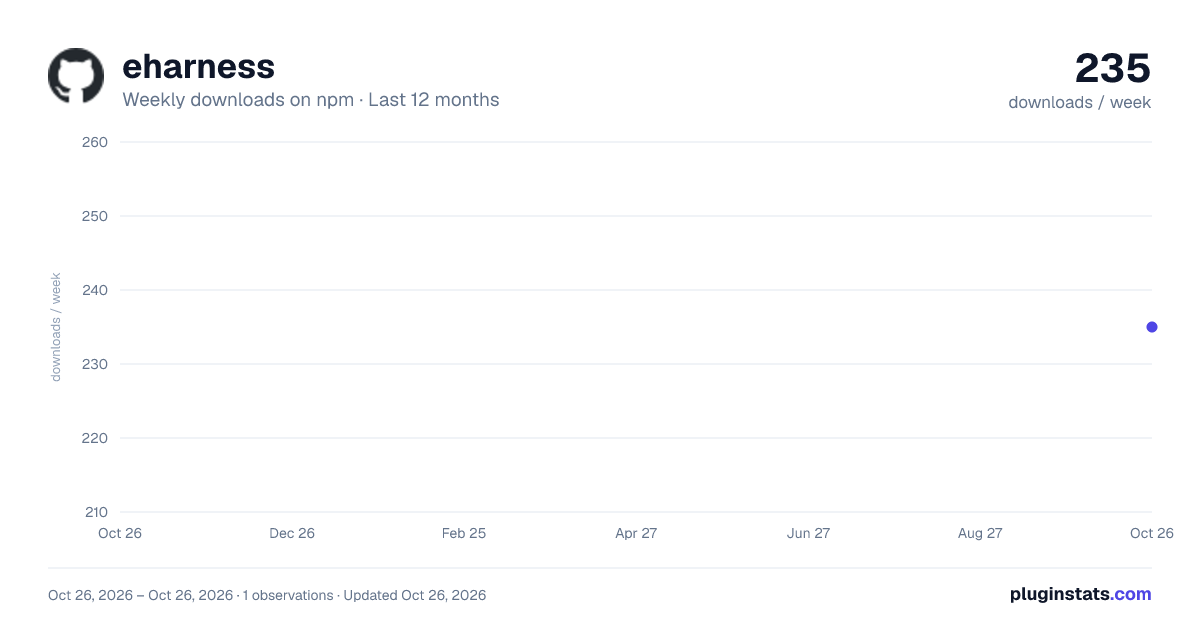
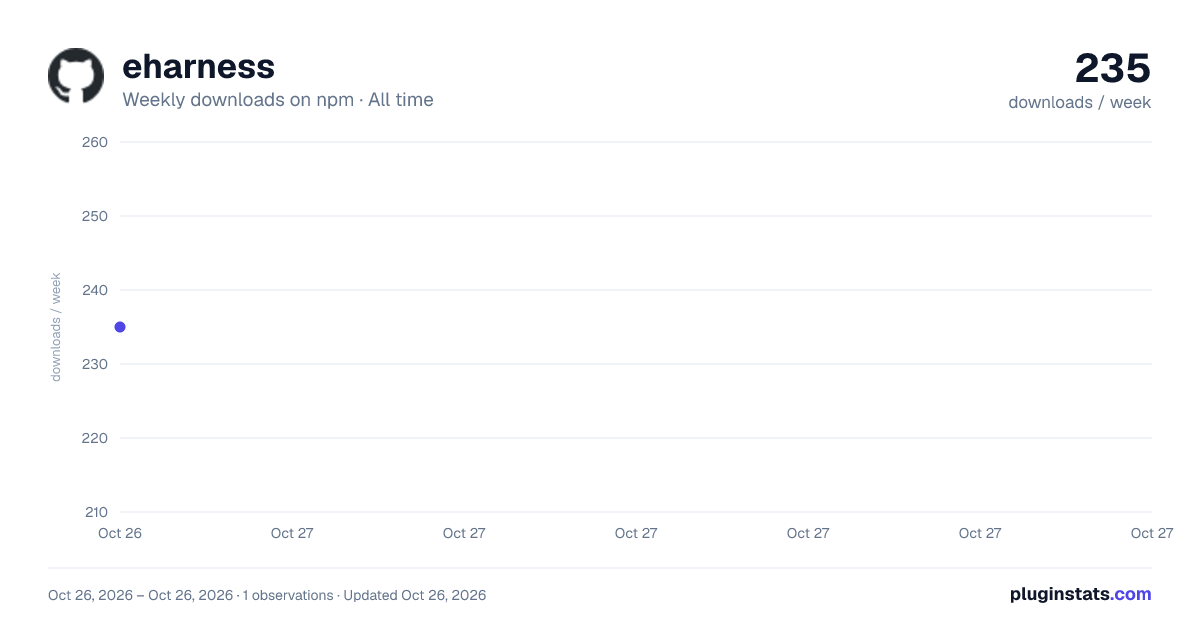
eharness has 235 recorded weekly downloads on npm, ranking #1598 of 2,644 tracked listings.
About eharness
eharness
Build your own agent harness on the Vercel AI SDK v7: plugins, context, messages, streaming, sessions and compaction, with storage you plug in.


Every agent built on AI SDK ends up writing the same harness around streamText: a step loop,
prompt assembly, skills, MCP, history that survives restarts, compaction, approvals, a UI stream.
eharness is that skeleton as a library. You keep your server, auth, database and domain logic;
it standardises the parts every harness reimplements and stays out of the rest.
Status. The contracts in docs/specs are implemented and tested. Before 1.0,
breaking changes ship only in minor versions with a migration note in the
changelog and in Upgrading
(API stability). Modules marked Draft below may change in a
minor release.
Why
- Plugins and typed context. Tools, skills, instructions, hooks, services and UI data parts bundle into plugins. Declare them as constants or load them at runtime (per user, per turn, from a database, from MCP); the agent does not care which.
- AI SDK all the way down. The stream is the AI SDK UI message stream (it works with
useChatas is), messages areUIMessages, tools aretool(), models areLanguageModel. No parallel types. - Storage is yours. A two-method
MessageAdapter, aStateAdapter, an optional durable inbox. The library ships memory adapters and conformance suites, so your Postgres, JSON or Redis adapter is provably correct. - Built for long, interactive, multi-instance turns. 500 steps by default with a progress guard, fixed compaction, USD budgets, risk-based approvals, steering, crash recovery, locks and a Stop button that reaches the instance running the turn.
- Product building blocks, all optional. Filesystem, shell, permissions, subagents, memory, todos, an LLM approval guard, OpenAPI tools, providers, connectors, an activity feed, an HTTP module and a browser client.
How it compares:
| What it is | Relation to eharness | |
|---|---|---|
AI SDK core (ai) | Model calls, tools, streams, UI messages | eharness is built directly on it; no parallel types |
AI SDK Harnesses (@ai-sdk/harness) | Adapter layer to run existing harness runtimes (Claude Code, Codex, ...) in a sandbox | Different layer: eharness is for building your own harness |
| eve (Vercel) | Filesystem-first, opinionated agent framework with Vercel-native durability | eharness is code-first, unopinionated about infrastructure and much thinner |
| Mastra | Full framework (workspaces, memory, workflows, deployment) | eharness is a library, not a framework: it owns no server, routes, auth or UI |
| LangChain Deep Agents | Harness on LangGraph with pluggable filesystem backends | Similar ideas (backends, composition); eharness has no graph runtime dependency |
More in concept (what eharness is and is not, principles, glossary).
Install
npm install eharness ai zod     # or: bun add / pnpm add
npm install @ai-sdk/mcp         # only if you use eharness/mcp
Node ≥ 22 or Bun. ESM only. ai and zod are peer dependencies; eharness has no runtime
dependencies of its own.
Quick start
import { tool } from 'ai'
import { defineHarnessAgent, defineSkill } from 'eharness'
import { filesystem } from 'eharness/filesystem'
import { inMemoryFs } from 'eharness/filesystem/memory'
import { z } from 'zod/v4'

const agent = defineHarnessAgent({
  model: 'anthropic/claude-sonnet-4.6', // AI Gateway id or any AI SDK model
  contextWindow: 200_000,
  instructions: 'You are a careful assistant. Keep notes as files under /notes.',
  tools: {
    get_time: tool({
      description: 'Current time as an ISO string',
      inputSchema: z.object({}),
      execute: async () => new Date().toISOString(),
    }),
  },
  skills: [
    defineSkill({
      name: 'note-style',
      description: 'Use before writing a note.',
      content: 'Bullets only.',
    }),
  ],
  plugins: [filesystem({ fs: inMemoryFs() })],
})

const session = agent.session('demo')
const run = session.send('Write the current time to /notes/now.md')
for await (const chunk of run.stream) {
  if (chunk.type === 'text-delta') process.stdout.write(chunk.delta) // or, in a route: await run.toResponse()
}

const result = await run.result // never rejects: errors end the turn with stop: 'error'
console.log(`\n${result.stop} after ${result.steps} steps`)
if (result.stop === 'error') console.error(result.error?.code, result.error?.message) // e.g. EH_PROVIDER_AUTH: set AI_GATEWAY_API_KEY
console.log(`${(await session.messages()).length} messages stored`)
The model string goes through the AI Gateway
(AI_GATEWAY_API_KEY); any AI SDK provider model (anthropic('claude-sonnet-4-6'), ...) works too.
This code is examples/quick-start.ts; bun examples/quick-start.ts
runs it offline with a scripted model. Walkthrough: getting started.
Terms such as turn, step, kind message and commit point are in the
glossary.
Tour
Each snippet is small; the guide linked under it has the full version. Values marked
// yours: ... are your application's.
Serve it to useChat
import { handleChatRequest } from 'eharness'
import { agent } from './agent' // yours: the agent from the quick start

declare function authenticate(req: Request): Promise<{ id: string }> // yours
declare function userOwnsChat(userId: string, chatId: string): Promise<boolean> // yours…
Description from the npm listing.
- ai
- ai-sdk
- agent
- harness
- llm
- tools
- skills
- mcp
README badge
Show your rank in a README or on your website. The badge updates automatically.
Charts
Images: 30d · 1y · all time · 1600×900 dark

Adoption over time
7/30/90-day growth
Ranking history
Listing placement
Listing placement
Filled points are observed values; hollow points come from Internet Archive snapshots of the listing page. Dashed segments span periods with no observations — values between points are not interpolated.
Each band is one page of 20. Weekly downloads on a linear scale. Placement is projected from weekly downloads, so it can differ from the marketplace's own sort order. Hover a dot to see the listing.
Recent observations
Full history (1)Similar npm AI SDKs plugins
All 20 eharness alternativesData source
Weekly downloads (trailing 7 complete days) come from the official npm downloads API. Downloads include CI and mirrors and are not equivalent to installs or users. npm publishes no ratings.
Listing: https://www.npmjs.com/package/eharness. First seen Oct 28, 2026; last successful collection Oct 28, 2026. See the methodology.