 PluginStats
dsh-auto-memory weekly downloads statistics
By AskTheWay · npm · Claude Code
Claude Code style auto-memory plugin for DeepSeek Harness: typed memory files + MEMORY.md index auto-injected into the system prompt
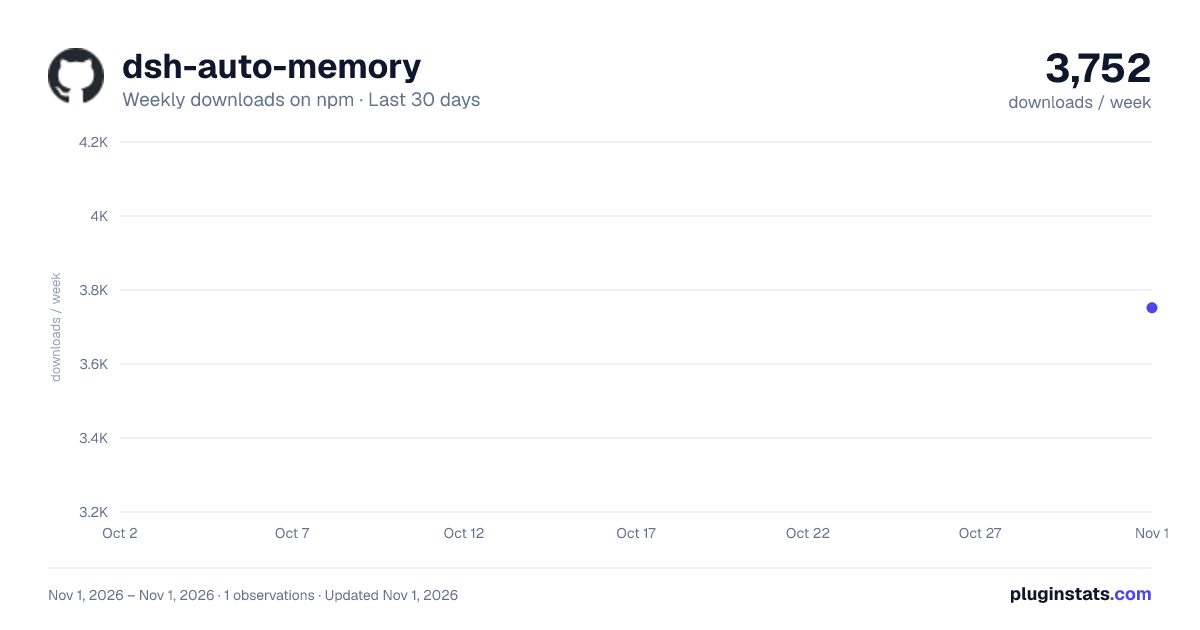
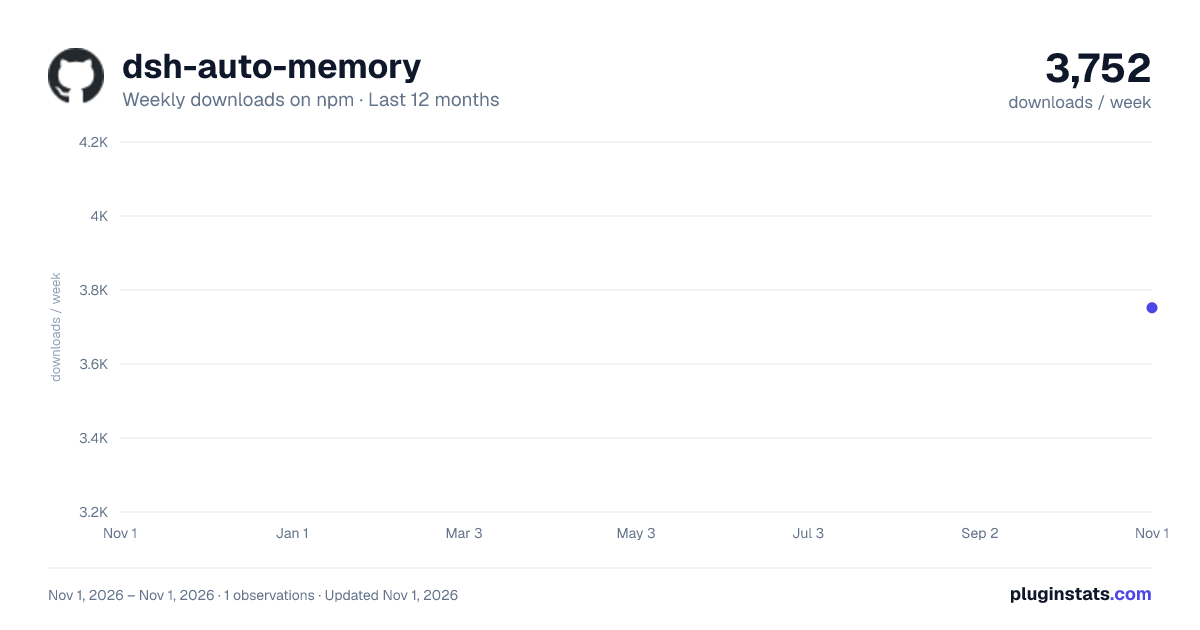
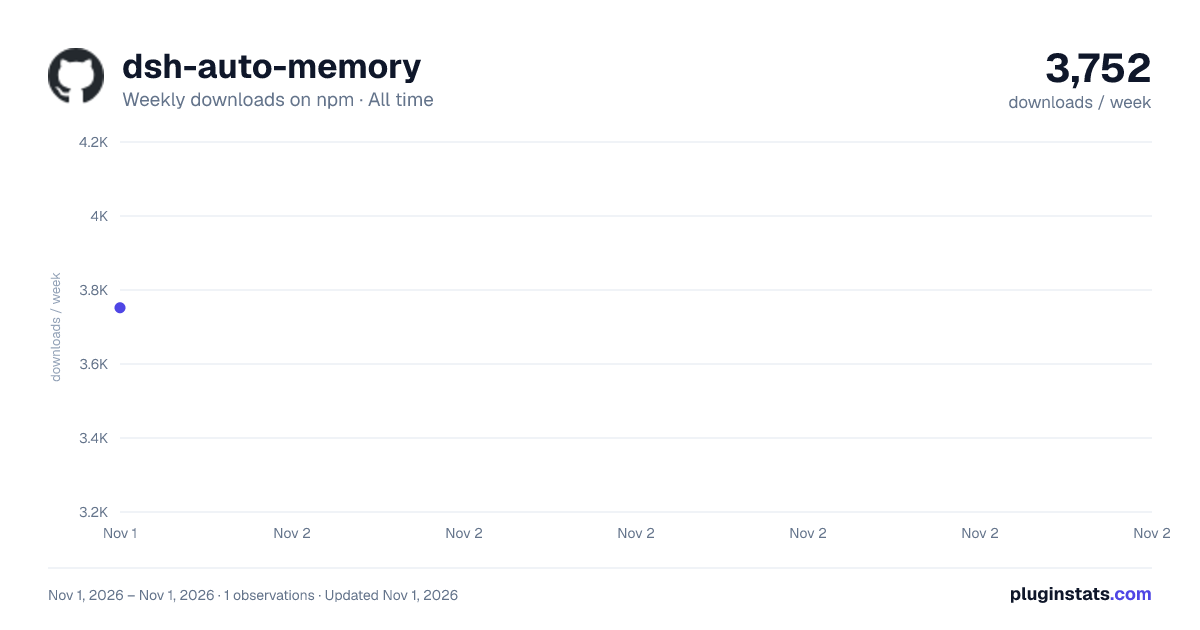
dsh-auto-memory has 3,752 recorded weekly downloads on npm, ranking #1461 of 2,762 tracked listings.
About dsh-auto-memory
dsh-auto-memory





Your dsh agent forgets everything you tell it. Every. Single. Session.
Fix it with one command. Claude Code-style persistent memory for DeepSeek Harness — native, zero servers, zero embeddings, zero setup.
dsh plugin --profile demo add dsh-auto-memory
Say "Remember: I'm a Python backend engineer preparing for interviews" today — open a brand-new session tomorrow, ask "what do you know about me?", and it remembers.

Highlights
1.x — trustworthy memory + measured end-to-end: consolidation products are
born candidate with verbatim evidence quotes; only you can grant
verified; disputed memories are never re-injected; every write passes an
injection-pattern guard at the store choke point. And it's measured: four
evaluation layers (deterministic / recall / consolidation / end-to-end) plus a
LongMemEval-S alignment run — including an honestly published off-target score.
Full history: CHANGELOG.md ·
Releases
Claude Code has this. dsh didn't. Now it does.
DeepSeek Harness is the hottest open agent harness on GitHub right now — models, tools, sandboxes, everything is a plugin. But it ships with no memory subsystem at all. The official answer is three default-off MCP configs to third-party servers, which the official docs themselves qualify: not auto-injected, no forgetting policy, substring-only search. Your agent has amnesia by design.
dsh-auto-memory closes that gap natively:
| MCP bridge approach | dsh-auto-memory | |
|---|---|---|
| Memories injected into every system prompt, automatically | ✗ | ✓ (zero tokens when empty) |
| Typed memories: user / feedback / project / reference | ✗ | ✓ |
| Workspace + user scope layers — no cross-project leakage | ✗ | ✓ |
| Crash & concurrency safety (cross-process locks, orphan recovery) | — | ✓ |
| External services / databases / embeddings required | ✓✓✓ | none — just plain Markdown files |
Memories are ordinary files under $DSH_HOME/memory/ — hand-editable,
grep-able, git-friendly, yours.
Trustworthy, not just persistent (1.0.0)
Model-consolidated memories can be confidently wrong — and a wrong memory
gets re-injected every session. So memories carry a trust status:
consolidation products are born candidate (with a verbatim evidence quote
from the transcript — fabricated citations are dropped by checking against
it), verified can only be granted by you in the panel, disputed /
superseded are never injected. Every write path passes an injection-pattern
guard at the store choke point; content changes downgrade trust and expire
old evidence. A 🩺 health board surfaces unverified / zombie / conflicting
memories for review. Same flat files, same zero services — now with an audit
trail for whether to believe them.
One minute to feel it
node scripts/demo.mjs # no API key, no browser: watch write → index → inject → recall → forget
Or for real, in a chat: tell your agent things worth remembering. The model
calls memory_write / memory_read / memory_list / memory_search /
memory_delete, following Claude Code's write discipline: dedupe-and-update
over piling up, absolute dates only, [[name]] cross-links, feedback
memories carry Why: / How to apply: lines.
The memory panel
The whole memory system has one home in the dsh Web UI: user-scope and project-scope groups, per-memory read counts and trust badges, pin / disable / edit / delete, injection statistics (per memory and per project, with budget truncation boards), the health board, and the Claude Code import/export bridges.

Import from Claude Code — and take it back
The panel's 📥 Import from Claude Code button scans
~/.claude/projects/*/memory read-only and lists every memory grouped by source
project. Tick what you want and apply: fields map one-to-one (same four types,
H1 → title, ISO modified → epoch), same-name memories are skipped, never
overwritten.
Imported files carry an origin block (kind / slug / file / imported /
hash) in their frontmatter, so the checkbox becomes reversible: uncheck an
already-imported memory and apply, and it is deleted from this plugin — the
Claude Code source stays untouched and can be re-imported any time. If the
memory was edited after import, the content fingerprint no longer matches; the
entry is marked modified and kept, never silently discarded. Memories
imported by earlier versions (no origin block) are recognised by exact content
equality and marked legacy import, so they can be revoked the same way.
You don't even have to check: the host scans the Claude memory directory every 5 minutes, and a hint bar appears above the list whenever sync-able memories are waiting.
Export to AGENTS.md — the bridge goes both ways…
Description from the npm listing.
- deepseek-harness
- dsh-plugin
- memory
- agent
- claude-code
README badge
Show your rank in a README or on your website. The badge updates automatically.
Charts
Images: 30d · 1y · all time · 1600×900 dark

Adoption over time
7/30/90-day growth
Ranking history
Listing placement
Listing placement
Filled points are observed values; hollow points come from Internet Archive snapshots of the listing page. Dashed segments span periods with no observations — values between points are not interpolated.
Each band is one page of 20. Weekly downloads on a linear scale. Placement is projected from weekly downloads, so it can differ from the marketplace's own sort order. Hover a dot to see the listing.
Recent observations
Full history (1)Similar npm Claude Code plugins
All 20 dsh-auto-memory alternativesData source
Weekly downloads (trailing 7 complete days) come from the official npm downloads API. Downloads include CI and mirrors and are not equivalent to installs or users. npm publishes no ratings.
Listing: https://www.npmjs.com/package/dsh-auto-memory. First seen Nov 3, 2026; last successful collection Nov 3, 2026. See the methodology.