 PluginStats
openqodex weekly downloads statistics
By openqodex · npm · Claude Code
Code review before you push, in Claude Code, Codex, Cursor and Cline. Scanners check your change and keep the findings on the lines you changed. Then a separate Claude Code or Codex reviewer answers every scanner finding. You or your agent can add a compa
openqodex has 1,169 recorded weekly downloads on npm, ranking #1610 of 2,819 tracked listings.
About openqodex
OpenQodex



Open source AI code review for coding agents. A separate reviewer checks every change your agent writes before you push. A code graph gives your agent a map of your codebase. Works in Claude Code, Codex, Cursor and Cline.
For people, in your terminal:
npx openqodex init
After the install, say to your agent: "review my change with openqodex".
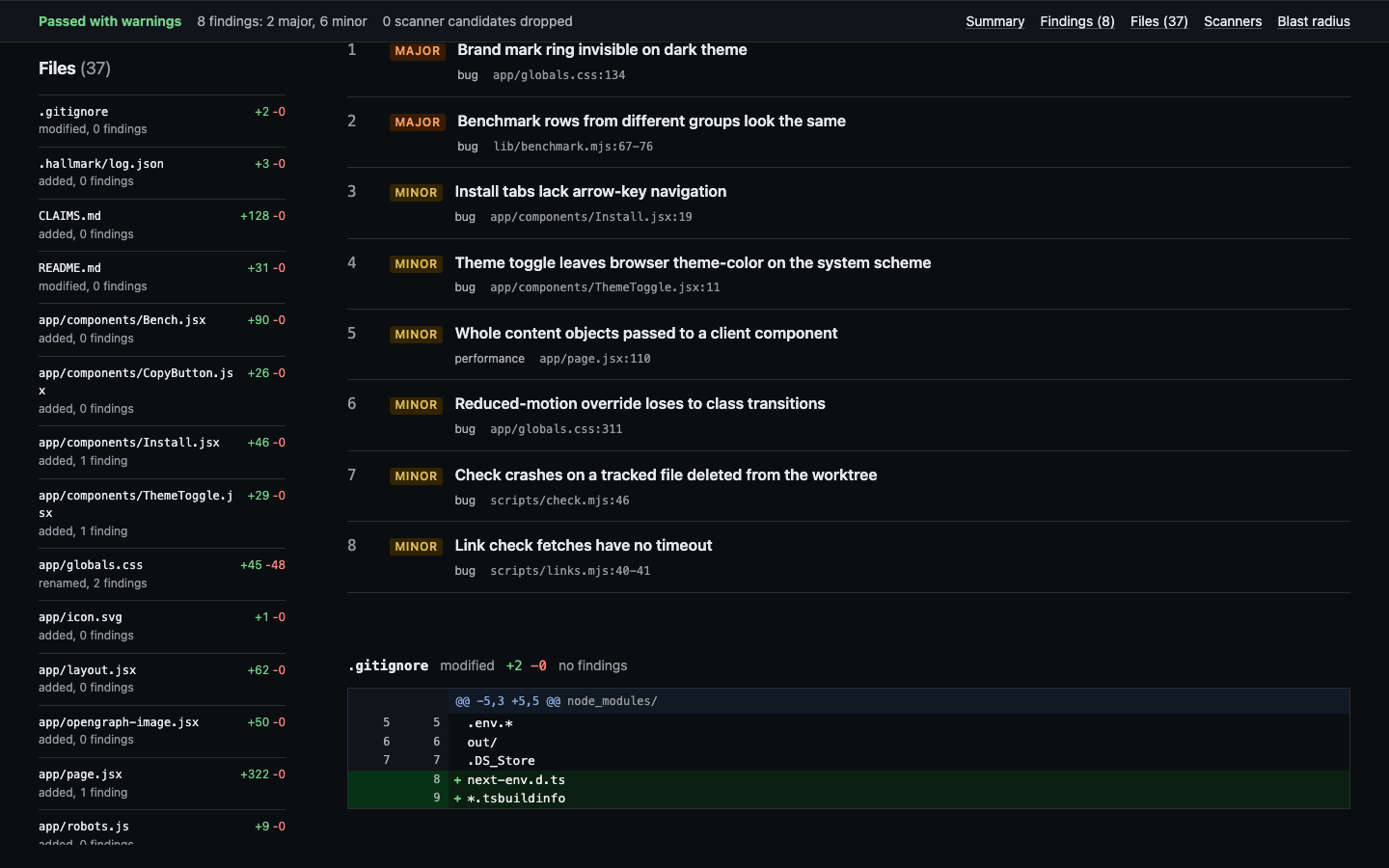
The report page of an OpenQodex review at its findings, captured 2026-10-25 with openqodex 0.14.0 and reviewer claude 2.1.310, on the openqodex/openqodex-lp repository.
The landing page: https://openqodex.com
AI agents: read the agent guide. After the install, ~/.openqodex/bin/openqodex guide for-agents prints the guide for the installed version.
OpenQodex reviews your code change before you push it. Your change is the commits you have not pushed plus everything uncommitted. OpenQodex runs on your machine, from your coding agent or your terminal.
First, OpenQodex runs the scanners that fit the files you changed. A scanner is a program that checks code without a model, such as gitleaks or semgrep. A finding is one problem at one place in the code, with a severity. OpenQodex keeps the scanner findings on the lines you changed. It drops findings in test fixtures and in rules you switched off. Every supported lockfile in the repository is checked against osv.dev at every review and scan of a change. Advisories outside the changed lines are shown, never counted, and kept out of the reviewer's brief. Each advisory names its fixed versions, or says no fixed version is published.
Then OpenQodex starts reviewers: separate Claude Code or Codex processes on your own login. By default, the agent that wrote the code does not review it. Finder sessions read each part of the change, with the code that calls it, and propose candidates with a quoted line as evidence. A script checks every quote against the code. Verifier sessions then judge each candidate and each scanner finding against the code, and must confirm or refute every one with a reason. Scripts check that every scanner finding was answered and that every changed line was given to a reviewer. Style and naming notes are shown as observations and do not block. Then you choose which findings your agent fixes.
Where it runs
| Coding agent | Starts a review | Can be the reviewer | Push gate |
|---|---|---|---|
| Claude Code | yes | yes | yes |
| Codex CLI | yes | yes | yes, after you trust the hook in Codex |
| Cursor | yes | no | no, a rule asks Cursor to review |
| Cline | yes | no | no, a rule asks Cline to review |
In Cursor and Cline, the review needs Claude Code or Codex installed as the reviewer. A push gate is a hook that looks for a review before your agent runs git push.
Requirements
- Node 22 or newer, and git.
- macOS or Linux. CI runs the gate on Node 22, on macOS and on Ubuntu Linux. No test runs on Windows or WSL.
- For a full review: Claude Code or Codex, installed and logged in. OpenQodex needs no account or API key of its own.
- Some scanners need a language runtime that OpenQodex does not install. brakeman and rubocop need Ruby. golangci-lint needs Go. cargo-deny needs Cargo.
Install
In a terminal, init finds Claude Code, Cursor, Codex CLI and Cline on your machine. It lists the files it will write. It asks you once. It starts the scanner downloads that your repository needs. Then it reviews your current change when a reviewer can start.
In your own terminal, run ~/.openqodex/bin/openqodex review. That path is the launcher, a small script that init writes. An npx install puts no openqodex on your PATH.
For agents, the same install with no question:
npx -y openqodex@0.16.0 init --yes --agent <host>
<host> is claude-code, codex, cursor or cline. In its default sandbox mode, Codex gives commands no network. From Codex, run this line in your own terminal. The quickstart has a prompt to paste into your agent.
To install only the skill, run npx skills add openqodex/openqodex -g. That installs no push gate and downloads no scanner. A later init replaces that skill with the skill that init installs.
OpenQodex itself collects no usage data. The built-in scanners, as OpenQodex runs them, send no code. The reviewer sends your change to the model service of your Claude Code or Codex login. The privacy page lists each network use of this version.
<!-- recording: added before launch -->What it does today…
Description from the npm listing.
- code-review
- ai-code-review
- code-review-tool
- static-analysis
- sast
- security
- secret-scanning
- linter
- code-quality
- pre-commit
- pre-push
- git-hooks
- claude-code
- claude-code-plugin
- agent-skills
- cursor
- codex
- cline
- coding-agent
- semgrep
README badge
Show your rank in a README or on your website. The badge updates automatically.
Charts
Images: 30d · 1y · all time · 1600×900 dark
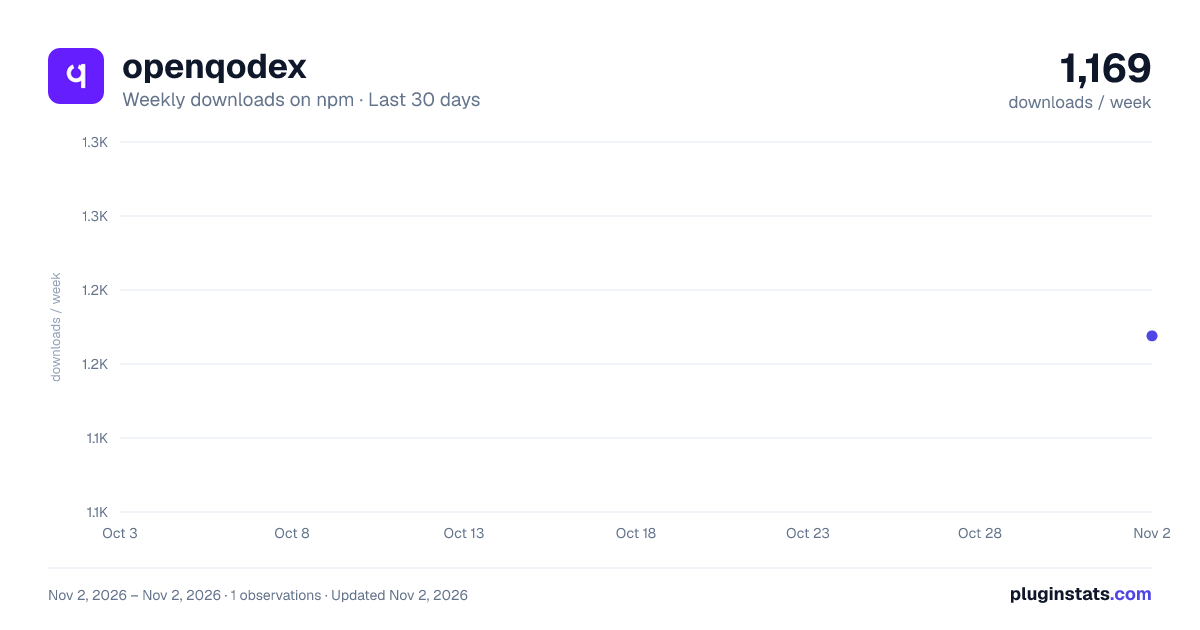
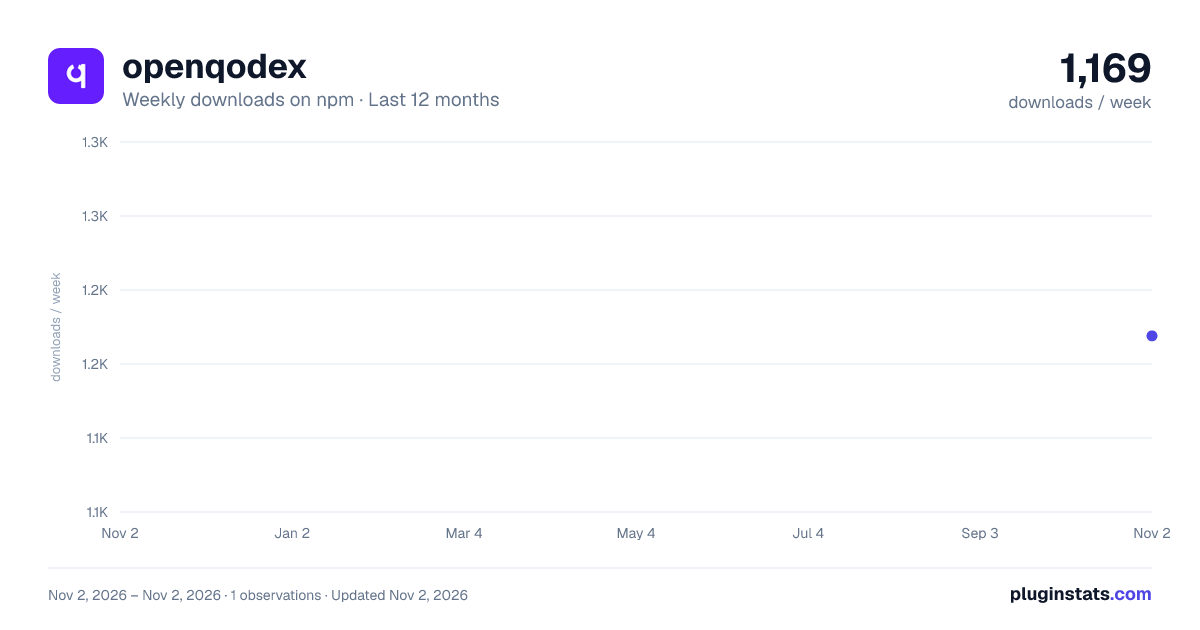
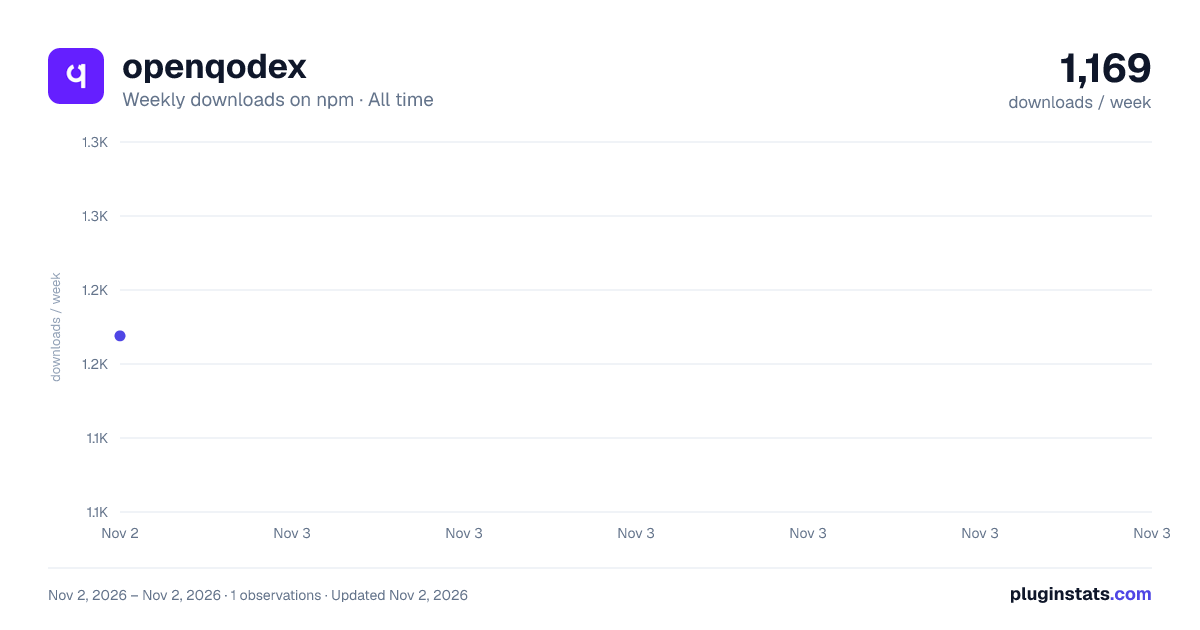

Adoption over time
7/30/90-day growth
Ranking history
Listing placement
Listing placement
Filled points are observed values; hollow points come from Internet Archive snapshots of the listing page. Dashed segments span periods with no observations — values between points are not interpolated.
Each band is one page of 20. Weekly downloads on a linear scale. Placement is projected from weekly downloads, so it can differ from the marketplace's own sort order. Hover a dot to see the listing.
Recent observations
Full history (1)Similar npm Claude Code plugins
All 20 openqodex alternativesData source
Weekly downloads (trailing 7 complete days) come from the official npm downloads API. Downloads include CI and mirrors and are not equivalent to installs or users. npm publishes no ratings.
Listing: https://www.npmjs.com/package/openqodex. First seen Nov 4, 2026; last successful collection Nov 4, 2026. See the methodology.